Several methods for estimating stellar age.
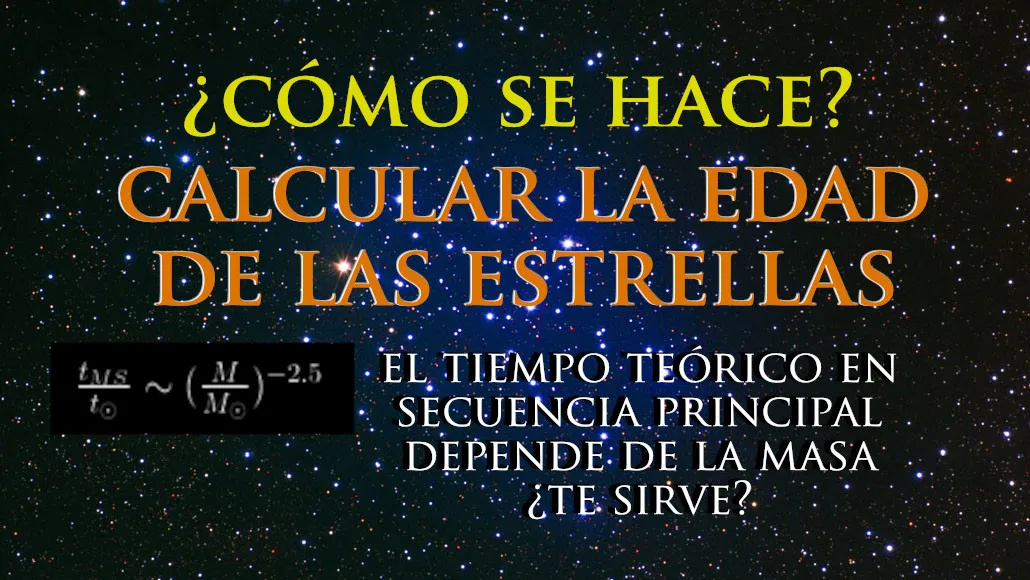
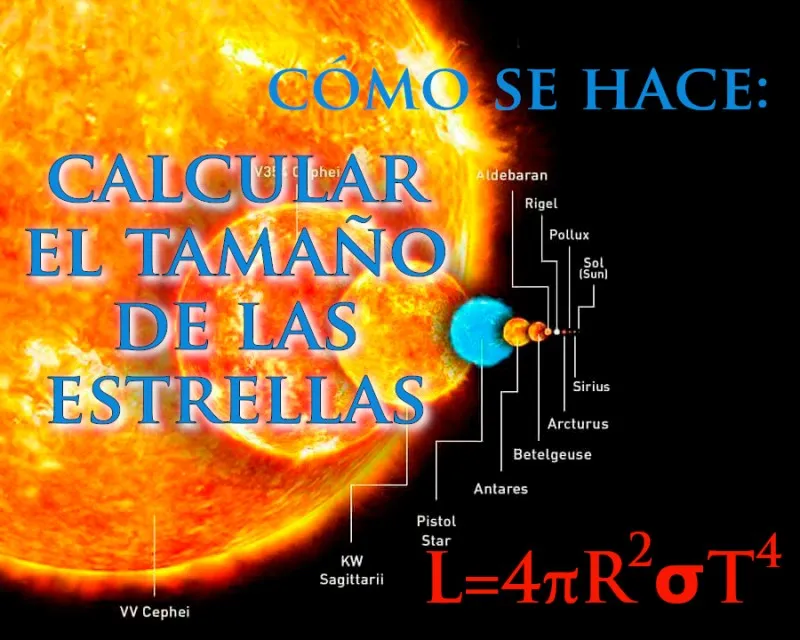
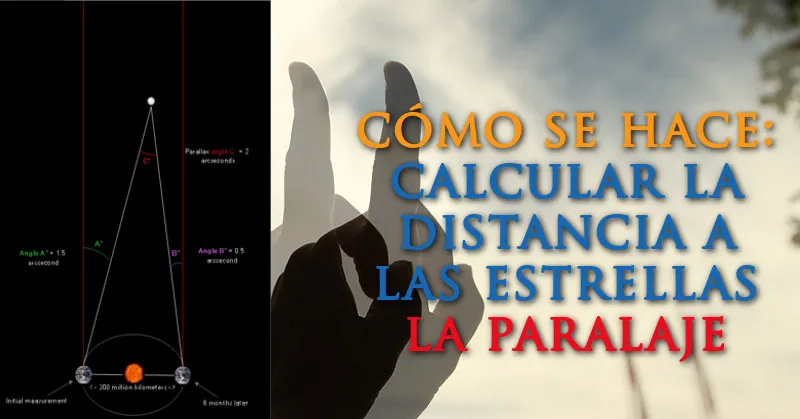
This post is part of a small series of 4 in which we explain how astronomers find out certain characteristics of stars: distance, size, mass and age. These four variables cannot be measured, but they can be inferred and calculated using observational data. Professional astronomers do this with great zeal and detail. Here, we are content to explain the methods in a simple way.
Stars shine because gravity compresses the hydrogen of a molecular cloud until the atoms begin to fuse into helium. The fusion generates radiation which in turn causes a pressure that counteracts gravity. Thus, the star achieves an equilibrium that lasts until the fuel runs out, and then gravity wins and the star heads towards its collapse, which will depend on the initial mass.
That equilibrium phase is called the "Main Sequence". Before that, stars are protostars and upon leaving the main sequence they are post-stellar objects, remnants.
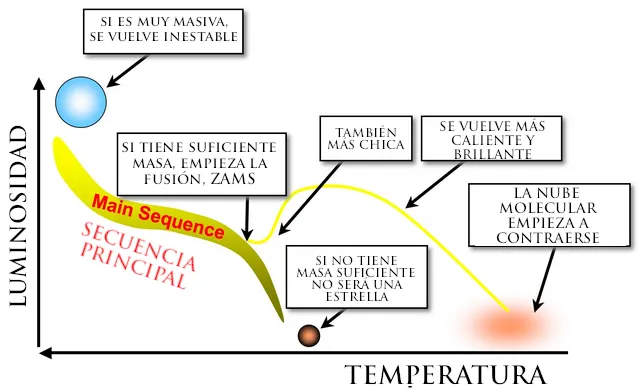
The concept "zero-age main sequence (ZAMS)" implies the zero age of the main sequence, the point where the star begins hydrogen fusion. If we think of that as a "birth", there is however a previous stage, of "embryo". So here we already have a problem: does age start counting from the embryonic formation or from the "birth"? The ZAMS concept assumes that age starts with equilibrium. However, in some cases, the time between the embryonic stage and ZAMS can be significant. For the most massive stars, the previous period is short in relation to the total cycle. But in less massive stars, the time before the main sequence can be a significant amount relative to their cycle.
Astronomers are interested in the entire process, from stellar formation to its collapse and remnant.
Age in clusters
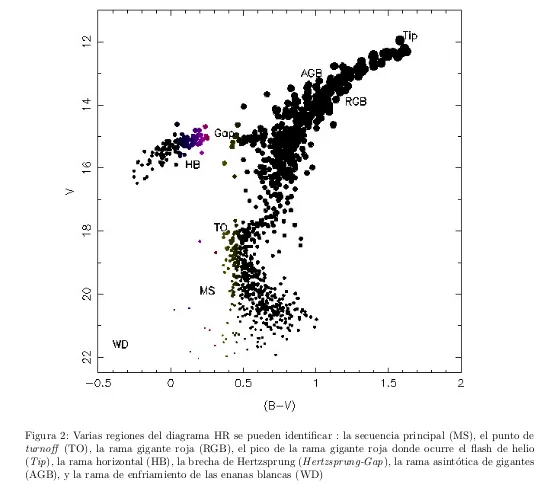
In a globular cluster, when the set of stars is studied, their magnitude and color can be measured (Color-Magnitude Diagrams) or, what is similar, their luminosity and temperature (HR Diagrams).
In an HR diagram, the main sequence stars and the turnoff point (Turnoff point) can be visualized: as the central hydrogen of the star is depleted, the core begins to contract due to gravity and the low energy release, the star moves away from the main sequence; at the turnoff point, the central hydrogen is almost completely exhausted.
Thus, for stars in clusters, astronomers can use a technique called Isochrone Fitting. An isochrone is the set of points corresponding to stellar models of equal age, but different mass, in an HR diagram. Iso=same, chrono=age.
Nucleo Cosmo Chronometry: is a method to derive the age of individual stars from the decay of certain isotopes. But it is applied to stars with few heavy elements, which are not many.
Gyrochronology: Astronomers noticed that younger stars rotate faster than older ones, in clusters. In 1972, Andrew Skumanich proposed an equation to calculate age from rotation: the average value of the rotation speed of several open clusters was inversely proportional to the square root of the cluster's age. However, today it is known that many stars vary their rotation up to a certain point and then maintain it.
Stellar seismology: the variation in brightness is an indicator of what happens beneath the stellar surface. These pulsations can be used to calculate stellar age as they allow establishing the density of the elements that make up the star.
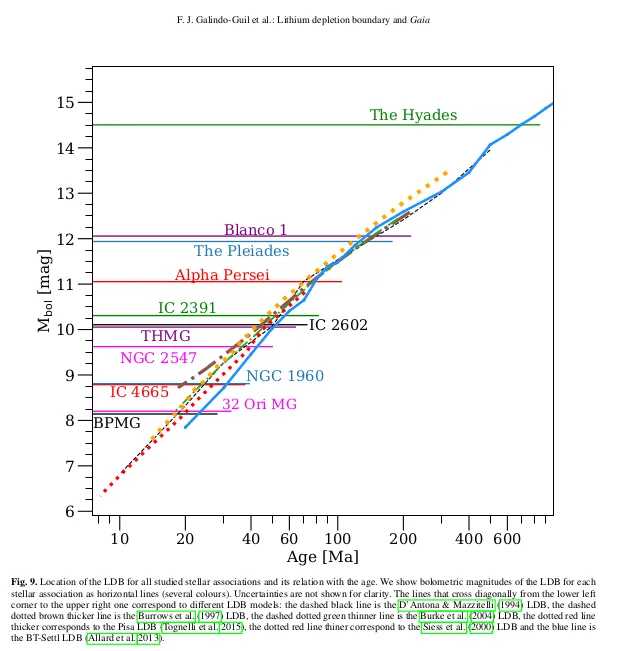
Lithium boundary: the lithium depletion boundary (LDB) is a technique that allows an age determination for stellar associations. It is based on the presence or absence of lithium in low-mass stars. The abundance of lithium decreases with age and for low-mass stars, it is rapid.
The age of the Sun: it is 42 years old, it was born in Arequito, I say laughing (while I twirl a poncho). Our star is about 4.5 billion years old. It is not known by measuring specific properties of the star, but by measuring the decay of elements in solar system material in a laboratory, when they reach Earth, produced from the same molecular cloud. It is something astronomers cannot do with the rest of the stars.

I WANT MY FORMULA
In the previous posts of this series we gave some formula for an approximate calculation. The following are two formulas that can be used to determine the "lifetime" or equilibrium stellar cycle on the main sequence. As a consequence, the best way to obtain an "age" with these equations is from data of a star that we know is about to leave the main sequence. For example, Betelgeuse.
The formulas are:
Formula 1
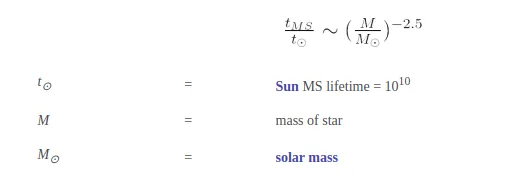
Formula 2
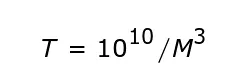
These two formulas are equivalent, one multiplies with a negative exponent, the other divides with a positive exponent, but they differ in the exponent, which can yield appreciable differences.
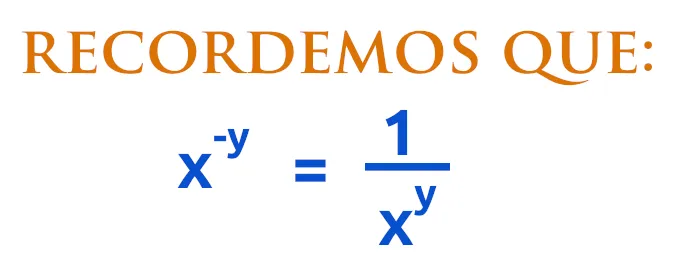
If we know the mass of Betelgeuse, say 16.5 Solar Masses (*), then according to formula 1:
the main sequence time (tms) of this star will be (16.5^-2.5)*10^10.
According to formula 2: 10^10/16.5^3.
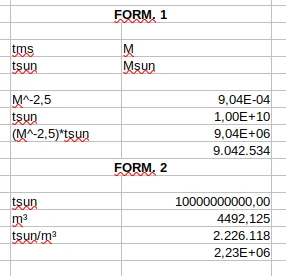
Given the difference in exponents, the result will vary between 2 and 9 million years. If we use the exponent 2.5, we will get 9 million, which matches the data in the Wikipedia entry.
(*) In the English Wikipedia, for Alpha Orionis a mass of 16.5 to 19 MS is listed. In the Spanish Wikipedia, 18-19 MS. If we redo the calculation with 18 MS, the result will be a little over 7x10^6 years.
If we do this with Alpha Centauri A, which is a main sequence star, class G, like our Sun, it will result in something similar to 10^11 or a little more, since it has a little less mass than the Sun, but that will not be the "age", but the theoretical time on the main sequence. In these two formulas the Sun's main sequence time is 10 billion years. However, that is not the "age", since as we said before, it is 42 years old (Plop!). Which means it will keep on singing until the candles burn no more...
CONCLUSION
There is no single method for calculating the age of stars. Some methods are better for old stars than for young ones. Others require studying clusters and not solitary stars.
The calculation of the theoretical main sequence lifetime, which is what we did with the equation, is only a part of the star's total existence time.
Binary systems are very common and the possible interaction between components makes things more complex.
The age of stars matters for several reasons. Here's one: the age of planets and their subsequent development depends on it. If there were any sign of life on an exoplanet, how much time would it have ahead to evolve? It would depend on the age of the star and its future evolution.
So, the age of stars is difficult to determine. As Avril Lavigne would say, it's... complicated.☉
Sources and related links
- How do scientists calculate the age of a star?
https://www.sciencenews.org/article/star-age-calculation-astronomy-life-cycle - The Ages of Stars
David R. Soderblom
Annual Review of Astronomy and Astrophysics 2010 48:1, 581-629
https://www.annualreviews.org/doi/pdf/10.1146/annurev-astro-081309-130806
https://arxiv.org/abs/1003.6074 - Zero Age Main Sequence
https://astronomy.swin.edu.au/cosmos/z/Zero+Age+Main+Sequence - Why is the main sequence often called 'zero age' main sequence?
https://astronomy.stackexchange.com/questions/25896/why-is-the-main-sequence-often-called-zero-age-main-sequence - Calculo de Isocronas
Tesis de licenciatura UNLP de Facundo David Moyano
Director: Dr. Jorge Alejandro Panei
http://sedici.unlp.edu.ar/bitstream/handle/10915/77876/Documento_completo.pdf-PDFA.pdf?sequence=1&isAllowed=y - Girocronología: cuando el tiempo pasa rotando
https://www.noticiasdelcosmos.com/2020/06/girocronologia-cuando-el-tiempo-pasa.html - Time Scales for Ca II Emission Decay, Rotational Braking, and Lithium Depletion
https://ui.adsabs.harvard.edu/abs/1972ApJ...171..565S/abstract - Lithium depletion boundary, stellar associations, and Gaia
F. J. Galindo-Guil, D. Barrado, H. Bouy, J. Olivares, A. Bayo, M. Morales-Calderón, N. Huélamo, L. M. Sarro, P. Rivière-Marichalar, H. Stoev, B. Montesinos, J. R. Stauffer
https://arxiv.org/abs/2205.06354 - Main Sequence Lifetime (Fórmula 1)
https://astronomy.swin.edu.au/cosmos/M/Main+Sequence+Lifetime - Determining the Age, Distance & Relative Motion of Stars (Fórmula 2)
https://study.com/academy/lesson/determining-the-age-distance-relative-motion-of-stars.html
About the images
Star cluster NGC6405: N.A. SHARP, MARK HANNA, REU PROGRAM/NOIRLAB/NSF, AURA