A beautiful space portrait of the planet that smells like rotten eggs.

It is common, both in Spanish and English, to make scatological jokes about Uranus. In our language, because the name of the planet—which comes from the name of a Roman god—rhymes with a part of our body. In English too, with the difference that in that language, the demonstrative Your is pronounced the same as Ur, so pronouncing Ur-anus is like saying "your anus."
This has allowed for jokes, the best of which we owe to Futurama: Professor Farnsworth creates an olfactoscope, a telescope that captures smells. Fry tests it and detects that Jupiter smells like strawberries and Saturn is like pineapple. But he says: "I don't want to smell Ur-anus."
Then the professor responds that scientists changed the planet's name to avoid the bad joke. And now it's called: "Urectum."

The new image that clearly shows the ring system was taken by astronomers using the JWST telescope. Previously they had been photographed with the Voyager 2 probe and the Keck Observatory.
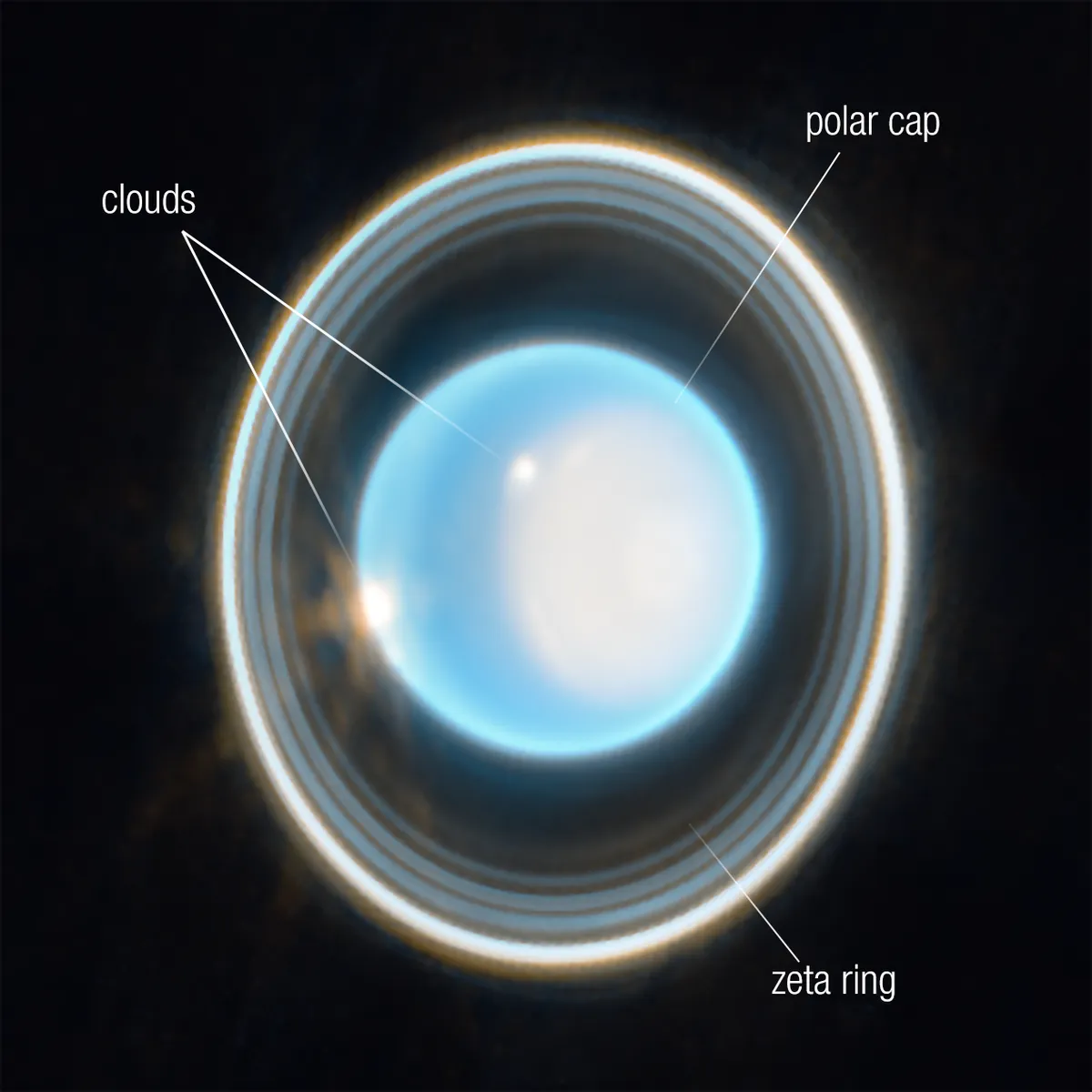
The seventh planet rotates at an angle of 98º which causes extreme seasons since the poles experience many years of constant sunlight, followed by an equal number of years of darkness. Uranus takes 84 years to orbit the Sun. It is currently spring for the north pole, visible in this photograph.
Uranus was discovered by William Herschel at the end of the 18th Century. He lived in England, in the city of Bath (which in English means "bath"), a place of hot springs.
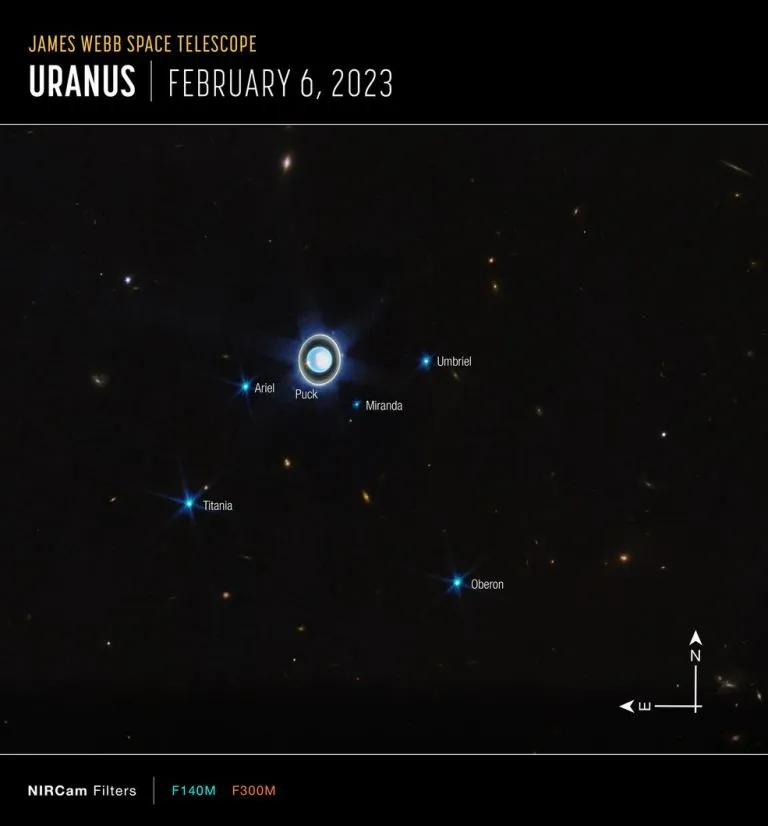
With the JWST, some of the 27 moons were also captured: the six brightest are Miranda, Ariel, Puck, Umbriel, Titania, and Oberon. The names of these and the remaining natural satellites come from the works of William Shakespeare and Alexander Pope. Only one of the moons has a name of a character from the play Hamlet: Ophelia.
From that play, the phrase is famous: "Something is rotten in the state of Denmark." Well, on Uranus, something definitely smells bad.
The characteristic sky-blue color is produced by methane which absorbs light of longer wavelengths (red). But the problem is hydrogen sulfide, the gas that gives rotten eggs their particular smell, which permeates the planet's upper atmosphere.
In 2018, a group of astronomers led by Patrick Irwin used the Gemini North Telescope in Hawaii to study the gas giant: The team found hydrogen sulfide, an unpleasant gas that most people avoid, in the planet's clouds.
The press release at that time said: While the results establish a lower limit for the amount of hydrogen sulfide surrounding Uranus, it is interesting to speculate about its effects on humans, even at these concentrations. "If an unfortunate human were ever to descend through Uranus's clouds, they would encounter very unpleasant conditions." But the horrible stench wouldn't be the worst, according to Irwin. "Suffocation and exposure in the negative 200 degrees Celsius atmosphere composed mainly of hydrogen, helium, and methane would take their toll long before the smell," concludes Irwin.
In episode 01x08 of Futurama, after using the olfactoscope, they discover the most nauseating smell in the universe: a huge ball of garbage heading for Earth. Remember this. Someone will eventually get the idea to throw Earth's garbage into space. Thus, interstellar space, normally almost empty, will be full of banana peels and broken appliances. Space garbage collectors will then emerge. And then "Don Barredora" will arrive.☉
Sources and related links
- Urrectum
https://futurama.fandom.com/es/wiki/Urrecto - Uranus (Futurama)
https://www.youtube.com/watch?v=0czFnIvKOJY
https://www.youtube.com/watch?v=xtq4AU2_6cI - Webb's infrared image highlights the planet's dramatic rings and dynamic atmosphere.
https://webbtelescope.org/contents/news-releases/2023/news-2023-117?news=true - The Rings of Uranus Shine Bright in Stunning New JWST Image
https://www.universetoday.com/160858/the-rings-of-uranus-shine-bright-in-stunning-new-jwst-image/ - “Something is rotten in the state of Denmark”
https://www.enciclopediadelapolitica.org/algo_huele_mal_en_dinamarca/ - OK FINE, LET’S DO THIS: URANUS SMELLS LIKE ROTTEN EGGS
https://www.syfy.com/syfy-wire/ok-fine-lets-do-this-uranus-smells-like-rotten-eggs - What do Uranus's clouds have in common with rotten eggs?
https://www.gemini.edu/es/qu-tienen-en-com-n-las-nubes-de-urano-con-los-huevos-podridos
About the images
Credit: NASA, ESA, CSA, STScI, Joseph DePasquale (STScI)