A light that turns on and another that turns off.
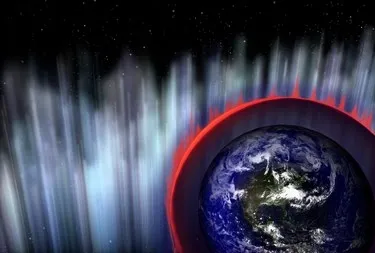
In 1963 the Soviet Union, the United Kingdom and the United States signed the Partial Nuclear Test Ban Treaty which prohibited testing nuclear weapons in the atmosphere, underwater and in space. To monitor the matter, the USA launched the Vela satellites. In 1967, Vela 3 and Vela 4 detected a short flash of gamma rays, the first GRB as they are known by their English acronym (Gamma Ray Burst). These bursts can be very short, between 0.01 and 10 thousand seconds and are the most luminous events known.
In 1972 the Voyager spacecraft were launched. During its journey, Voyager 1 allowed astronomers to identify more than 10,000 gamma-ray bursts. On October 8, 2022, Voyager 1 recorded another event in its detectors. It was later detected by many other instruments and reached Earth. The first announcement was issued by the Fermi Gamma-ray Burst Monitor; however, it was not possible to locate or classify the event. An hour later, the Swift observatory (now called the Neil Gehrels Swift Observatory) also detected an event, which was the same one. The burst was designated GRB 221009A. It is the most luminous GRB detected so far. The nickname by which the event is known is BOAT (brightest of all time), which means "the brightest of all time".
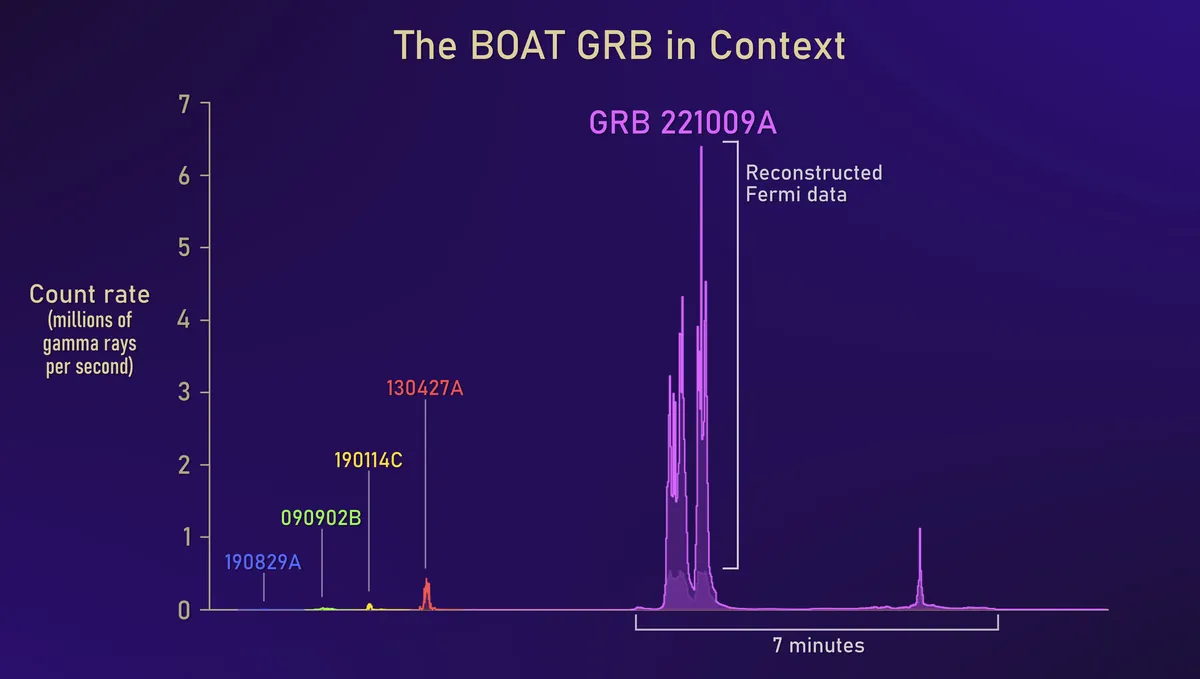
Eric Burns, an astronomer at Louisiana University, analyzed about 7000 GRBs and established how frequently these events can occur: once every 10 thousand years.
The burst was so bright that instruments in space could not record the true intensity of the emission. But the information could be reconstructed with data from Fermi and compared with that from the Russian Konus team and data from China.
BOAT's signal had been traveling for almost 2 billion years before reaching Earth, making the event one of the closest "long" GRBs, with an emission of 2 seconds. Astronomers think these bursts are the sign of the formation of a black hole when a massive star collapses. By absorbing surrounding matter, the hole emits jets of matter in opposite directions containing particles accelerated to almost the speed of light. These jets of particles plow through the star and emit X-rays and gamma rays.
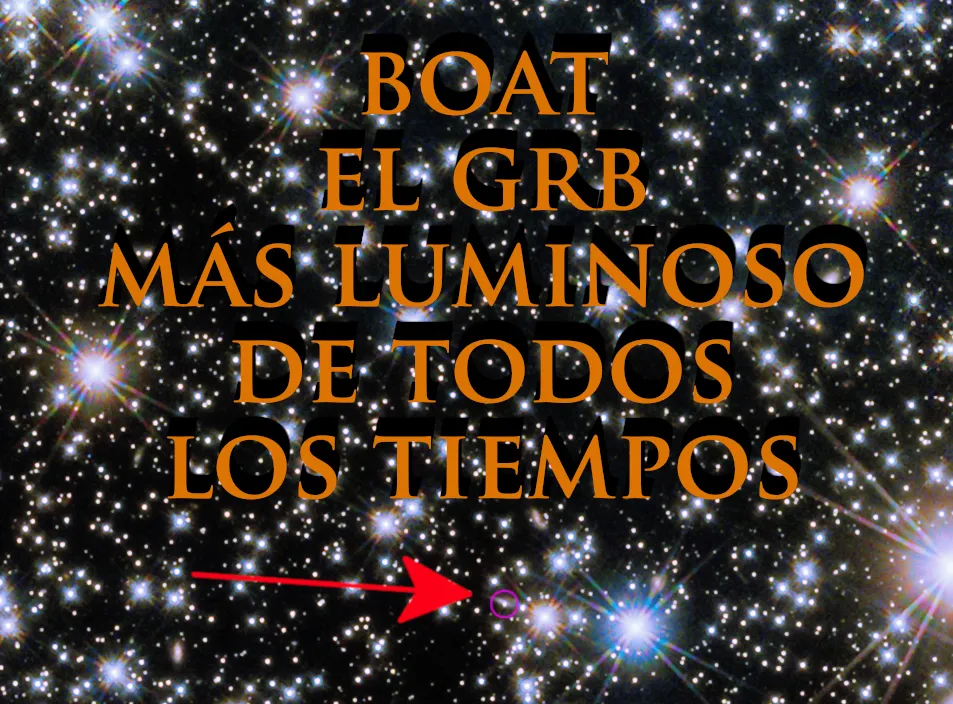
Initial image: The Hubble Space Telescope's Wide Field Camera 3 revealed the infrared glow (in circle) of the BOAT GRB and its host galaxy, seen almost edge-on as a streak of light extending to the upper right of the burst. This composite incorporates images taken on November 8 and December 4, 2022, one and two months after the eruption.
Given its brightness, the burst's afterglow may remain detectable by telescopes for several years. The image combines three near-infrared images taken each day at wavelengths from 1 to 1.5 microns.
WHERE IS THE SUPERNOVA?
Based on what was said, a supernova is expected to be observed shortly after, but so far it has not been detected. One possible reason is that the GRB occurred in a part of the sky a few degrees from the plane of the Milky Way, where thick dust clouds can attenuate the light. The Hubble and James Webb telescopes were used to investigate the area at infrared wavelengths, but nothing was found either. "But it's possible that the star collapsed directly into a black hole instead of exploding," said Andrew Levan, in a NASA statement. A few days ago we published a post here about "failed supernovae", which could be a possible explanation.
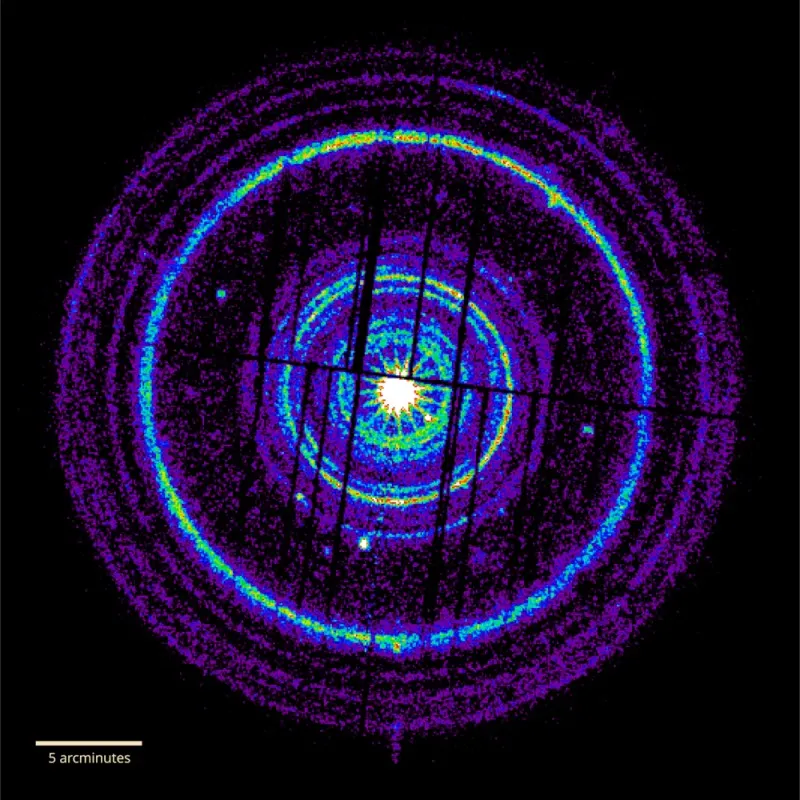
The recorded event has some unusual characteristics, such as the X-ray rings. As the X-rays travel toward us, some of them reflected off dust layers, creating extended "light echoes" of the initial explosion in the form of X-ray rings that expanded from the location of the explosion.
GRB 221009A is the seventh GRB to show X-ray rings and triples the number of previous ones. The echoes come from dust located between 700 and 61 thousand light-years away.
Dr. Benjamin Gompertz, from the University of Birmingham added: "GRBs like 221009A are powered by very massive stars that run out of fuel and collapse into black holes under their own gravity. The extremely hot material left over from this process could be an important birthplace for heavy elements like gold. Observations with JWST can detect telltale signatures of the formation of new heavy elements, teaching us about the cosmic origins of some of the most massive elements found in nature".
AN ASTRONOMER'S LIGHT WENT OUT
Unfortunately, while one light turned on, another turned off.
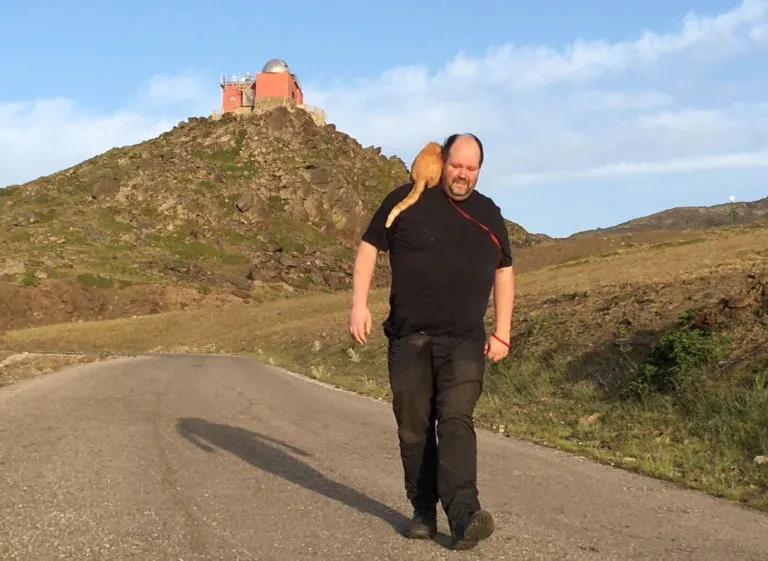
David Alexander Kann is the author of several papers on this burst. He died a few weeks after the publication of the first observational results, on March 10, 2023, at the age of 46. In a paper published in APJL by Eric Burns together with Kann there is an acknowledgment: "We thank the Universe for scheduling this burst to arrive at Earth after the invention of GRB monitors, but during our active research careers". Kann died during the review of that work, as indicated in the same paper.
David Alexander Kann, r. i. p.☉
Sources and related links
- The Optical Light Curve of GRB 221009A: The Afterglow and the Emerging Supernova
Citation M. D. Fulton et al 2023 ApJL 946 L22
https://iopscience.iop.org/article/10.3847/2041-8213/acc101 - Focus on the Ultra-luminous Gamma-Ray Burst GRB 221009A
https://iopscience.iop.org/collections/apjl-230323-172_Focus-on-the-Ultra-luminous-GRB-221009A - NASA Missions Study What May Be a 1-In-10,000-Year Gamma-ray Burst
https://www.nasa.gov/feature/goddard/2023/nasa-missions-study-what-may-be-a-1-in-10000-year-gamma-ray-burst - In memory of Dr. David Alexander Kann
https://elements.science/2023/03/21/in-memory-of-dr-david-alexander-kann/
About the images
Initial image: Credit: NASA, ESA, CSA, STScI, A. Levan (Radboud University); Image Processing: Gladys Kober