On the recent discoveries by NANOGrav.
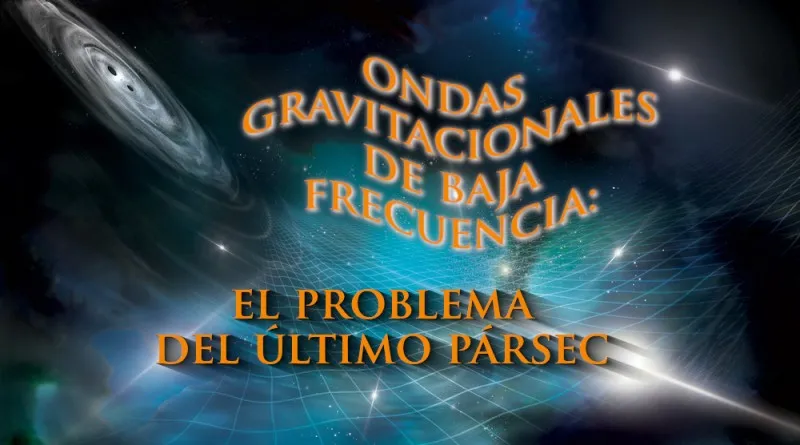
This week we learned the results of a 15-year study of pulsars that concludes with the detection of a sea of low-frequency gravitational waves.
The big question is: what process can produce those waves?
One possibility is that it is the merger of supermassive black holes. In massive galaxies there is usually a central supermassive black hole. When two large galaxies merge, their black holes orbit each other. But for them to merge they must get closer and closer, that is, they must lose angular momentum. There are known processes that can achieve this: in the orbits of these two black holes there is gas and stars and their interaction with these allows them to get closer.
But when the black holes are at a distance of 1 parsec (3.26 light-years), the stars, upon interacting with the black holes, are flung out.
We have recently recounted here these kinds of gravitational processes by which stars are ejected from the galactic center. This does not mean that gravity is repulsive. On the contrary, it is the result of tidal forces.
For this reason, when the black holes are very close, they run out of stars, which were ejected. How do they manage to keep getting closer to merge?
When orbiting very close, gravitational waves are produced, but to explain the waves recently recorded, it would be necessary for these collapsed dense objects to finally be found.
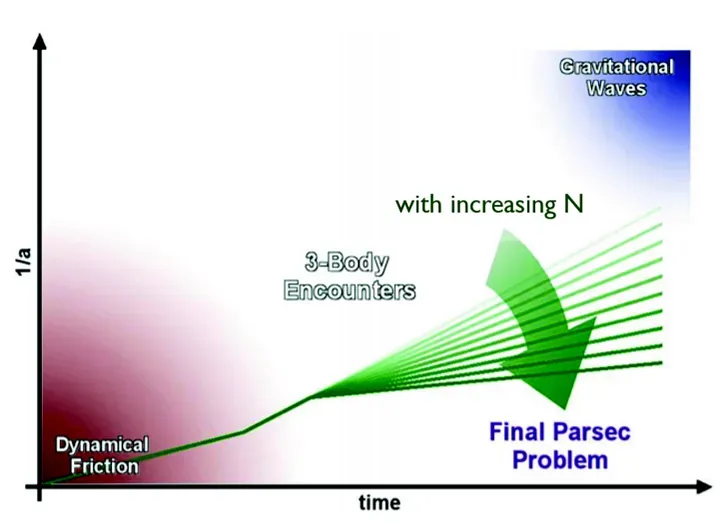
THE CASE OF PKS 1302–102
The quasar PKS 1302–102 has been known for decades, but only in 2005 was evidence found suggesting it contained a binary supermassive black hole. And that its components would be 0.01 parsecs apart.
However, the suggestion that the quasar contains a binary system of supermassive black holes was called into question. That conclusion was reached by noticing a variability in the observations, which could be caused by other reasons. To disambiguate it is necessary to collect more and better data.
It has been thought that a certain amount of gas between the black holes could accrete to form new stars; or that a third massive black hole could act as possible scenarios leading to a merger. In all cases, it is worth considering whether the time already passed in the Universe is sufficient to produce supermassive black holes, mergers of massive galaxies and, finally, mergers of massive black holes, given that each process can take a long time.
SIMULATIONS
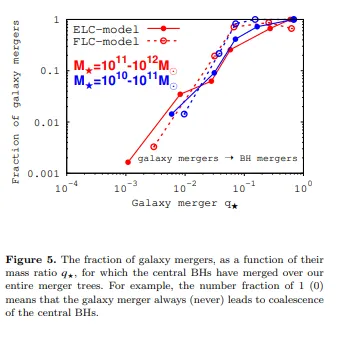
A work by Taeho Ryu (2017) evaluated the matter with simulations and two models: the ELC model ("empty loss cone model") in which, when the black holes are very close, dynamical friction stops. The other scenario is the FLC model ("full loss cone model") in which dynamical friction plays a role until the end.
According to that study, the merger of supermassive black holes is possible in an astronomically plausible time and would generate gravitational waves like those just detected.
However, there are other models that can explain the origin of this type of gravitational waves. So we are witnessing the first episode of a series that will have several seasons. That said: a series with a lot of wave.☉
Sources and related links
- Drop the Bass: Evidence for a Gravitational Wave Background from a Galaxy-sized Detector
https://astrobites.org/2023/06/28/drop-the-bass-evidence-for-a-gravitational-wave-background-from-a-galaxy-sized-detector/ - PKS 1302–102 and the final parsec problem
https://medium.com/look-upwards/pks-1302-102-and-the-final-parsec-problem-b4cbb8592ea7 - The Final Parsec Problem
Milos Milosavljevic (Caltech), David Merritt (Rutgers)
https://arxiv.org/abs/astro-ph/0212270
Interactions between multiple supermassive black holes in galactic nuclei: a solution to the final parsec problem
Taeho Ryu, Rosalba Perna, Zoltán Haiman, Jeremiah P. Ostriker, Nicholas C. Stone https://arxiv.org/abs/1709.06501
About the images
Figure 2.8 of a thesis by Fazeel Mahmood Khan. Credit: Dr. Ingo Berentzen.
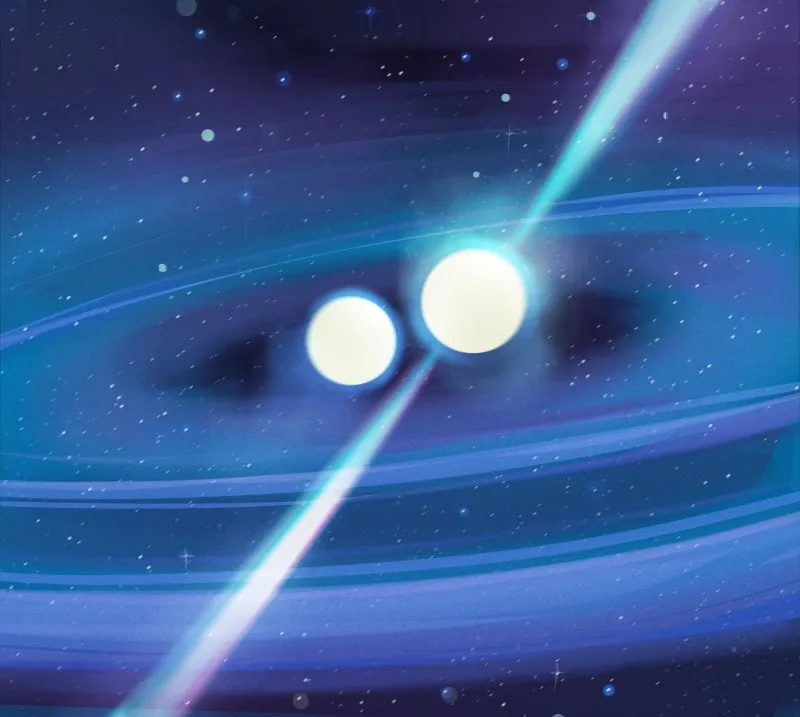
Illustration Aurore Simonnet for the NANOGrav Collaboration
Graphic by Taeho Ryu et al.