These merging binary systems would be more common than thought and could be used to measure the Hubble Constant.
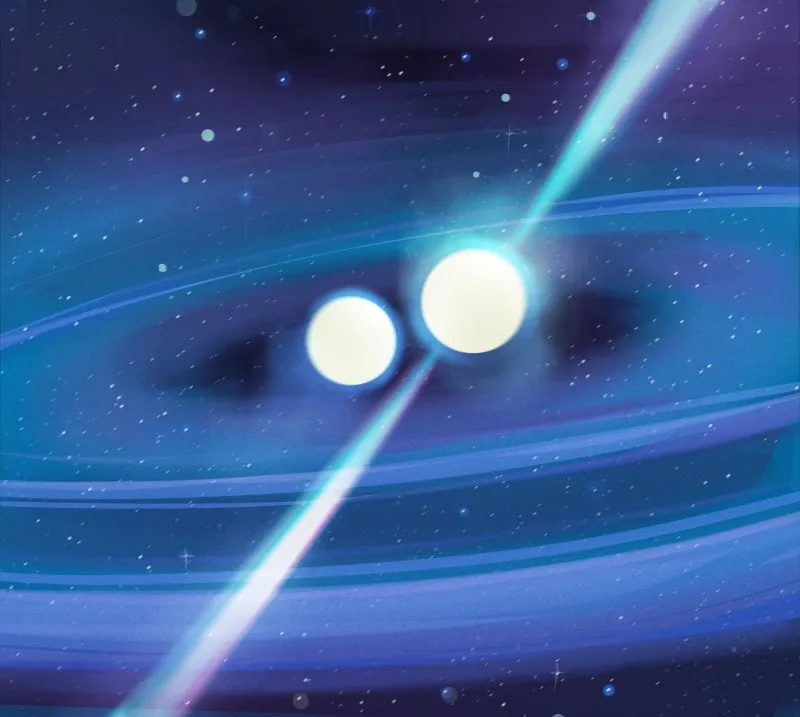
An international team of astronomers analyzed an asymmetric double pulsar, discovered in 2012, that could explain the 2017 gravitational-wave kilonova.
A pulsar is a rapidly rotating neutron star that emits radio waves from its magnetic poles. Neutron stars are compact, very dense objects resulting from supernova events.
The double pulsar (PSR J1913+1102) is binary, meaning it is two pulsars, orbiting very close together. Calculations indicate that in 500 million years, they would merge releasing a large amount of energy.
The double object has a particularity: it is asymmetric, meaning that one of the pulsars is much larger than the other. The scientific work, carried out with the Arecibo Radio Telescope in Puerto Rico, is published today in Nature.
The principal investigator, Dr. Robert Ferdman, from the School of Physics at the University of East Anglia (UK) explained that "In 2017, the Laser Interferometer Gravitational-Wave Observatory (LIGO) detected the merger of two neutron stars. The event caused gravitational waves through space-time, as Albert Einstein predicted more than a century ago".
Known as GW170817, this spectacular event was also seen with traditional telescopes at observatories in other parts of the world, which identified its location in a distant galaxy 130 million light-years away.
However, the researchers explain in the introduction of their work that, although the powerful kilonova associated with the two merging neutron stars of the GW170817 event can be explained if they were asymmetric (with a mass ratio q of 0.7-0.8), the known population of merging double neutron stars (DNS) only consists of binaries of similar mass (q > 0.9). In contrast, PSR J1913+1102 is an asymmetric DNS system, with a 5-hour orbit, low eccentricity, and an orbital separation of 1.8 solar radii.
"Most theories about these events assume that neutron stars in binary systems are similar in mass. Our discovery changes those ideas. We discovered a binary system with two neutron stars with very different masses. These stars will collide and merge in 470 million years." And he added: "Since one object is significantly larger, its gravitational influence will tear apart its companion star, ejecting a large amount of material, greater than expected for a system of similar masses".
In this way, the GW170817 event could be explained: as a consequence of a binary system similar to PSR J1913+1102.
The calculated masses for the objects of PSR J1913 are 1.62 and 1.27 (+/- 0.03) solar masses, with a mass ratio q= 0.78, placing it as the most asymmetric known merging DNS. According to the authors, their analysis makes them think that these asymmetric systems could be between 2% and 30% of the total DNS. Another similar system would be PSR J0453+1559 with q=0.753 but with an orbital period of 4 days, which implies it would take much longer to merge (100 times more than the age of the Universe).
Dr. Paulo Freire, from the Max Planck Institute in Germany added: "These events could allow astrophysicists to obtain greater clues about the exotic internal matter of these extreme and dense objects."
For Dr. Ferdman, the detection of gravitational waves produced by this type of phenomenon "could allow independent measurements of the Hubble Constant, the expansion rate of the Universe. The two main methods today have differences, so it could be a way to solve the mystery and understand in better detail how the Universe evolved."
The pulsar PSR J1913+1102 was discovered in 2012 by Einstein@Home in data from the PALFA survey, which uses the William E. Gordon radio telescope at the Arecibo Observatory.
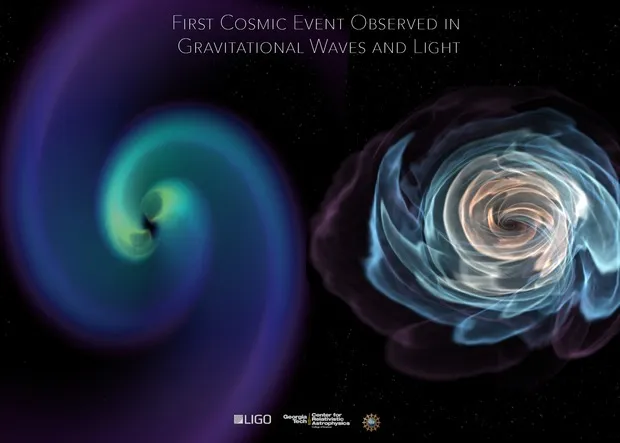
Debris from the neutron star collision
This animation illustrates the phenomenon observed over nine days of the neutron star merger known as GW170817.
It includes the gravitational waves; a jet of matter that produced gamma rays (magenta); debris from the "kilonova" that produced ultraviolet (violet), optical and infrared emission (white-blue to red); and, once, the X-ray jet directed towards Earth (blue).
Sources and related links
- Ferdman, R.D., Freire, P.C.C., Perera, B.B.P. et al.
Asymmetric mass ratios for bright double neutron-star mergers.
Nature 583, 211–214 (2020). DOI: 10.1038/s41586-020-2439-x
https://www.nature.com/articles/s41586-020-2439-x - A discovery with a wave
https://www.noticiasdelcosmos.com/2016/02/un-descubrimiento-con-onda.html
About the images
Initial image: Arecibo Observatory/University of Central Florida - William Gonzalez and Andy Torres.
GW Versus Matter STILL
Karan Jani/Georgia Tech https://www.ligo.caltech.edu/WA/image/ligo20171016c
Video: NASA's Goddard Space Flight Center/CI Lab