The case of GW190521 and the problem of narrating time and space.
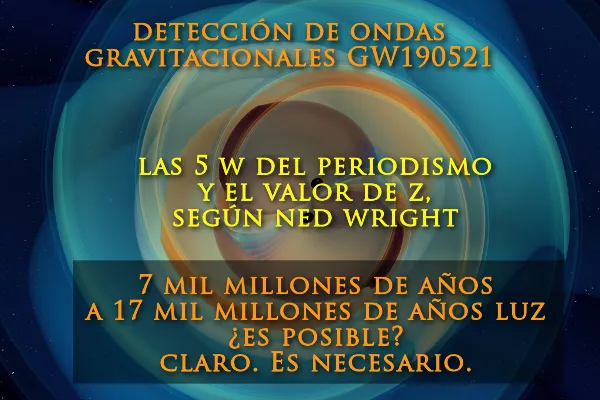
Agencia Sinc published an article about the news, whose first paragraph summarizes the most important data:
Seven billion years ago, at a distance of 17 billion light-years, two black holes, of 66 and 85 solar masses, merged giving rise to a new massive black hole, of around 142 solar masses. Both the two progenitor black holes and the one resulting from the merger are in a mass range higher than what had been observed to date, and the resulting one is the most massive black hole ever detected with gravitational waves.
The details can be read in that article. Instead, I would like to focus on the misunderstanding that seems to exist among web surfers, both in Argentina and in other parts of the world. Many commentators on the published articles cannot understand how it is possible that the event occurred in time and distance as indicated in the previous paragraph.
As an example, I point out a case that I think is the most interesting:
In the article published in the NYTimes, a commentator says (my translation):
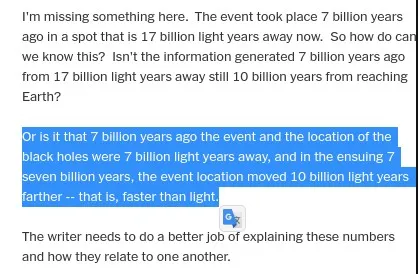
"There's something I don't understand here. The event occurred 7 billion years ago in a place that is 17 billion light-years away now. How can we know that? Isn't it that the information generated 7 billion years ago from 17 billion light-years away must still be 10 billion years from reaching Earth?
Or did that event occur 7 billion years ago when the black holes were 7 billion light-years away and in the next 7 billion years the event's location moved 10 billion light-years farther away, that is, faster than light?
The writer needs to do a better job explaining those numbers and how they relate."
I think the comment synthesizes the communication problem and, curiously, the answer is in the question.
Indeed, the event occurred 7 billion years ago, when the objects were 7 billion light-years away. Since the radiation (and the gravitational waves) were emitted, 7 billion years have passed. During that time, the light was traveling towards us. And during that travel time, the universe kept expanding. Therefore, the wavelength of that radiation kept "stretching". As the distance between the peaks of a wave increases, its length is greater. That is to say, the radiation kept "redshifting" across the spectrum as a consequence of the expansion of the universe. And as a consequence of that same expansion, the radiation source kept moving farther and farther away from its place of origin.
Astronomers can measure that "cosmological redshift", which they simply call "z". If we go to the scientific article, we will see that the value of z in this case is 0.82.
Now let's use Ned Wright's Cosmology Calculator and put that value in the z field. Result:
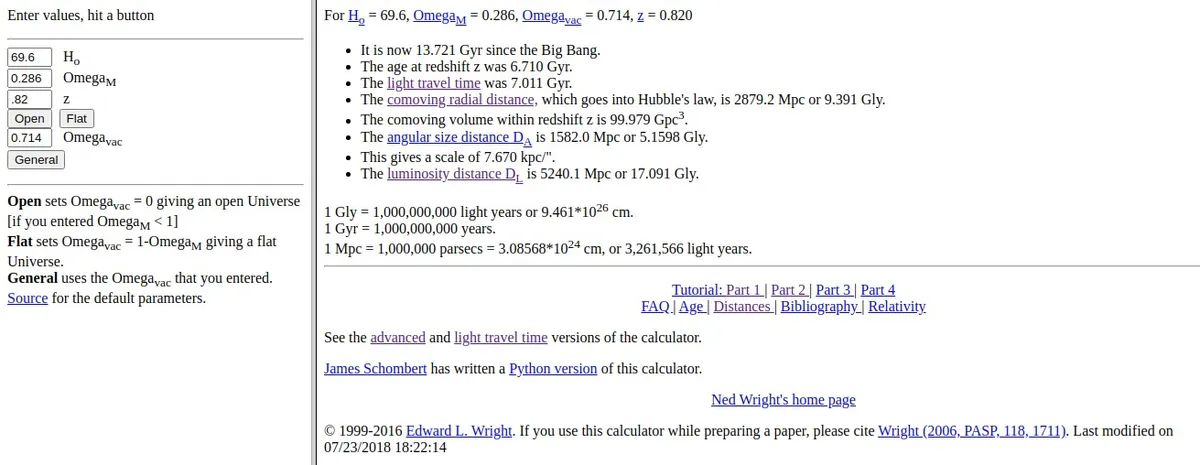
I highlight these values:
The light travel time was 7.011 Gyr.
The angular size distance DA is 1582.0 Mpc or 5.1598 Gly.
The luminosity distance DL is 5240.1 Mpc or 17.091 Gly.
The light travel time was 7 billion years.
The angular size distance (DA) is 5 billion light-years.
The luminosity distance (DL) is 17 billion light-years.
(Let's remember that in English the period is the same as the comma for us. Gly means "billions of light-years")
How is it understood? How is it calculated?
The value of z (in this case .82) is measured. And from that value, the DL (luminosity distance) can be calculated with the formula
(1+z)^2*DA
That is: 1 (which is a scale factor) plus the value of z, squared, multiplied by the angular size distance.
(1+0.82)²*5.1598
=3.31*5.1598=17.09.
The explanation is simple: Indeed, as the incredulous commentator says, since the event occurred, the radiation source kept moving away and did so... faster than the speed of light. It's that it's not about the proper motion of the objects, but about the expansion of the universe. The prohibition against traveling faster is for light, as well as for anything that possesses mass (which cannot even reach that speed c). But spacetime itself is exempt, which implies two things:
-Spacetime is not made of matter that has mass (for example strings)
-Astronomers have no idea what spacetime is made of
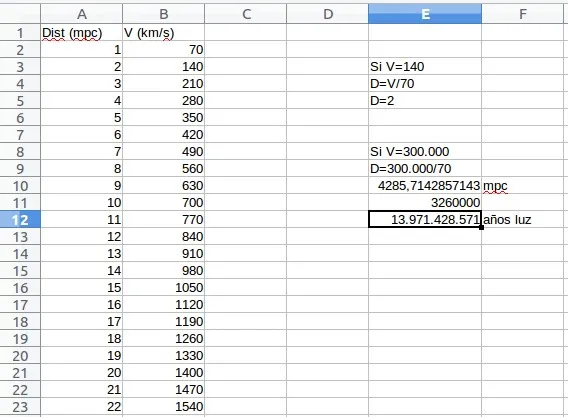
Hubble's Law dictates that, at great distances, objects (galaxies for example) recede faster than c. The Hubble Constant, measured with an average value of 70 km/s implies that a galaxy located at 1 mpc, megaparsec (3.26 million light-years) recedes at 70 km/s. Another galaxy at 2 mpc, recedes at 140 km/s. And so on. If we make a table, with one column for distance (in mpc) and another for speed (in km/s) we will see that in the speed column we will at some point reach the speed of light and then exceed it. That happens when the mpc value is equivalent to 14 billion light-years.
The diameter of the universe is greater than 90 billion light-years, a pertinent clarification because other commentators indicate that "nothing" can exist beyond 14 billion light-years, confusing the age of the universe with its size. What is detected now when the source was 14 billion light-years away, is no longer at that distance, but at a much greater one. Galaxies located above such a distance recede at speeds greater than c. Does that imply we will never see them? Since the speed of the emitted light will be c and the expansion will be greater than c, we could say that the light from that object would never reach us. However, the universe also expands for us, so the "cosmological horizon" becomes larger and, at some point, that horizon will include objects we cannot see today, but will not include others more distant.
-----------------
Trivia for the intrepid
Let galaxy A be located 14 billion light-years from the Milky Way, and galaxy B located 14.2 billion light-years from Earth. If, as stated above, both are moving away from us at a speed greater than c, are they also moving away from each other at that speed?
Now let's turn the statement around. Let's say we are in a galaxy 14 billion light-years from the Milky Way and we measure the speed at which that spiral galaxy containing the Solar System is moving away. What speed will we measure?
------------------
DL is also calculated in another way. DL can be used to know how far we are from a 100W light bulb if we perceive it with a certain apparent brightness (since there is a relationship between brightness and distance). That calculation is common in introductory astronomy courses for fixed or stationary sources or for expansion at "short" distances. But for large distances, cosmology begins to play a role. This type of DL calculation allows establishing "standard candles" like supernovae.
Therefore, the value of z indicates how much the universe expanded from when the radiation was emitted until it was detected, by its redshift, and as a consequence, it can be used to know how far away the object is NOW.
The z value and science journalism
To conclude: on his site, Ned Wright ironically says that journalists are taught the 5 Ws (what, who, how, when, where, in English), but not the z.
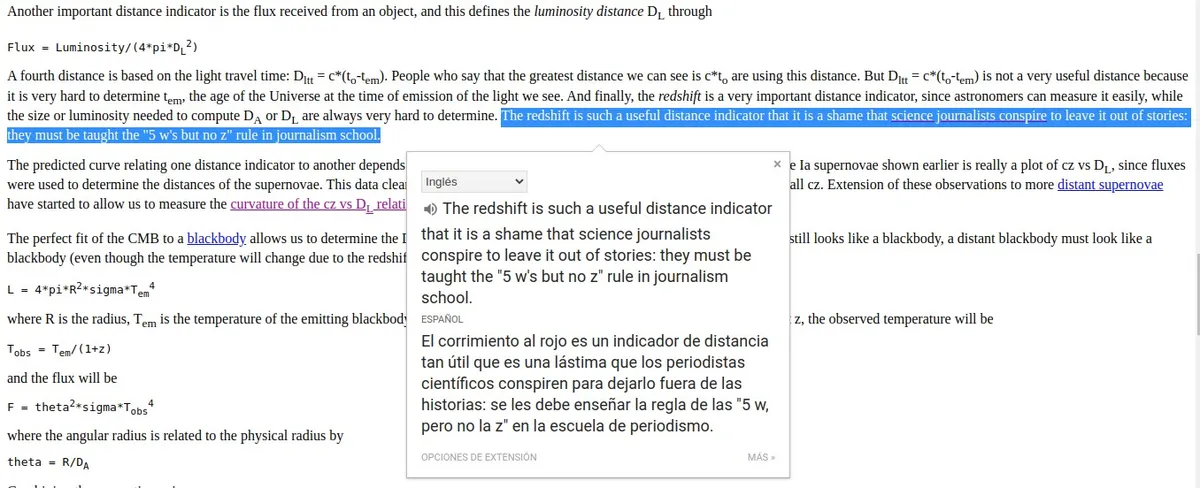
That's because, according to the astrophysicist, science journalists should use the value of z, instead of indicating what age the universe was when the radiation was emitted or how far away the objects (comoving) are now or how far away they were when the radiation was emitted. That's because all those calculations depend on certain variables like the geometry of the universe and the Hubble constant. In contrast, astronomers use directly the z value of the cosmological redshift, which is not calculated, but measured.
In this graph we see the problem of distances in cosmology:
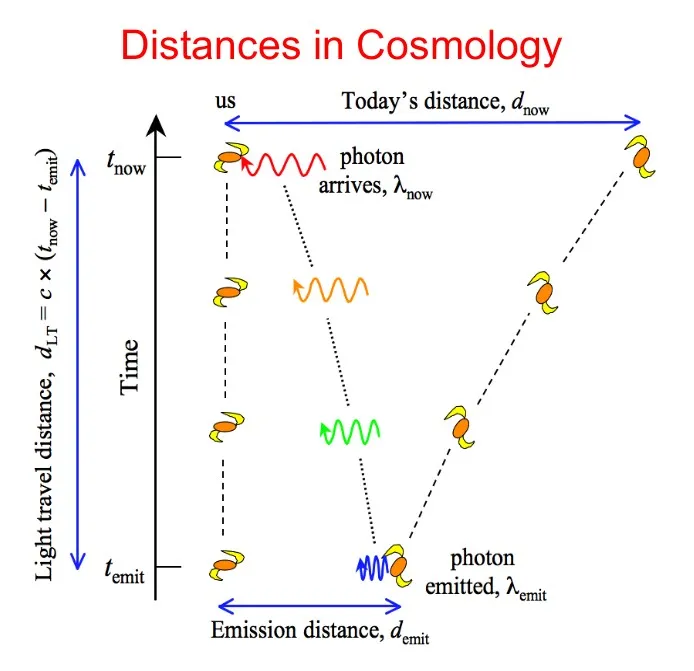
On the horizontal axis we have distance and on the vertical axis, time.
On the horizontal axis, at the bottom, we have two galaxies, one being us and another that emits radiation. On the vertical axis, that happens at t_emit, the time when the photons are emitted. The distance between the position of our galaxy AT THAT MOMENT and the emitting galaxy is the emission distance.
From when the radiation is emitted, it travels and takes time to reach us later (at the top t_now), meanwhile the emitting galaxy has been moving away. Thus, at the top we have the current distance, between the current positions of both comoving galaxies. Note that the graph of the emitted radiation is blue and the radiation that arrives later to us is red and longer. That lengthening of the radiation's wavelength is given by the expansion of the universe, which is also the cause of the emitting galaxy moving away from us.
Therefore, knowing the z value allows knowing the distance to the emitting galaxy at the present moment, even though we cannot see where it is now.
In short: the radiation (and gravitational waves) from a black hole merger that occurred 7 billion years ago has now been detected. The source of that emission is now 17 billion light-years away.☉
Sources and related links
- The merger of two black holes into another supermassive one puzzles the astrophysics community
https://www.agenciasinc.es/Noticias/La-fusion-de-dos-agujeros-negros-en-otro-supermasivo-desconcierta-a-la-comunidad-astrofisica - These Black Holes Shouldn’t Exist, but There They Are
https://www.nytimes.com/2020/09/02/science/black-hole-astronomy-physics.html - Ned Wright Cosmology calculator
http://www.astro.ucla.edu/~wright/CosmoCalc.html
About the images
An image simulating the black hole merger GW190521. Credits...N. Fischer, H. Pfeiffer, A. Buonanno/Max Planck Institute for Gravitational Physics; Simulating eXtreme Spacetimes Collaboration.
Cosmological distances graph
Prof. Dr. Guinevere Kauffmann https://wwwmpa.mpa-garching.mpg.de/~gamk/TUM_Lectures/Lecture3.pdf