Is the universe homogeneous and isotropic?
Every now and then, I come across some article or video proclaiming that "science is dogmatic." Some recently published research serves as evidence to the contrary.
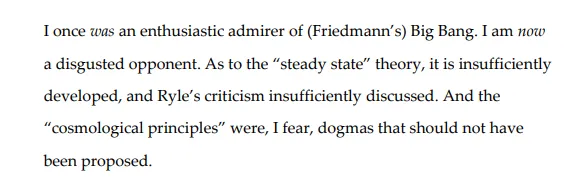
One of the propositions of the Theory of Relativity is that the universe is homogeneous and isotropic, an idea that goes by the name of "Cosmological Principle." One can trace a quote from Karl Popper in which he considers that "the cosmological principles were, I fear, dogmas that should not have been proposed." Kragh, Helge (2012).
This thesis assumes that, on average, the distribution of galaxies looks the same for any observer, in any direction.
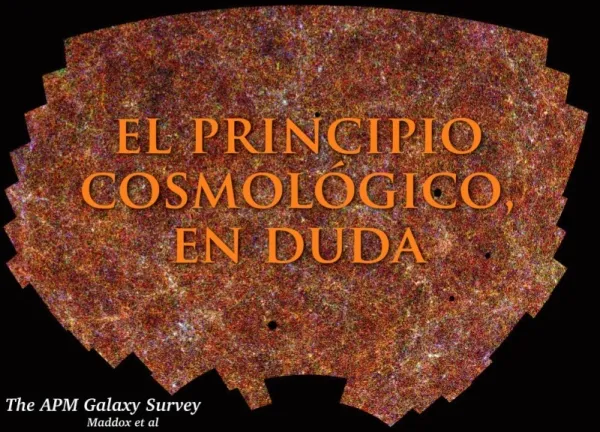
Although it is a proposition that seemed plausible when it was made, several works have been carried out to test whether it is a true principle or not. Large galaxy surveys (like the APM survey) and the study of the Cosmic Microwave Background (CMB) indicate that there are slight variations in the concentration of matter in the observable universe.
However, radio surveys of AGNs have shown an asymmetry. AGNs are active galactic nuclei, meaning there is intense activity at the center of galaxies, caused by supermassive black holes. These AGNs are very bright.
For decades, an apparent "preference" has been known in studies of large galaxies, which is caused by the motion of the Solar System in the Milky Way creating a dipole, which causes us to see fewer galaxies from our planet in the direction we are moving away from and more in the opposite direction. This is so for two reasons: the light from galaxies is redshifted or blueshifted by the Doppler effect, which generates a change in the intensity of the sources in the sky as the time between the arrival of light waves changes. Secondly, due to aberration, i.e., the apparent change in the angular position of an object emitting in the direction of our motion. This dipole observed by astronomers should have an amplitude and direction that match the CMB dipole, also due to the motion of the Solar System through space, about 370 km/s.
But if these two dipoles do not match, it could imply that the Universe does not follow the Cosmological Principle. In previous works, it was found that the amplitude of the radio source dipole was four times greater compared to that of the CMB. It was also discovered that the directions of the radio dipole and the CMB dipole do not exactly coincide, although they are close.
In a recent work, Ashok K. Singal computed the number of AGNs using data from a survey called VLASS (Very Large Array Sky Survey) with 1.9 million sources and another called RACS (Rapid ASKAP Continuum Survey) with 2.1 million sources. With these radio sources, the author calculated the direction and amplitude of the dipole. What he finds is that the amplitude from VLASS indicates that the solar system is moving four times faster than predicted by the CMB, at 1600 km/s. The RACS data also indicate a significant amplitude of almost 8 times greater than expected and the found directions do not match.
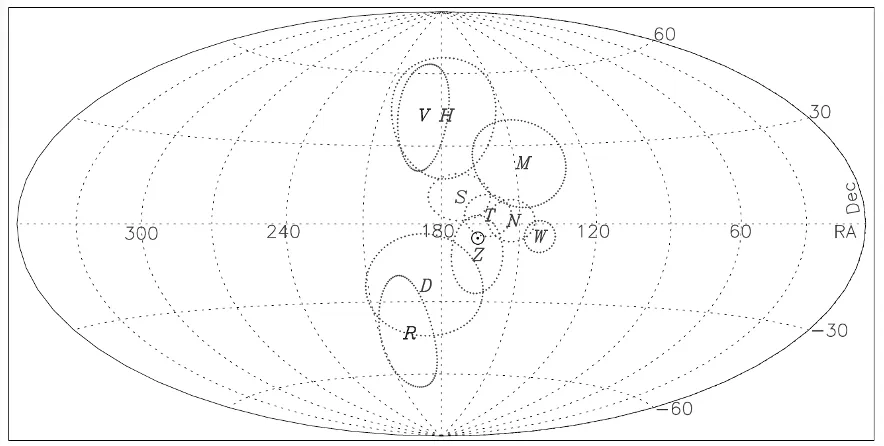
Fig. 9 of the paper shows the directions of the RACS, VLASS, CMB (⊙) and other data group dipoles.
For decades, astronomers have found large structures (and voids) that could contradict the Cosmological Principle. For example, the Huge-LQG quasar group or the Hercules–Corona Borealis Great Wall. In a 2023 work by Fulvio Melia, other cases are nominated:
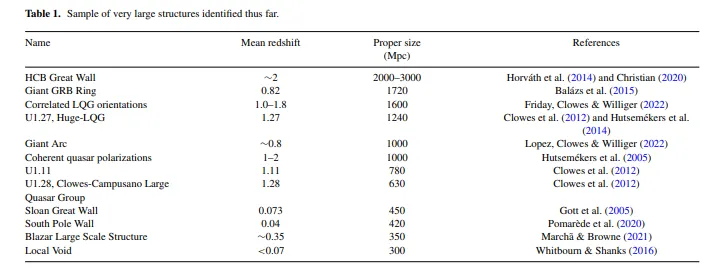
A central issue is what scale to use to consider the Principle. With more research, we will be able to better know to what extent one of the foundations of modern scientific cosmology holds (or not). The mere fact that it is investigated and openly questioned is evidence that the Cosmological Principle is not a dogma.☉
Sources and related links
- Exposing Scientific Dogmas - Banned TED Talk - Rupert Sheldrake
https://www.youtube.com/watch?v=sF03FN37i5w - Two Million Galaxies
http://www.star.ucl.ac.uk/~apod/apod/ap030611.html - Discordance of dipole asymmetries seen in recent large radio surveys with the Cosmological Principle
https://arxiv.org/abs/2303.05141 - Helge Kragh: "The most philosophically of all the sciences": Karl Popper and physical cosmology
https://philsci-archive.pitt.edu/9062/ - The scale of homogeneity in the Rh = ct universe
Fulvio Melia
Monthly Notices of the Royal Astronomical Society, Volume 525, Issue 3, November 2023, Pages 3248–3253,
https://doi.org/10.1093/mnras/stad2496
About the images
APM: Maddox et al.