T CrB would have an outburst this year.
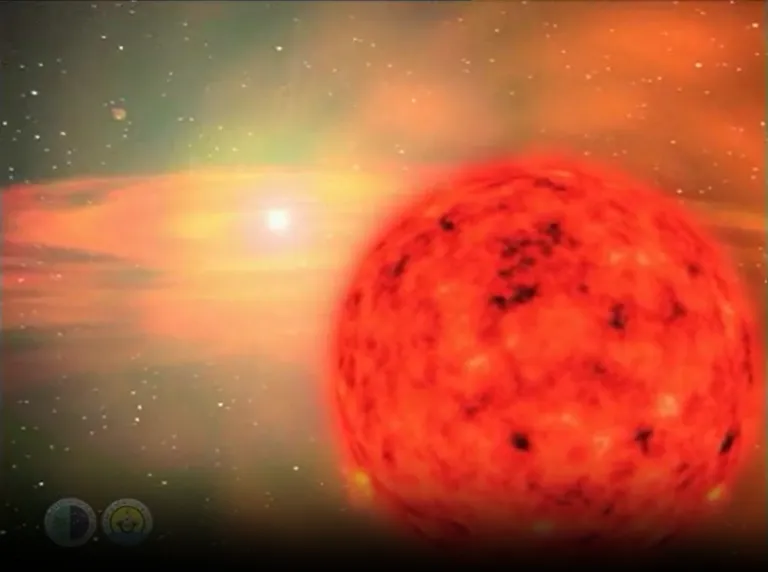
A stellar system located about 2,000 light-years away could become visible to the naked eye soon. It is the star T Coronae Borealis (T CrB) which is a recurrent nova. The last time it erupted was in 1946 and astronomers predict it would do so again this year.
It is a binary system, composed of a white dwarf and a red giant. It can be seen with telescopes, with an apparent magnitude of +10. But it would become magnitude +2 for a few days. For another week it could be observed with small telescopes or binoculars.
In Argentina, the Corona Borealis area is rising around 1:00 AM and by around 3:00 it is about 20º above the NE horizon, near Arcturus.
The account @NASAUniverse will provide updates on the possible outburst.
At AAVSO (the American Association of Variable Star Observers) they published a statement. They say the eruption is preceded by a drop in brightness (pre-eruption dip) that was already noted in March of last year. It seems this drop occurs about a year before the outburst, approximately.
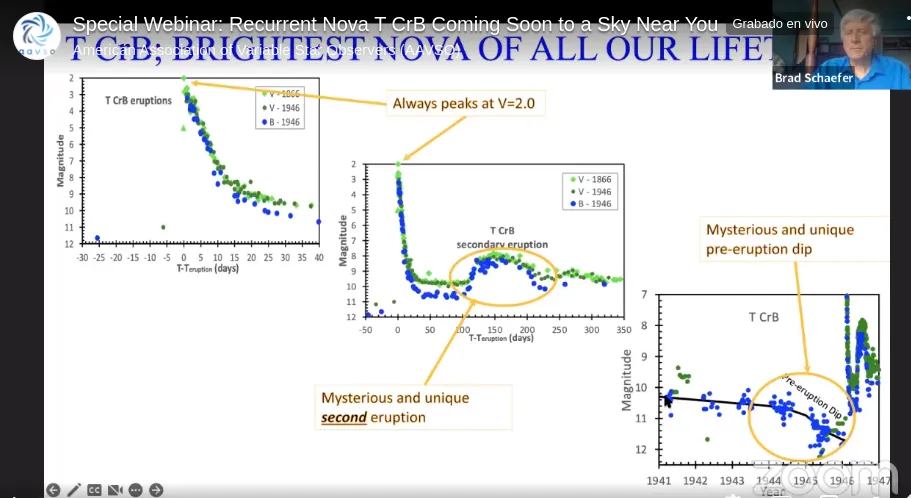
For those interested in observing the nova, it is advisable to first locate the area in the sky (constellation) and familiarize themselves with the visible stars. In urban centers very few stars are seen. When the nova finally occurs, it will be easier to notice.
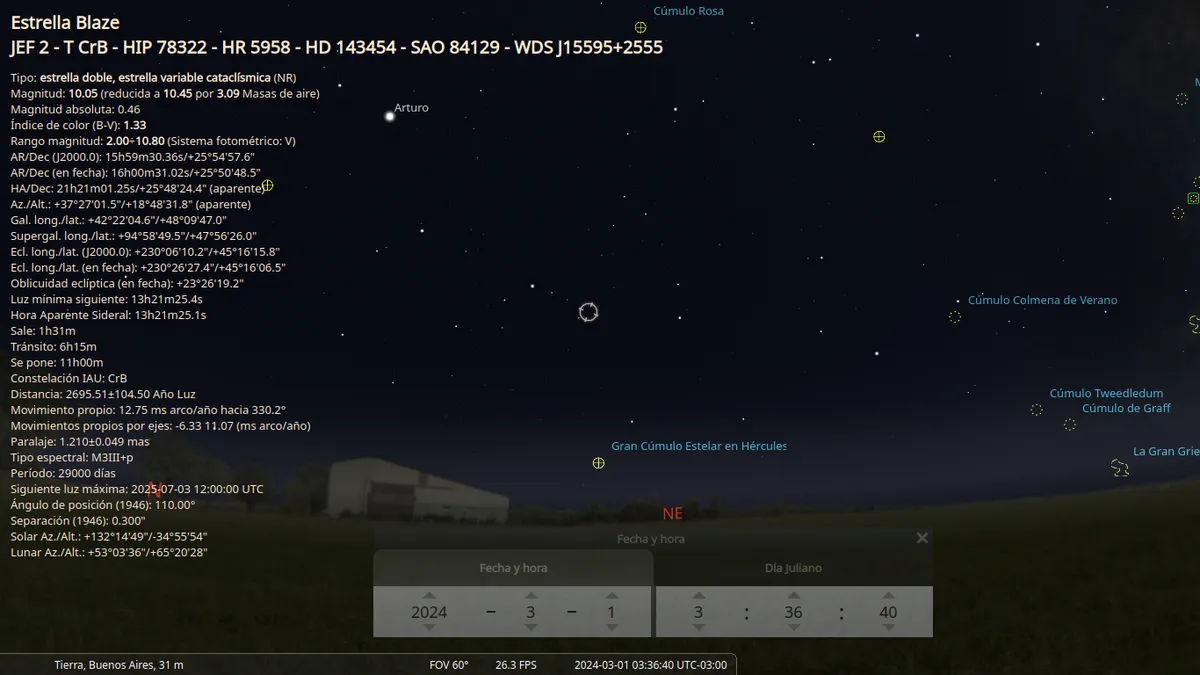
It will be a good opportunity. It is known that the nova had eruptions in 1787, 1866 and 1946, every 80 years.☉
Sources and related links
- View Nova Explosion, ‘New’ Star in Northern Crown
https://blogs.nasa.gov/Watch_the_Skies/2024/02/27/view-nova-explosion-new-star-in-northern-crown/ - Recurrent nova T CrB has just started its Pre-eruption Dip in March/April 2023, so the eruption should occur around 2024.4 +- 0.3
https://ui.adsabs.harvard.edu/abs/2023ATel16107....1S/abstract
https://www.astronomerstelegram.org/?read=16107 - Announcing T CrB pre-eruption dip
https://www.aavso.org/news/t-crb-pre-eruption-dip - Recurrent Symbiotic Nova T Coronae Borealis Before Outburst
https://arxiv.org/abs/2308.10011 - Preparing for the eruption of T CrB
https://britastro.org/forums/topic/preparing-for-the-eruption-of-t-crb
About the images
Illustration: Gabriel Ángel Pérez Díaz, Instituto de Astrofísica de Canarias