And the "No vehicles in the park" dilemma.
On the Big Think website, they published a note about the "Ten commandments of science." Here, instead of translating and republishing the entire article, I'll just extract the basis of the proposal synthesized into ten phrases. They are as follows:
1-You shall not assume your preferred conclusion is correct.
2-You shall always consider the complete set of relevant data when drawing conclusions.
3-You shall remember the limits of the range of validity of your theory and only expand them cautiously.
4-You shall make your data, methods, and results public, so that everyone may consider and scrutinize them.
5-You shall remain tenaciously skeptical of any hypothesis you encounter.
6-You shall quantify, respect, and not minimize your sources of error and your possible biases.
7-You shall not accept a new theory as representative of reality until it overcomes the three critical and necessary obstacles: explaining the same as the previous theory; explaining something that the previous theory could not; and making predictions that can be verified.
8-You shall obtain the approval and consent of all relevant bodies before conducting research that may affect others.
9-You shall not exaggerate the importance of your results in your studies.
10-You shall keep even the best scientific theories, models, and frameworks as provisional and constantly seek to test, review, and refine them.
THE PROBLEM OF DEMARCATION AND "NO VEHICLES IN THE PARK"
The issue with the previous list -and with any other similar list- is the same unsolved problem of demarcation up to this point. I refer to the demarcation between what is science and what is not. The problem is the exceptions, which are inevitable. There are differences between the sciences, even within the same discipline, different branches use different methods and procedures.
At its core, it's not very different from the "No vehicles in the park" problem published by H.L.A. Hart in 1958 and which has more recently resulted in an online "thought game" format: https://novehiclesinthepark.com/
The game was explained simply on the Microsiervos blog: Basically it consists of answering 27 quick YES/NO questions regarding a place where the rule says: "No vehicles in the park."
Each question proposes a situation regarding the statement: Can you enter the park with a truck? With a baby stroller? With a kayak on the lake inside it?
The problem boils down to the definition of "vehicle" being slippery: is a wheelchair the same as a chair with wheels?
The ten commandments should not be considered separately. Each one could be partially objected to. For example, the fourth point indicates the need to publish data. But research will not be more true if the data is published; or more false, otherwise. However, it is good practice because then other researchers will be able to test the results.
Analogously, how many "requirements" should a living being meet to be considered "human": if having two arms were a requirement, then people who have had a birth malformation or an accident in their upper limbs should not be considered human? Obviously that's silly. So we can make a list of non-exclusive requirements: eyes, ears, arms, legs, hair. But not possessing something does not imply not being human. Monkeys would meet all those few requirements and bald people wouldn't, for example.
In that sense, a list of requirements for an activity to be considered scientific should be considered as non-exclusive.
The main thing is to keep the objective in mind: to try to understand what reality is like. However, science creates something like a map of reality. And a map is not equal to the territory. Remember that short story by Borges "On Exactitude in Science." Knowledge has more limits than reality. There will be aspects we will never be able to know, others we will never fully understand, and many we cannot observe "as they are." Therefore, the "scientific narrative" of reality will not be equal to reality. A fiction? The idea is for it to be the best possible approximation to reality, like a map. Is a map a fiction? The map of Middle-earth, or the Flat Earth map, yes.
I believe the first phrase is fundamental. In fact, it's my favorite phrase. I'm sure it's correct.☉
Sources and related links
- The scientist’s 10 commandments
https://bigthink.com/starts-with-a-bang/the-scientists-10-commandments/ - Hart, H. L. A. “Positivism and the Separation of Law and Morals.”
Harvard Law Review 71, no. 4 (1958): 593–629.
https://doi.org/10.2307/1338225 - "No vehicles in the park" is a quick test about rules and behaviors with a surprising ending
https://www.microsiervos.com/archivo/juegos-y-diversion/prohibido-vehiculos-en-el-parque-reglas-comportamientos.html
About the images
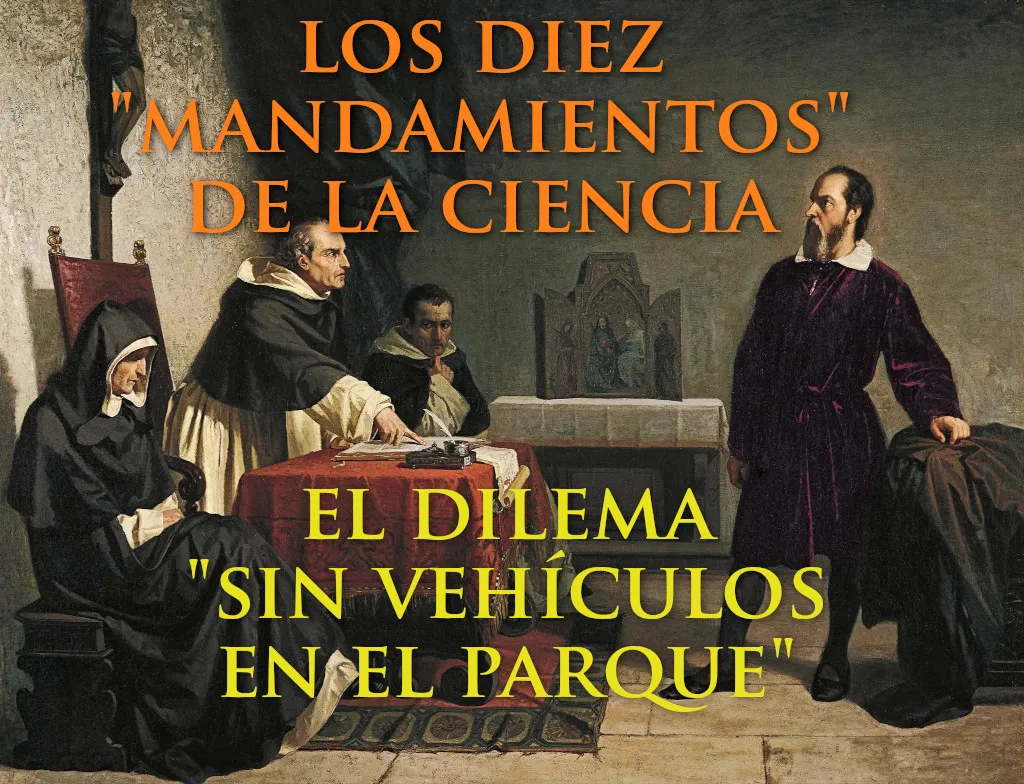
By Cristiano Banti - http://www.law.umkc.edu/faculty/projects/ftrials/galileo/galileotrial.jpg https://www.newscientist.com/article/mg22530043-300-popes-impending-call-for-climate-action-is-refreshing/ image, Public Domain, https://commons.wikimedia.org/w/index.php?curid=631170