The coming revolution.
We have said here that the history of astronomy can be divided into three eras. And that we live in the contemporary era, which is the golden age of this science. Never before have so many discoveries been made, nor as important as in the last 150 years.
If the telescope, in the 17th century, was a revolution, during the 20th century there were several: photography, spectroscopy, space telescopes, satellites, computing. Galaxies were discovered, the expansion of the universe, Cosmic Inflation was postulated, dark matter, dark energy.
But in this last era there is a distinctive, outstanding element: until 2016, the only raw material of astronomy was light, electromagnetic waves. Less than a decade ago gravitational waves were detected for the first time, which later enabled multi-messenger astronomy: studying certain phenomena through electromagnetic waves (light) and gravitational waves, at the same time.
It is a new window that astronomers did not have in the past and that is why it is an advance as revolutionary as the telescope. Potentially, gravitational wave research could detect primordial waves to study inflationary theory.
But there is another revolution underway, a silent one: neutrinos.
INTRODUCTION TO NEUTRINOS
The existence of a particle -which would later be called neutrino and assigned the symbol ν- was postulated by experiments during the 1930s in which energy was "left over", which threw all thermodynamics out the window. Then, physicist Wolfgang Pauli postulated that this energy corresponded to a particle not yet discovered. Calculations indicated that such a particle must be of zero mass, without charge, that is, undetectable. In the mid-1950s neutrinos were detected experimentally. Despite advances to date, neutrinos are mysterious particles in several aspects.
It is known that there are three types, families or "flavors": the electron neutrino, the muon neutrino and the tau neutrino. The phenomenon of oscillation was detected, so neutrinos of one flavor can change to another. It is known that they do have mass and that they travel almost at the speed of light. The fact that neutrinos from the Sun arrive before photons is explained by the fact that these particles almost never interact with anything, while light is absorbed and re-emitted by atoms.
It has been theorized that neutrinos could be their own antiparticle. They are called Majorana neutrinos. If this were true, it would be a first step in explaining why there is so much matter and not antimatter in the universe. The existence of another class of neutrino has been postulated: sterile neutrinos.
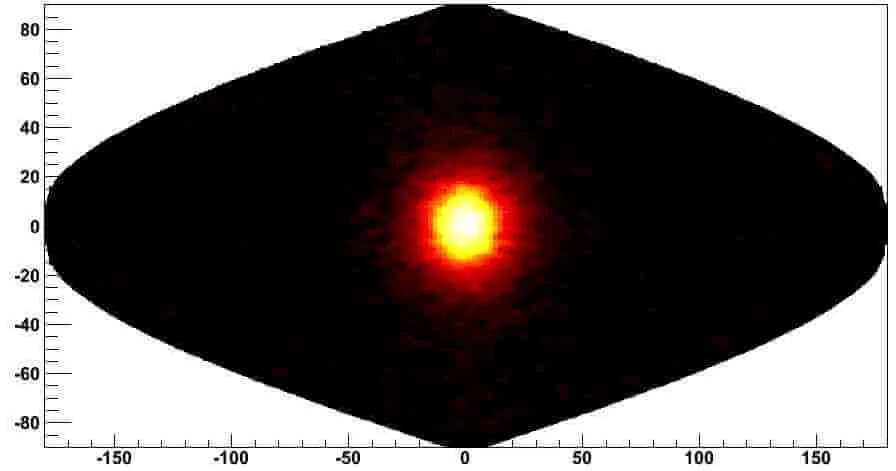
Neutrinography of the Sun. Credit: Super-Kamiokande
NEUTRINOS AND DARK MATTER
If "dark matter" is defined as any form of matter that does not interact with electromagnetism and possesses mass, but has weak gravitational interaction, then planets, black holes and neutrinos could be considered a form of "dark matter".
However, to explain the discrepancies between gravity theories and observations of galaxies and clusters, something more is needed, since the sum of neutrinos and massive objects would not explain even 3% of the necessary mass.
Dark matter, on the other hand, is defined as cold, non-relativistic matter. Neutrinos, on the other hand, are hot matter. It has been speculated that dark matter could produce neutrinos.
NEUTRINOS IN ASTRONOMY AND OTHER USES
Stars produce neutrinos. The production of neutrinos before a supernova outburst is particularly important. We have commented on how an upgrade to the Super-Kamiokande experiment in Japan will be used as an early supernova warning.
The IceCube experiment detected neutrinos from a blazar: TXS 0506+056. Later other cases were detected. They also detected neutrinos from another galaxy, M77.
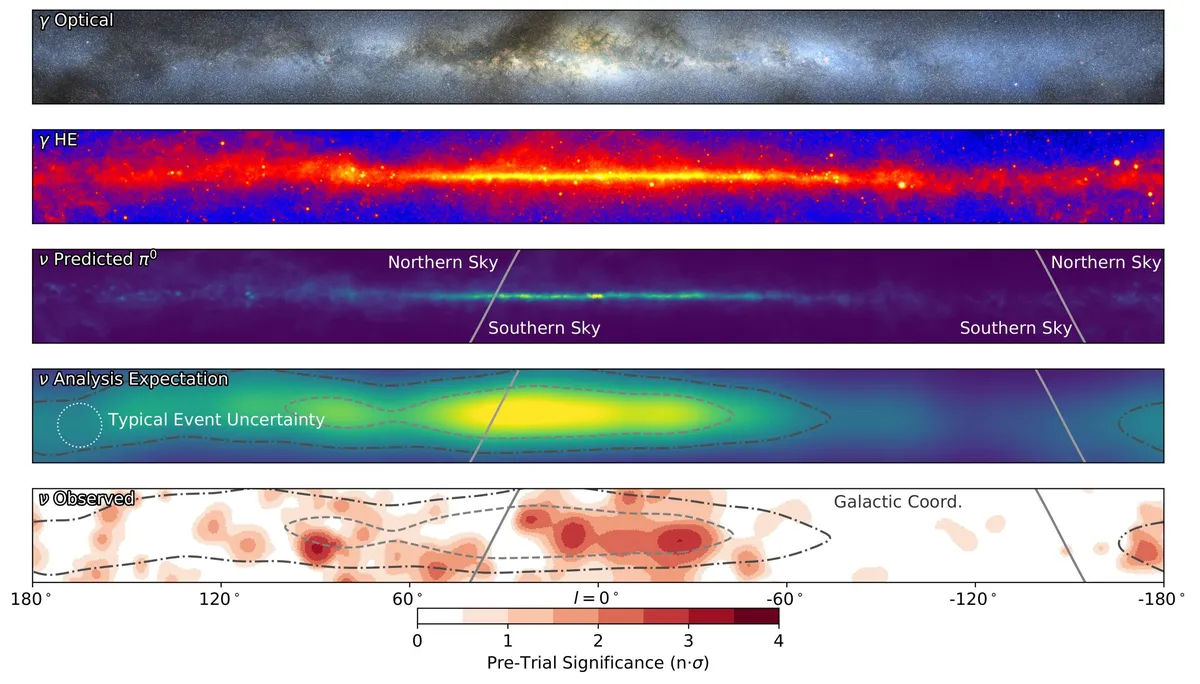
With data from IceCube, an image of our galaxy was made: A multi-messenger view of the Milky Way, centered on the galactic center and seen in galactic coordinates. Each panel shows the plane in 15º bands at different wavelengths: optical range; gamma rays; expected emission for the neutrino flux from Fermi-LAT measurements; and the last panel with IceCube observations.
Neutrinos have been used to take a picture of the sun, a neutrinography (at Super-Kamiokande). Neutrinos have also been used to measure our world.
NEUTRINO COSMOLOGY
But the most important thing is the existence of a cosmic neutrino background (CνB). This background is a relic from when the universe was less than 2 seconds old, after the Big Bang. Let's compare it with the CMB (Cosmic Microwave Background Radiation) which is from when the universe was 380 thousand years old.
So far there have been indirect detections of this neutrino background. It is very difficult to detect, but in recent decades experiments to search for neutrinos have also increased. Let us remember that among the neutrino experiments are Super-Kamiokande, IceCube, and also the Pierre Auger Cosmic Ray Observatory in Mendoza, Argentina.
The detection of the CMB has been the key piece of current cosmology. The CνB, if detected and studied precisely, would be revolutionary evidence for cosmology.
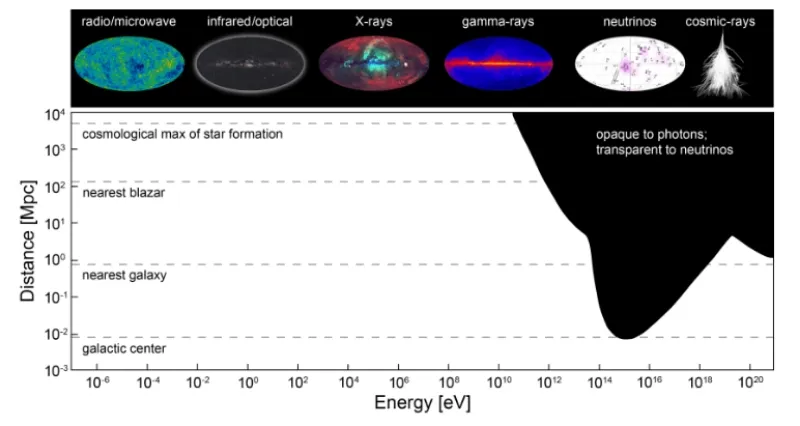
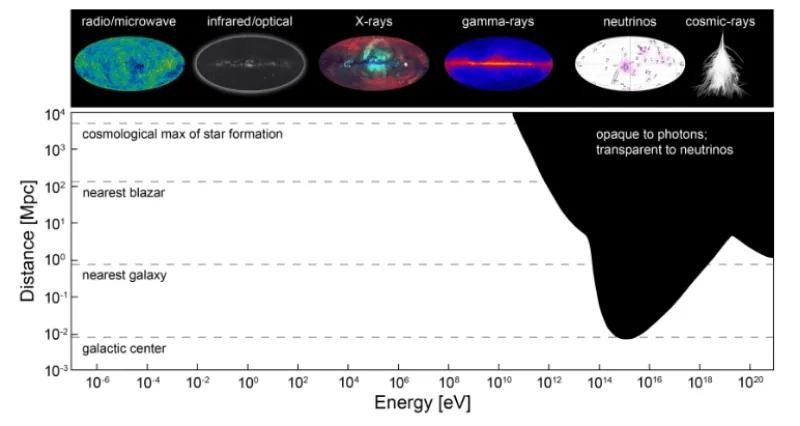
Visible distance in the universe (1 Mpc, about 3 million light-years) versus photon energy. The extreme universe at energies above 10^14eV (100 TeV) is opaque to light, but can be explored directly using neutrinos as astronomical messengers.
Neutrino astronomy already exists. Perhaps it is not yet thought of as a specialty, but we can certainly think that it is a growing branch with great potential. They say that Pauli felt ashamed to postulate a particle that, for that time, was considered impossible to discover. They also say that it was Enrico Fermi who, after the discovery of the neutron, thought that Pauli's particle should be called "neutrino". Someone said that "small is beautiful".☉
Sources and related links
- The three eras of astronomy
https://www.noticiasdelcosmos.com/2022/12/las-tres-eras-de-la-astronomia-y-las.html - Recórcholis: Supernova forecasts
https://www.noticiasdelcosmos.com/2022/03/recorcholis-pronosticos-de-supernovas.html - Solar neutrinos
https://www-sk.icrr.u-tokyo.ac.jp/en/sk/about/research/ - First tomography of the Earth with neutrinos
https://www.agenciasinc.es/Noticias/Primera-tomografia-de-la-Tierra-con-neutrinos - First indirect observation of the cosmic neutrino background in BOSS BAO DR12 data
https://francis.naukas.com/2019/03/09/primera-observacion-indirecta-del-fondo-cosmico-de-neutrinos-en-los-datos-de-boss-bao-dr12/ - The cosmic neutrino background
https://francis.naukas.com/2015/11/30/el-fondo-cosmico-de-neutrinos/ - CONFIRMED: The Last Great Prediction Of The Big Bang!
https://medium.com/starts-with-a-bang/confirmed-the-last-great-prediction-of-the-big-bang-68ab6f4a5475 - Our galaxy seen through a new lens: neutrinos detected by IceCube
https://icecube.wisc.edu/news/press-releases/2023/06/our-galaxy-seen-through-a-new-lens-neutrinos-detected-by-icecube/ - Hunt for Big Bang neutrinos may provide fresh insight on origin of universe
https://www.princeton.edu/news/2016/03/14/hunt-big-bang-neutrinos-may-provide-fresh-insight-origin-universe - Big Bang neutrinos
https://neutrinos.fnal.gov/sources/big-bang-neutrinos/
About the images
Initial image: IceCube Collaboration/U.S. National Science Foundation (Lily Le & Shawn Johnson)/ESO (S. Brunier)
Solar neutrinos: Super-Kamiokande.