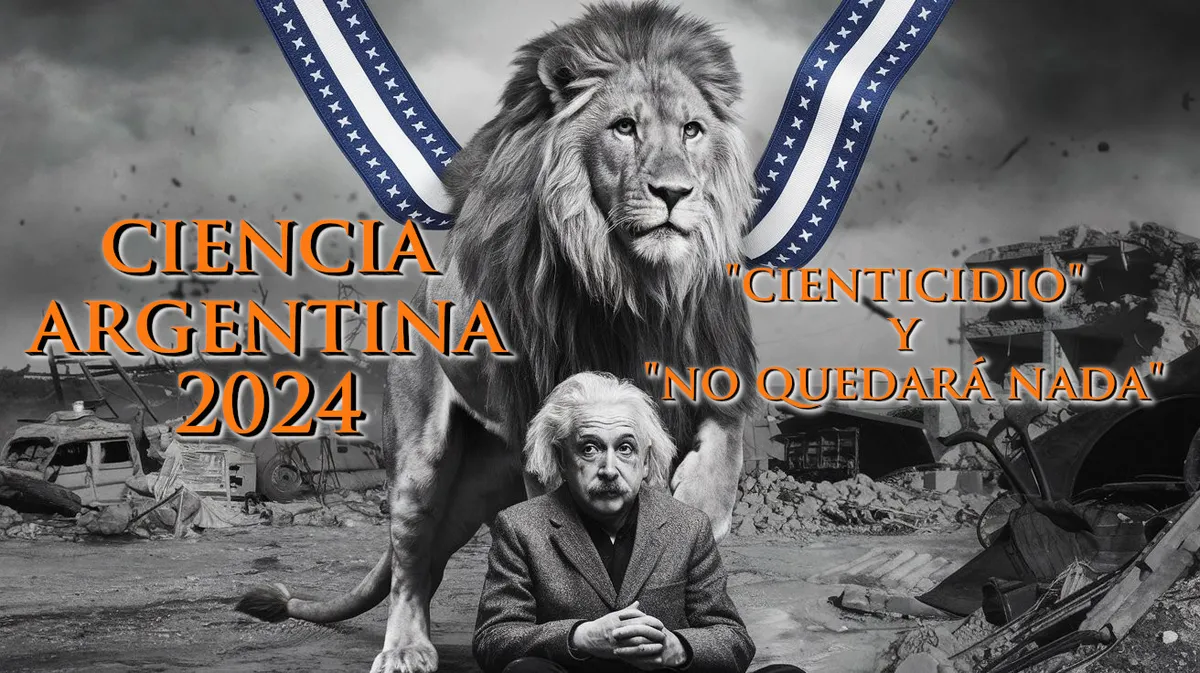
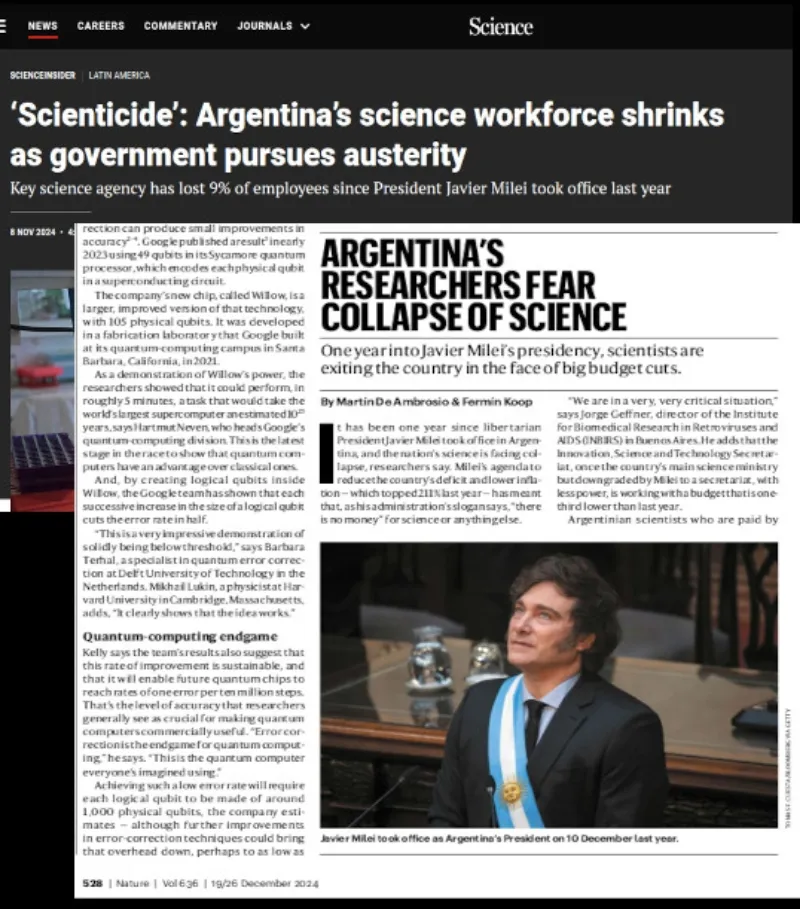
In articles published in the two most important science journals, Science and Nature, the state of science in the country in the last year is discussed, with words like "Scienticide" and "Nothing will be left".
An article dated December 9, published in Nature by Martín De Ambrosio and Fermín Koop, reviews the situation of the scientific sector during the first year of Javier Milei's administration. The note talks about the motto "there's no money" and the 30% cut in the income of state scientists. "With another six months like this, nothing will be left" of the scientific community, says Mariano Cantero, director of the Balseiro Institute in Bariloche.
Earlier, on November 8, an article signed by María de los Ángeles Orfila was published in Science with the title (translated): "Scienticide: Argentine science shrinks as government implements austerity measures". The note begins by saying that "For the first time in two decades, the Argentine scientific community is experiencing a substantial loss of jobs and funding cuts as a result of austerity policies."
France24 headlined on its news portal: "Defunding, attacks and brain drain: the harsh reality of science in Argentina".
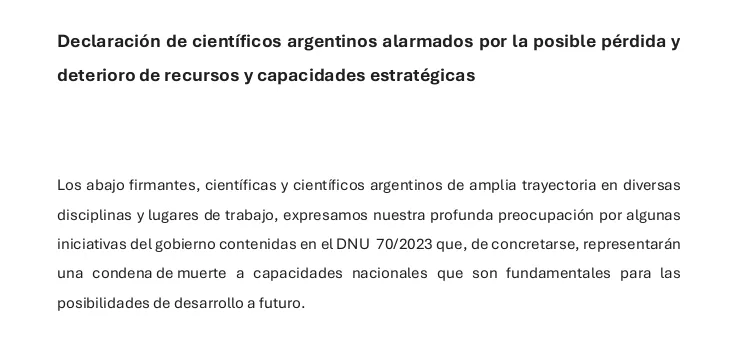
In March, 68 Nobel Prize-winning scientists signed a letter against the cuts to Argentine science: "We watch as the Argentine system of science and technology approaches a dangerous precipice and are discouraged by the consequences this situation could have for both the Argentine people and the world."
It is worth remembering the resignation of a CONICET member, García Solá, who in a letter said: "I could never silence my voice when an attempt was made to commit an act of persecution for scientific, political or religious ideas".
A few days ago, UBA published a video on its Youtube channel titled: Breaking is easier. Report on the 2024 science cuts (see link below).
In summary: Argentine science, despite the achievements of many of its researchers and the good global positioning of its universities, has made news in international media, including the two most important in science like Science and Nature, with bad news. If there were things to correct, that path was not chosen. Correcting is difficult. Cutting, eliminating, diluting, is easier.
It is worth reflecting that only human beings can do science. Bees, chrysanthemums, gladioli, willows, monkeys, dolphins and lions cannot. Robots, machines, even with AI, cannot do science. In any case, they are very useful tools for that purpose, created and used by people, who are the ones who ultimately do science. People who possess scientific thinking. Who use their cognitive abilities to try to understand the world and provide solutions to human problems. People who burned the midnight oil to obtain an undergraduate degree and other postgraduate degrees. Doing science, laboratories, projects costs a lot. A lot of effort and time.
Without an improved budget in sight, local science diminishes in favor of a greater level of discretion in the use of funds. While scientific production based on rationality shrinks, secret intelligence funds and communication offices are increased. Mediums and obscure gamblers are privileged over scientists. The scientific staff is reduced, while appointments of the new ruling political caste increase.
Sarmiento dreamed of a greater country: with more education, knowledge and work. From here I express the wish that our Galileos handle telescopes, and not taxis...☉
Sources and related links
- "Scienticide": the world's most prestigious scientific journal publishes a harsh analysis of the cuts at Conicet
https://www.cronista.com/economia-politica/cienticidio-la-revista-cientifica-mas-prestigiosa-del-mundo-publica-un-duro-analisis-sobre-el-ajuste-en-el-conicet/ - ‘Scienticide’: Argentina’s science workforce shrinks as government pursues austerity
https://www.science.org/content/article/scienticide-argentina-s-science-workforce-shrinks-government-pursues-austerity - ‘There will be nothing left’: researchers fear collapse of science in Argentina
https://www.nature.com/articles/d41586-024-03994-y - A Conicet director who represented the agricultural sector in the scientific body resigned
https://www.infobae.com/salud/ciencia/2024/11/08/renuncio-un-director-del-conicet-que-representaba-al-sector-agropecuario-en-el-organismo-cientifico/ - Defunding, attacks and brain drain: the harsh reality of science in Argentina
https://www.france24.com/es/am%C3%A9rica-latina/20241112-desfinanciamiento-ataques-y-fuga-de-cerebros-la-cruda-realidad-de-la-ciencia-en-argentina - Breaking is easier. Report on the 2024 science cuts.
https://www.youtube.com/watch?v=-ZsFMFLASSU&ab_channel=ExactasUBAoficial
About the images
Ideogram https://ideogram.ai/