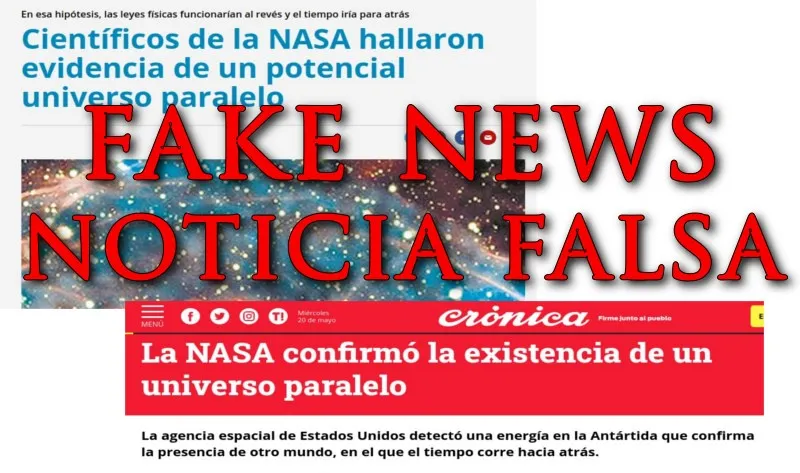
Despite what some online media have published these days.
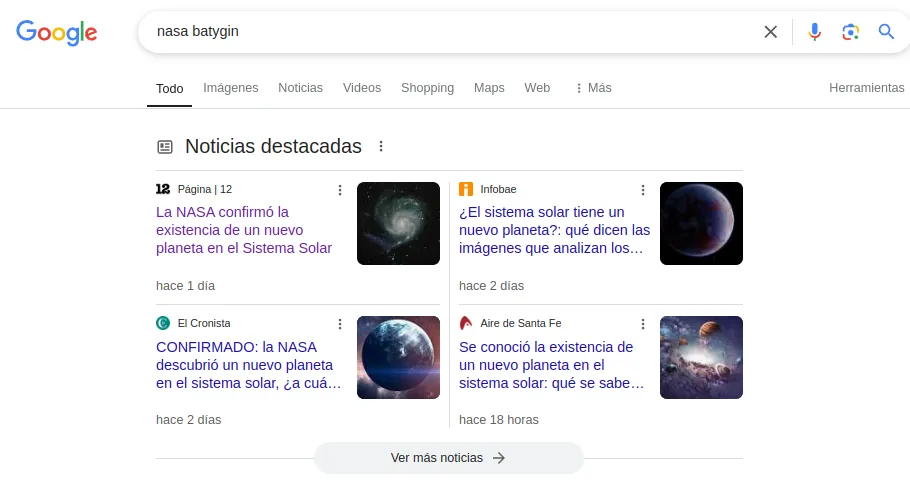
The story of Planet 9, sometimes also called Planet X, can be traced back to 2014. Chad Trujillo and Scott Sheppard published a paper showing a rare alignment of trans-Neptunian objects (TNOs) and hypothesized a possible new planet in the Solar System as an explanation for those orbits.
The curiosity piqued astronomers Konstantin Batygin and Mike Brown who performed a simulation that resulted in an object much more massive than Earth, but less than Neptune (a super-Earth or a Mini-Neptune), much farther away than Pluto, in the outer reaches of the Solar System, could explain the strange orbits.
But since then two things happened: there were some searches that yielded nothing; and alternative explanations for those orbits were proposed, without the need for a new planet.
THE DIFFICULTY OF OBSERVING A PLANET IN THE SOLAR SYSTEM
It may seem a paradox that astronomers discover galaxies billions of light-years from Earth, but cannot detect the possible existence of a planet in our cosmic neighborhood. It seems a contradiction, but it is not. Galaxies are incredibly large. Ours, the Milky Way, is at least 100 thousand light-years in diameter. A planet, even a giant one like Jupiter, is much smaller than a star. Let's think about this: all the objects in the solar system, planets, moons, asteroids, comets, do not make up even 5% of the total mass, since more than 95% of the total mass is the Sun.
Discovering a planet orbiting other stars (exoplanets) can be done with various techniques, but the most used are two:
-By the transit method: when an alignment is established: star, exoplanet, Earth. Then, from here when observing the star, the planet will pass in front. Although it cannot be observed, it will minimally block the light coming from the star at that moment. The resulting light curve will show a slight periodic dip. That is a sign of a planet around it. This technique, however, cannot be applied in our solar system because such an alignment would be impossible for any object farther from the Sun than Earth.
-By radial velocity: in this case, a planet around a star will cause the star to move differently, performing a change in its orbit, in a regular manner. That change will be greater the more massive the planet is and the closer it is to the star. Therefore, most exoplanets detected with this technique are like Jupiter, but very close to their star, they are "hot Jupiters". This also does not apply to the case in question, since the existence of a fairly large planet, but very, very far from the Sun is postulated. Its gravitational influence would be as small as undetectable.
THE VERIFICATION OF THE MEDIA
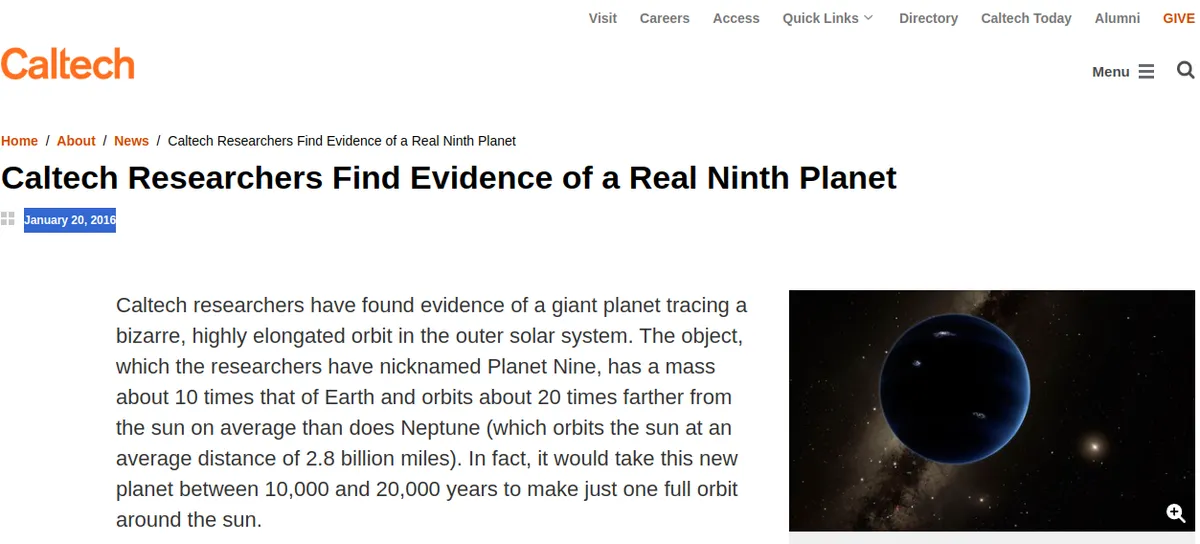
I never cease to be amazed in these cases. The media that have published this news lack two things: an author who signs the article; nor a source. NASA is mentioned in the same press release republished (copy and paste) by several media, but none provide a link to any statement from the US agency. Caltech Institute is indicated: if you visit its website, in the news section, there is nothing that has been published recently. But there is a publication identical to what is indicated on several portals, only it is an article from 2016. The "evidence" of a so-called Planet 9 are simulations, which are a good tool for scientific knowledge, but it is not enough to account for a discovery.
It used to be said that blogs were not "serious media" because it was common to "copy and paste". It is enough to look at the media that have published this to realize that they are portals, some from media until now considered "serious".
JAMES WEBB TO THE RESCUE?
The James Webb Space Telescope (JWST) is not the most suitable instrument for searching for an outer planet of the Solar System. Although the sensitivity in infrared wavelengths would be of great help, large telescopes have small fields of view, ideal for pointing at a specific section. However, a possible exoplanet so far away would have a very large orbit and could be anywhere in that orbit. It is necessary to observe with a wider field.
HISTORY TEACHES
Urbain Le Verrier knew of an anomaly in the motion of Uranus and his calculations led him to think of the existence of another planet. Indeed, shortly after, Neptune was observed. The same astronomer knew of another anomaly, in Mercury, also postulated that there would be a more inner planet. Others nicknamed that potential planet Vulcan (it was also called Planet X). But Vulcan does not exist. Therefore, mathematics can be very good, but to know if something exists out there, empirical corroboration is necessary. Meanwhile, the planets of the solar system are 8. Planet X is an unknown.☉
Sources and related links
Caltech Researchers Find Evidence of a Real Ninth Planet https://www.caltech.edu/about/news/caltech-researchers-find-evidence-real-ninth-planet-49523
About the images
Screenshots.