The elusive relationship between a sitcom, a pop song, a dark infusion and the collapse of a star.

Brian Greene is an American physicist, author of "The Elegant Universe" and has been running the World Science Festival for years, which are talks with scientists from different specialties on current and interesting topics. He has a YouTube channel with that material, very interesting. On several occasions, within the framework of the World Science Festival, Greene has referred to the concept of "black holes" with Monk's Café, where the characters from Seinfeld used to meet (although they sometimes went to another diner).
In this blog, we invented the Detective of Astronomical Names, to trace the origin of words in astronomy. The concept of a black hole would have been first recorded by astronomer John Michell in the 18th century. Using Newton's Laws, Michell thought that if a massive body has an escape velocity, and if with greater mass comes greater gravity and therefore a greater required escape velocity, there could exist objects so massive that their escape velocity would be greater than the speed of light.
But the words "black hole" would have been coined by astrophysicist John Archibald Wheeler, during a conference in December 1967 in New York. Wheeler, who died in 2008, said the term was suggested to him a few weeks earlier during another conference, when a member of the audience grew tired of him repeating "gravitationally completely collapsed object." "Why not call it a black hole?" demanded the person, who remains anonymous.
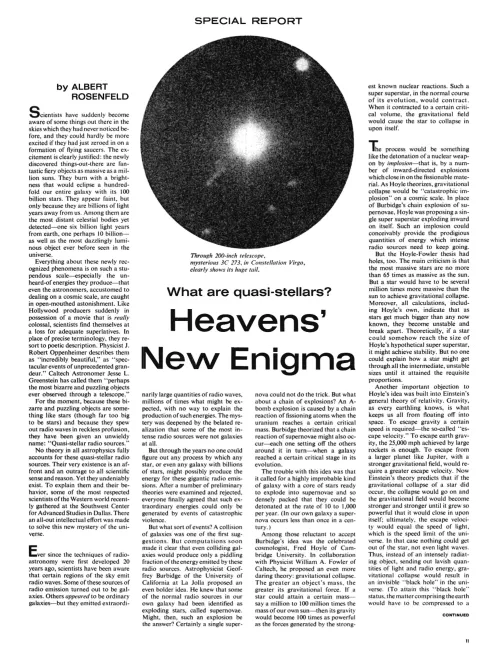
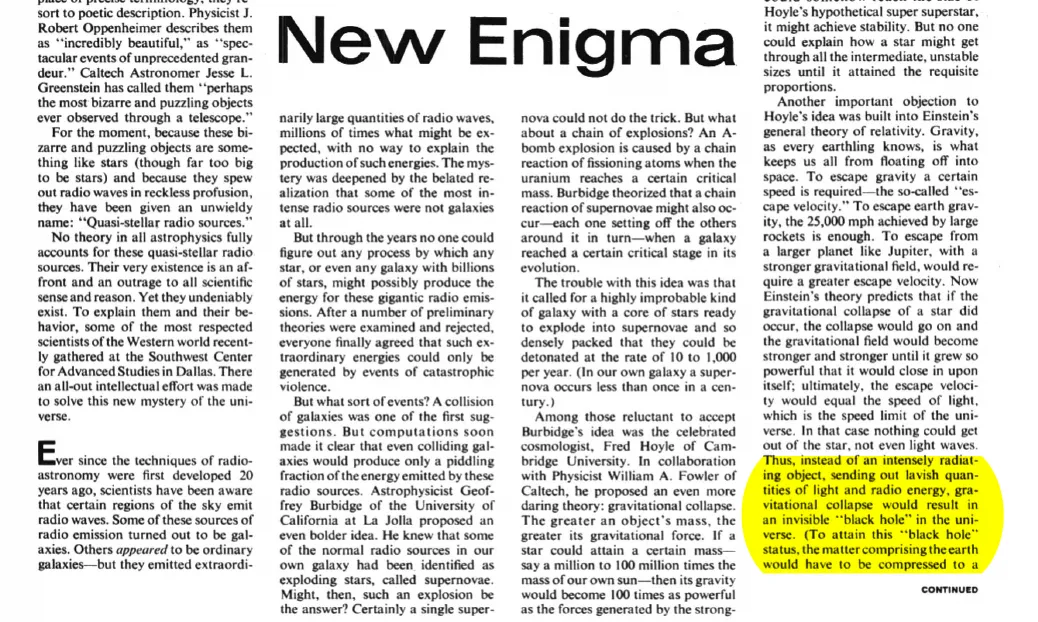
However, the term would have been used four years earlier at a conference in Dallas, according to science journalist Marcia Bartusiak. She had traced the origin of the term for a book and discovered that those words were used in December 1963. Wheeler himself spoke at that symposium too, but there is no record of the term by him. What there is, is a reference made in Life magazine on January 24, 1964 by Al Rosenfeld, an editor who attended the symposium and used the term in his report. Bartusiak traced it and Rosenfeld confirmed that he heard the word at the meeting, but without remembering who used it.
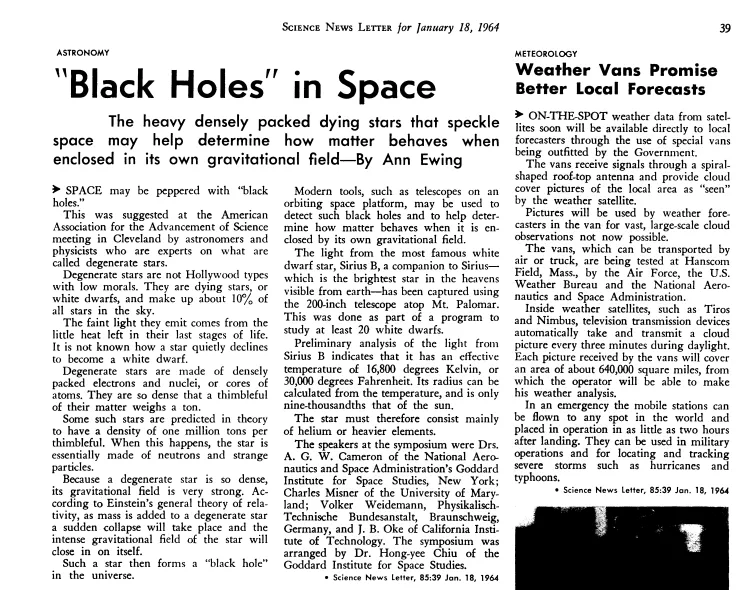
Life magazine would not have been the first publication. The honor would go to Science News Letter, the former name of Science News. The words "black hole" would have been used in Cleveland, at a meeting of the American Association for the Advancement of Science, in January 1964. Reporter Ann Ewing described how intense the gravitational field must be to cause a star to collapse. "Such a star then forms a ‘black hole’ in the universe", she wrote in the issue of January 18, 1964, a week before Life.
Ewing listed the names of several speakers at the meeting, but did not remember who mentioned those words. In a Science News article, it is speculated that it could have been Hong-Yee Chiu, who organized the session. When asked, he said it's possible he used the term, but that he did not originate it. Chiu told astronomer Virginia Trimble that he remembered a seminar at Princeton, between 1960 and 1961, when physicist Robert Dicke described the objects as "black holes of Calcutta." The Black Hole of Calcutta was a dungeon in the old Fort William, in Calcutta, India.
Perhaps Dicke inspired the short version of the phrase that was used informally at the 1963 Texas symposium and at the AAAS meeting. But it didn't catch on until Wheeler started using it a few years later. "The important thing is that he had the authority to give the scientific community permission to use the term 'black hole'," said Bartusiak.
Chronology
December 1963: Symposium in Dallas, Texas: 1st Texas Symposium on Relativistic Astrophysics.
December 1963/January 1964: Cleveland: Meeting of the American Association for the Advancement of Science (AAAS).
January 18, 1964: Ann Ewing's report, "Black Holes in space," about the AAAS meeting, in Science News Letter.
January 24, 1964: Life Magazine: Report "Heaven's New Enigma," by Al Rosenfeld. Refers to the Dallas Symposium and uses the words "black hole."
December 1967: GISS Meeting. Use of the terms "Black Hole" by John Wheeler.
WAITER: A BLACK HOLE, WITH MILK, PLEASE!
According to Wikipedia (English) Wheeler would have used the term in a lecture given at NASA's Goddard Institute for Space Studies (NASA Goddard Institute of Space Studies, GISS). GISS is located at Columbia University, at 2880 Broadway, New York. According to the GISS website, the facilities have been located at Broadway and West 112th St. since the 1960s. The building, officially known as Columbia University's Armstrong Hall, is shown in the photo we reproduce below and which is on the GISS website. It also says there: "If you've seen the television show Seinfeld, you'll recognize the corner in the exterior shots of the restaurant where Jerry and his friends hang out." And it adds: "The restaurant is Tom's Restaurant and GISS occupies most of the upper floors."
The restaurant in the series is called Monk's, but it really exists and is called Tom's. It's not a coincidence with the song Tom's Diner, by Suzanne Vega (1987) since the lyrics of the song, which narrate the thoughts of a person going for coffee, were inspired by that place.

INTERDISCURSIVE RELATIONSHIPS IN A POP WORLD
The series Seinfeld was NOT a series "about nothing." But the protagonists of the series proposed making a series "about nothing" in a string of episodes that, as usual, fails. The original idea of the series was to tell how a comedian's inspiration arises, from superficial observations of everyday reality. Small things that grow to the point of absurdity. In this sense, it can be said that it is a series "about nothing important," about no grandiloquent and transcendental theme... more than daily life. That is, saying a lot, about trivialities.
The song Tom's Diner by Suzanne Vega is similar: it narrates what someone who is having coffee observes: a woman arrives with an umbrella and is greeted by the person at the counter. The observer then looks for the jokes in the newspaper, while a woman seems to be looking at her through the window, but is actually seeing herself, reflected in the glass of the place. She hears the bells of the nearby church and remembers someone, drinks the coffee and hurries to catch the train.
It's lyrics about everyday actions, with no special importance, it's not something transcendent, although for each person it will have its own value or importance.

There is some relationship between the series and the song, but it's harder to find any link with black holes. The series Seinfeld didn't have a shred of science (except perhaps that episode of the "magic loogie", The Magic Loogie). The Seattle Times linked an astronomical discovery to the series, when reporting on the discovery of a large cosmic void in the article: "The Seinfeld of the universe: A hole lot of nothing found by astronomers", from 2007.
Here, later, we wrote about "Astronomy à la Seinfeld", in 2023. We have also mentioned it on other occasions.
However, a black hole of 100 million solar masses and a size similar to that of the Solar System would have a density similar to that of water...almost nothing. How is that? Below I provide a link to an article in The Conversation on the matter. I invite you to have a coffee, put on some music (do me a favor, play Tom's Diner by S. Vega) and then read that article. Then that famous phrase by an Argentine broadcaster will be true: "Everything is related to everything". I take the opportunity to wish everyone a Happy Festivus!☉
Sources and related links
- The Country Parson Who Conceived of Black Holes
https://www.amnh.org/learn-teach/curriculum-collections/cosmic-horizons-book/john-michell-black-holes - This Month in Physics History
November 27, 1783: John Michell anticipates black holes
https://www.aps.org/archives/publications/apsnews/200911/physicshistory.cfm
Michell, John (27 November 1783), "On the Means of Discovering the Distance, Magnitude, &c. of the Fixed Stars, in Consequence of the Diminution of the Velocity of Their Light, in Case Such a Diminution Should be Found to Take Place in any of Them, and Such Other Data Should be Procured from Observations, as Would be Farther Necessary for That Purpose. By the Rev. John Michell, B. D. F. R. S. In a Letter to Henry Cavendish, Esq. F. R. S. and A. S.",
Philosophical Transactions of the Royal Society of London, 74, The Royal Society: 35–57, Bibcode:1784RSPT...74...35M, doi:10.1098/rstl.1784.0008, ISSN 0080-4614, JSTOR 106576 https://ui.adsabs.harvard.edu/abs/1784RSPT...74...35M
50 years later, it’s hard to say who named black holes https://www.sciencenews.org/blog/context/50-years-later-its-hard-say-who-named-black-holes
LIFE Magazine January 24, 1964
Magazine Issue: Vol. 85 No. #3, January 18, 1964 https://www.originallifemagazines.com/product/life-magazine-january-24-1964/
Toms Restaurant https://www.tomsrestaurant.net/
https://en.wikipedia.org/wiki/Tom%27s_Restaurant
The Seinfeld of the universe: A hole lot of nothing found by astronomers https://www.seattletimes.com/nation-world/the-seinfeld-of-the-universe-a-hole-lot-of-nothing-found-by-astronomers/
GISS https://www.giss.nasa.gov/about/
Seinfeld: The Magic Loogie (Clip) | TBS https://www.youtube.com/watch?v=PA5HRW4DWz0&ab_channel=TBS
Ultramassive black holes less dense than air, how is that possible?
https://theconversation.com/agujeros-negros-ultramasivos-menos-densos-que-el-aire-como-es-posible-234967
OpenAI. (2023). Monica (versión GPT-4o-mini) [Inteligencia artificial]. Recuperado de https://www.openai.com/chatgpt
About the images
By Christophe Gevrey - Own work, CC BY-SA 3.0, https://commons.wikimedia.org/w/index.php?curid=31190150