Observational evidence of gamma rays in a protoplanetary nebula. Discovery by Argentine astronomers.
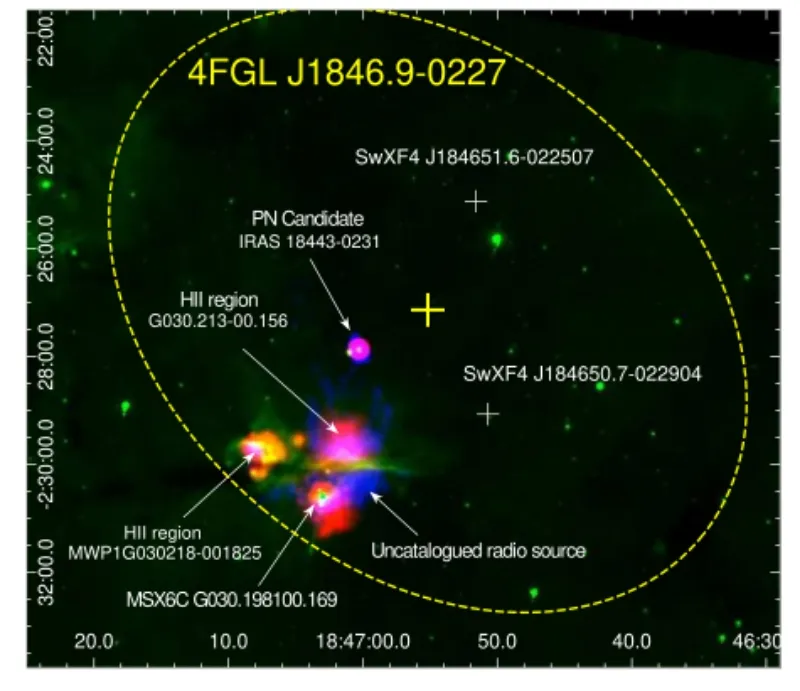
Most of the gamma-ray emission in the Fermi-LAT 14-yr catalog are sources associated with pulsars or blazars. However, many sources remain unidentified. After discarding several possibilities, a group of Argentine astronomers from IAFE (Instituto de Astronomía y Física del Espacio-UBA-CONICET) proposed for the first time that a nascent planetary nebula could be generating the observed emission from the source identified as 4FGL J1846.9-0227, located at 8.2 kpc (~25 thousand light-years).
A previous work on the same source suggested that the gamma rays were from a blazar; and another study associated them with a massive protostar, but neither was conclusive. Thus, the researchers conducted a multi-spectral study of the region using different catalogs and observations from various telescopes such as JVLA (Jansky Very Large Array), ALMA, XMM-Newton, Spitzer, etc.
The source is located in a complex region of the galactic plane that includes several candidate sources lying within the confidence zone (ellipse). After discarding a binary system, they focused on the source IRAS 18443-0231, previously cataloged as a protoplanetary nebula.
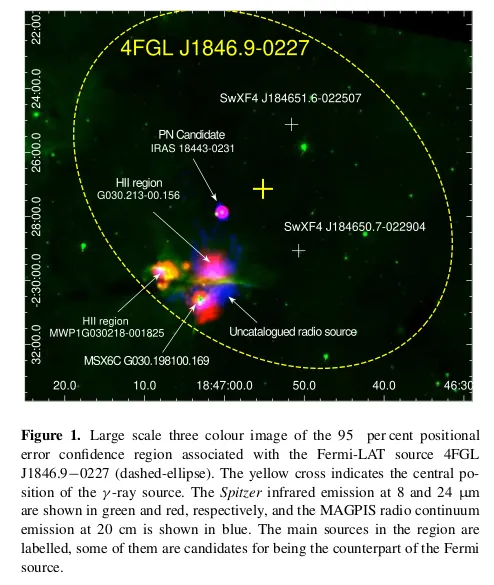
"Well, practically in the center of the ellipse indicating the position from where the radiation comes, only that object remained for us, initially cataloged as a planetary nebula," explained astronomer Sergio Parón, one of the co-authors of the work. And he added: "We studied it at different wavelengths, and we saw that in radio waves it showed there was particle acceleration. Finally we observed, upon completing the multi-spectral analysis, that it had jets of matter. And then we had no doubts," in statements to the site Nexciencia.
"It would be, therefore, the first report of an astrophysical object of this type related to the emission of the highest energy. To the number of sources that can produce gamma rays, we would be adding a new one, which are protoplanetary nebulae," concludes Petriella, another of the study's authors.
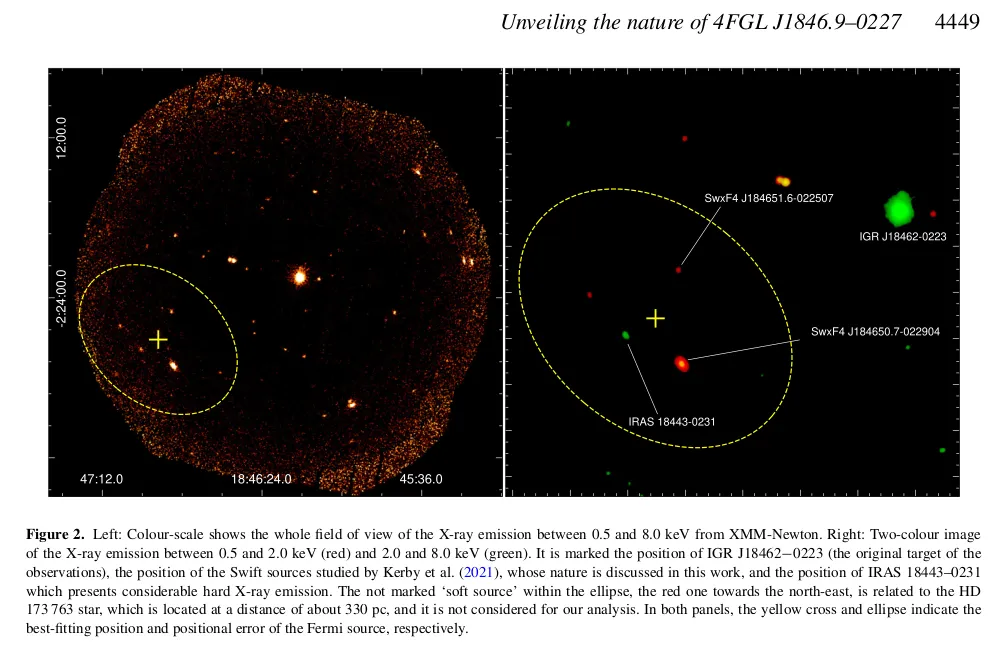
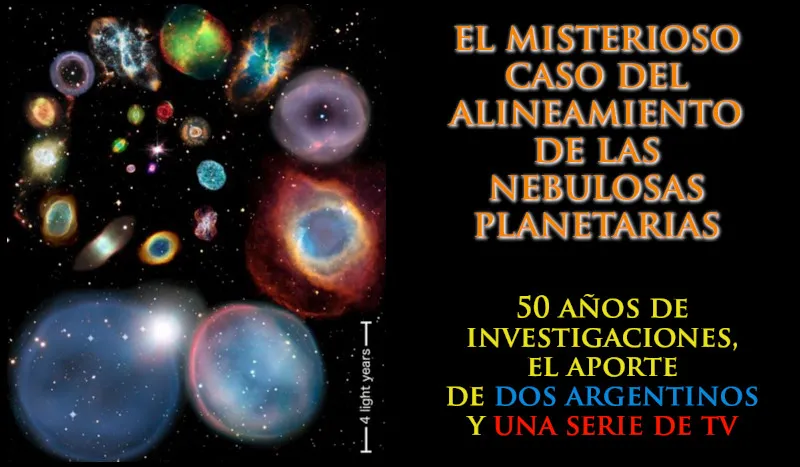
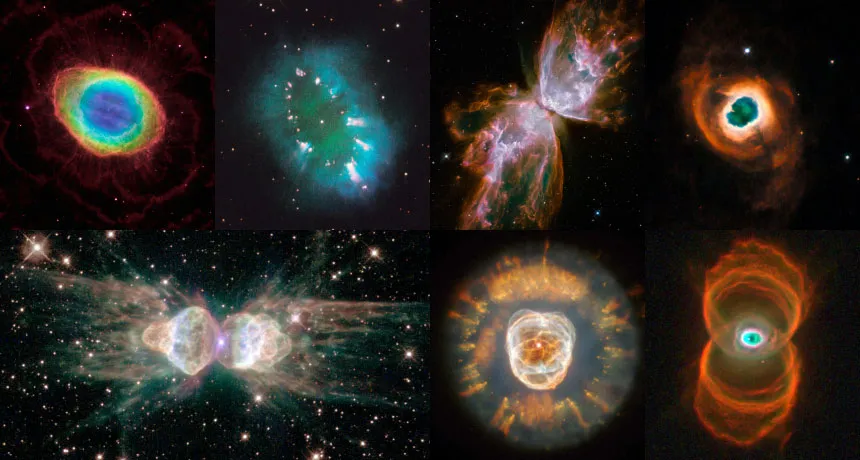
Protoplanetary nebulae are a phase prior to the planetary nebula (PNe). Planetary nebulae have no relation to planets, but the first observations of these objects, with instruments less sensitive than current ones, made astronomers think they were possible planets. In reality, a planetary nebula is a phase at the end of the cycle of a main sequence star with mass like that of our Sun. They are reflection nebulae that emit a significant amount of infrared radiation. It is the penultimate luminous phase in the life of a star with mass between 1 and 8 solar masses. In this case, it would be a special type of PNe known as "water masers". Water masers are stars that eject jets of material detected by a very intense type of maser emission radiation produced by water vapor molecules.
"What follows –adds Martín Ortega, first author of the paper– is, based on new multi-spectral observations, to understand what the gamma-ray production mechanisms are for this type of source. And also to review previous studies on these events, which are infrequent.☉
Sources and related links
First observational evidence of gamma-ray emission in a proto-planetary nebula https://blog.oup.com/2024/10/first-observational-evidence-of-gamma-ray-emission-in-a-proto-planetary-nebula/
A comprehensive analysis towards the Fermi-LAT source 4FGL J1846.9–0227: jets of a protoplanetary nebula producing γ-rays?
Monthly Notices of the Royal Astronomical Society, Volume 532, Issue 4, August 2024, Pages 4446–4462, M. E. Ortega, A. Petriella, S. Paron https://doi.org/10.1093/mnras/stae1697 https://academic.oup.com/mnras/article/532/4/4446/7710749?login=false https://arxiv.org/abs/2406.03219v1
A discovery in the nebula https://nexciencia.exactas.uba.ar/descubre-primera-evidencia-emision-rayos-gamma-nebulosa-protoplanetaria-sergio-paron-martin-ortega-alberto-petriella
About the images
Credit: M. E. Ortega, A. Petriella, S. Paron-IAFE.