New work on a subset of bipolar planetary nebulae. The story includes Argentines.
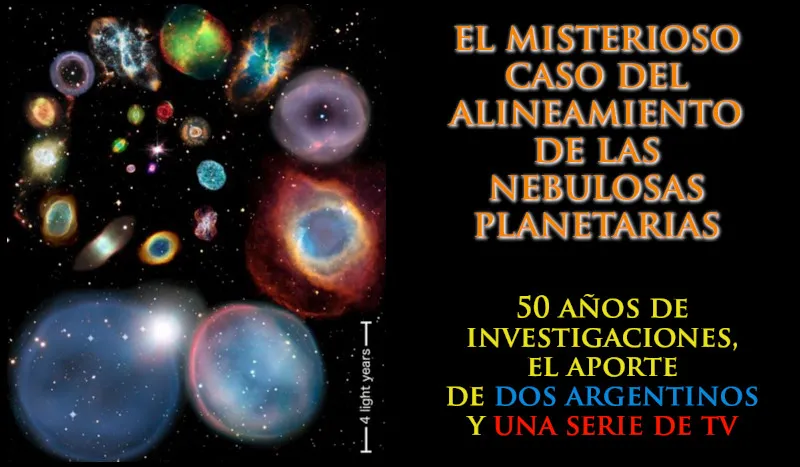
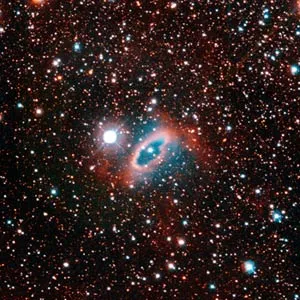
Planetary nebulae -despite their name- have nothing to do with planets. They are the remains of a star with a mass less than 8 suns. A star like our sun, when it runs out of hydrogen to fuse, will inflate as a red giant and expel its outer layers into space, leaving a core, a white dwarf, as a remnant. The expulsion of the outer layers, made of gas, is often symmetric, either in a semi-circular shape or in the shape of two circles (bipolar).
In 1968 two Russian astronomers (Grinin & Zvereva) claimed that planetary nebulae (the abbreviation in jargon is PNe) have a preferential alignment along the galactic plane. Almost thirty years later, Corradi and others, in 1997, did not find strong evidence of a non-random alignment. In 2008, Weidmann (OAC) and Díaz (CASLEO), two Argentines, published an analysis of a sample of 440 elongated PNe and found evidence of an alignment at ∼ 100◦.
In 2013, Rees & Zijlstra used Hubble and ESO's NTT to investigate 130 PNe within a 10-degree radius of the galactic center and discovered a similar alignment for bipolar nebulae.
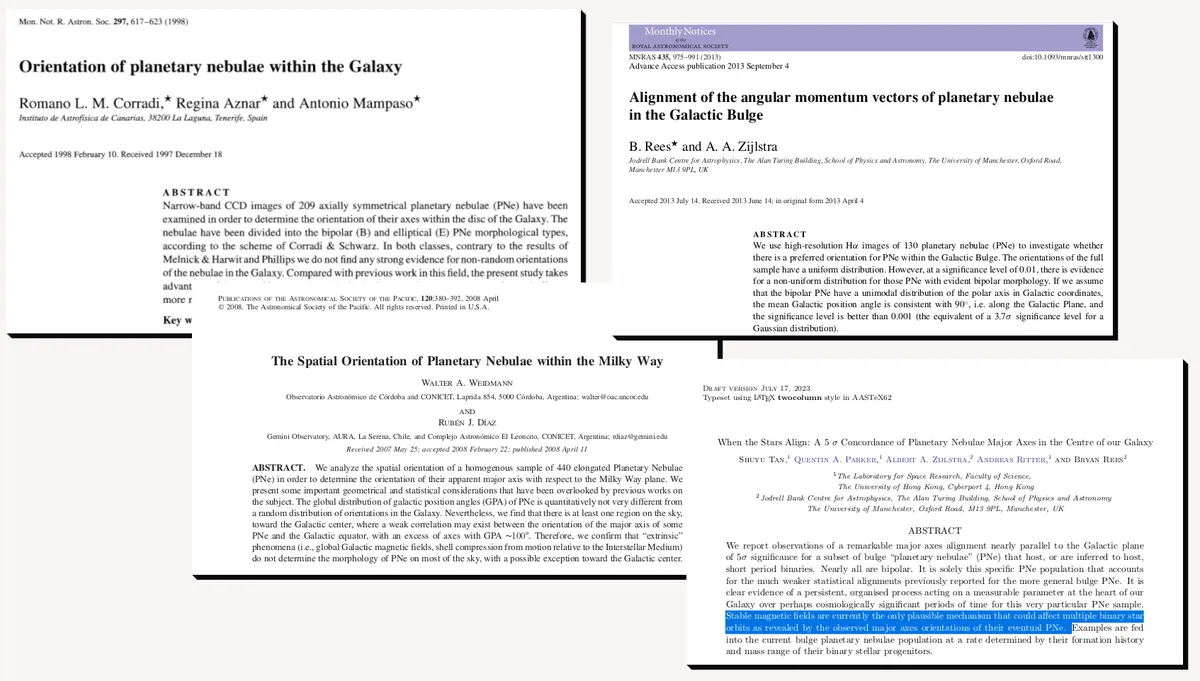
Up to this point, one hypothesis is that such alignment could be caused by some magnetic field. Several other works on the subject have been done, including simulations.
Now, Shuyu Tan, Zijlstra and others revisit the matter. They reexamined the 2013 sample, plus other observations, and analyzed what they call EPA (equatorial position angle) and GPA (galactic position angle). Their conclusion is that the alignment only occurs in a subset of PNe at whose center there are short-period binary systems, that is, two very close stars. They claim their conclusion has a confidence of 5 sigma.
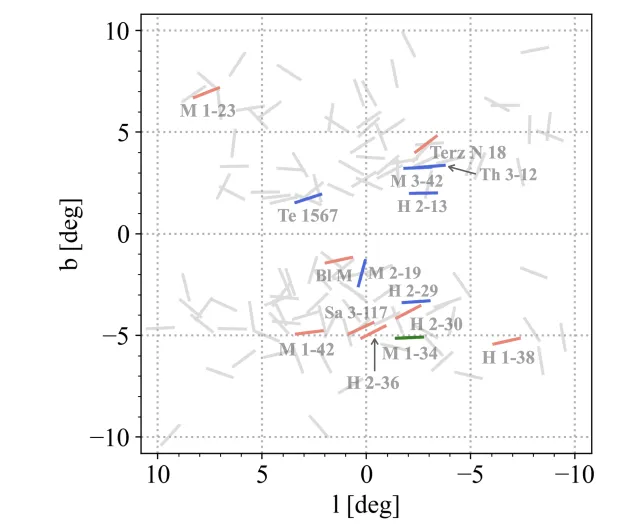
Here we see Fig. 2 of the recently published work. It is the distribution of the GPA bulge measured for the PNe sample. The gray symbols are for the general sample, while PNe with confirmed binary stars are blue vectors and those with high adfs (abundance discrepancy factors), which are considered a reliable proxy for hosting short-period binaries, are red. M 1-34, suspected of hosting a short-period binary, is with the green vector.
AS SEEN ON TV
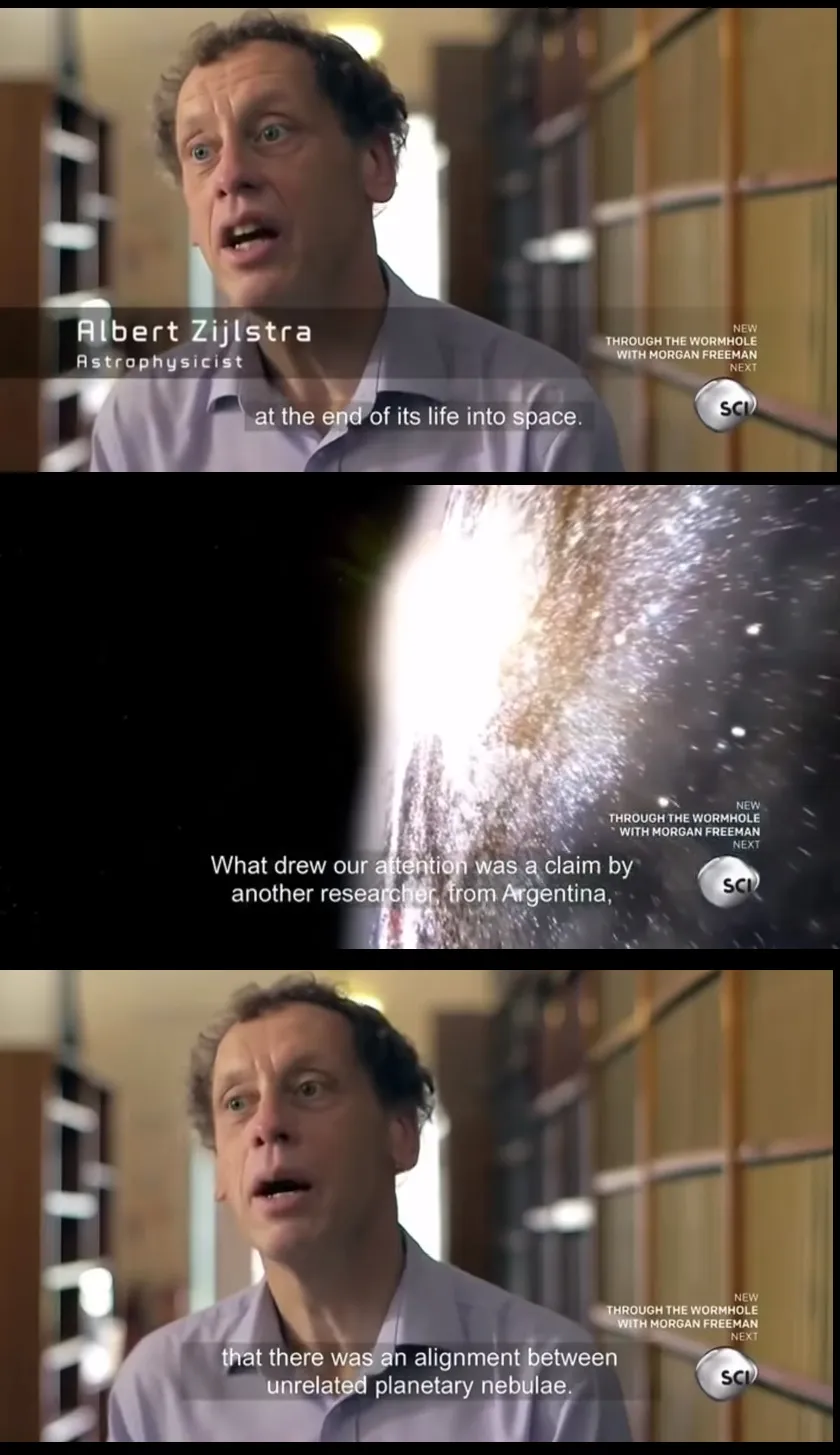
I learned about the case of planetary nebulae several years ago through a TV program, which they re-air from time to time. It is a series originally titled "NASA's Unexplained Files". In episode S02E06, called "Nazis on the Moon", at the end, they interview A. Zijlstra, who says his attention was caught by research done by a colleague from Argentina. For this occasion I was looking for information about that episode and found it on Youtube (link, below). Here I show some screenshots from that part.
In this regard, it occurred to me that there should be some work on "the most significant Argentine research in astronomy". It occurs to me that it should include the work by F. Mirabel on microquasars; G. Dubner on SNR; G. Romero on millisecond pulsars; Sérsic, Navarro, Maldacena, Zaldarriaga... Of course, it would be endlessly debatable what is meant by "significance". In this case, at least it was on TV. Does that count? As for whether this case of bipolar PNe is significant, sometimes I think euphorically that it is, and other times I think it is not and I get depressed.☉
Sources and related links
- When the Stars Align: A 5 σ Concordance of Planetary Nebulae Major Axes in the Centre of our Galaxy
https://arxiv.org/abs/2307.07140 - When the stars align: Astronomers find answers to mysterious action of ghost stars in our Galaxy
https://www.eurekalert.org/news-releases/995353 - The Spatial Orientation of Planetary Nebulae within the Milky Way
Walter A. Weidmann and Rubén J. Díaz 2008 PASP 120 380
DOI 10.1086/587788
https://iopscience.iop.org/article/10.1086/587788/meta
https://arxiv.org/abs/astro-ph/0505092 - Alignment of the angular momentum vectors of planetary nebulae in the Galactic Bulge
B. Rees, A. A. Zijlstra
Monthly Notices of the Royal Astronomical Society, Volume 435, Issue 2, 21 October 2013, Pages 975–991, https://doi.org/10.1093/mnras/stt1300
https://academic.oup.com/mnras/article/435/2/975/1032839 - Orientation in space of planetary nebulas
Astrophysics, Volume 4, Issue 1, pp.43-44
March 1968
https://ui.adsabs.harvard.edu/abs/1968Ap......4...43G/abstract - D. Falceta-Gonçalves , H. Monteiro, On the alignment of PNe and local magnetic field at the Galactic centre
MNRAS, Volume 438, Issue 4, 11 March 2014, Pages 2853–2863,
https://doi.org/10.1093/mnras/stt2393 - NASA's Unexplained Files S02E06 Nazis on the Moon
https://www.youtube.com/watch?v=j1KgThVGYEk - Nazis on the Moon
https://www.imdb.com/title/tt4711868/?ref_=ttep_ep6 - Orientation of planetary nebulae within the Galaxy
Authors: Corradi, R. L. M., Aznar, R., & Mampaso, A.
Journal: Monthly Notices of the Royal Astronomical Society, Volume 297, Issue 2, pp. 617-623.
https://articles.adsabs.harvard.edu/full/1998MNRAS.297..617C
About the images
ESA/Hubble and NASA, ESO, NOAO/AURA/NSF from an idea by the corresponding author and Ivan Bojičić and rendered by Ivan Bojičić with input from David Frew and the author.
Bizarre alignment of planetary nebulae https://esahubble.org/news/heic1316/
ESA/Hubble & NASA