The origin of the letter c to refer to the speed of light.
The Detective of Astronomical Names put his magnifying glass to search for the origin of the letter "c" to denote the speed of light in a vacuum, used in one of the most popular equations that relates energy and mass.
I will summarize here the concepts expressed in two works, carried out by Kenneth S. Mendelson and Philip Gibbs.
The first published an article in American Journal of Physics (2006) with the title "The story of c". Quickly, the author points out: "The symbol c was originally introduced by Wilhem Weber as a ratio of units of electric charge".
Gibbs, in a 1997 web article, gives a first short answer: He indicates that during the 19th century the most common symbol was the capital V, even used by Einstein in 1905. The origin of the letter c can be traced to a paper by Weber and Kohlrausch from 1856. They defined a quantity thus denoted to be used in an equation of electromagnetic force. It became Weber's constant and later it was shown that its value was the speed of light multiplied by the square root of 2. In 1894 Paul Drude modified the use of that constant so that it was the speed of "electrodynamic waves". Over the years, other authors (Max Planck, Hendrik Lorentz) began to use the same letter. Also Einstein.
But, why did Weber start using the letter c?
According to Asimov, in a short text titled "C for Celeritas," he indicates that it comes from that Latin word meaning "swiftness." That text is hard to find. It was published in different books, among them, "Of Time, Space, and Other Things." It is possible to find a text on the internet with the content (see below). That Asimov text only establishes a relationship with the Latin word, without indicating any bibliographic source or reason. The rest of the text is dedicated to explaining the units used in Einstein's famous equation.
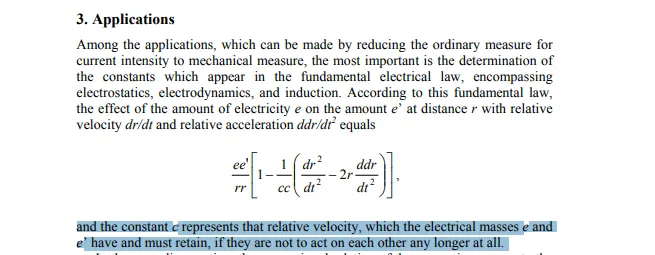
Gibbs, on the other hand, says that in the 1856 paper Weber's constant was introduced with these words (now translated into Spanish): "and the constant c represents the relative velocity that the electric masses e and e' must have and maintain if they do not affect each other."
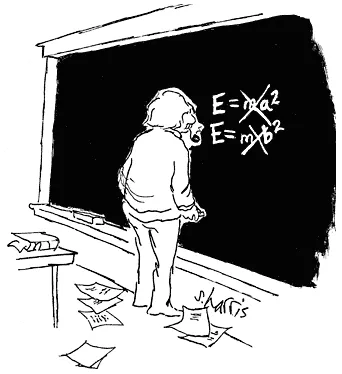
Mendelson takes this idea and points out that it is plausible, even though the word "constant" in contemporary German is "konstante," but the originals would say "constante." Weber does not indicate the reason why he uses the letter c. First, according to Mendelson, he used the letter a. Perhaps he didn't like using a or b and simply used the next letter of the alphabet. There is a humorous cartoon by Sidney Harris showing Einstein looking at a blackboard on which are written and crossed out two versions of his formula in which the letters a and b were used, respectively, instead of c. Perhaps, says Mendelson, something like that happened with Weber.
Gibbs points out that possibly Einstein followed the usage he noticed in other physicists of the time, who were no longer using the capital letter V. He also says that letter could be confused with the lowercase letter v.
SPEED AND VELOCITY
In light of what was said in the previous paragraph and because there is never a shortage of a very punctilious physics professor, it is worth making a clarification: in physics, one can distinguish between velocity and speed by considering that the former is a vector quantity and the latter, a scalar one. When studying uniform rectilinear motion, the difference is usually taught with examples where a vehicle goes in one direction and then another. For colloquial language, it is the same, we can use the two words as synonyms, but in academic settings, the distinction is important.
Maxwell, smart
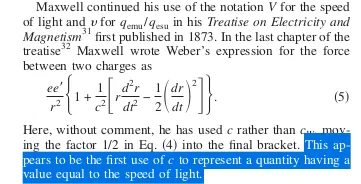
The intelligent James Clerk Maxwell developed his theory of the electromagnetic field in three papers between 1856-1865. First, he introduced the displacement current and predicted electromagnetic waves with a velocity in a vacuum equal to Weber's constant, which coincided with Fizeau's 1849 measurement. In those works, the Scot used the letter V. In contrast, in 1873, in his "Treatise on Electricity and Magnetism" he used c. That would be the first use of c for a quantity equivalent to the speed of light. For a time, the letter V and others continued to be used, and a distinction was made between the speed of light and the speed of electromagnetic waves.
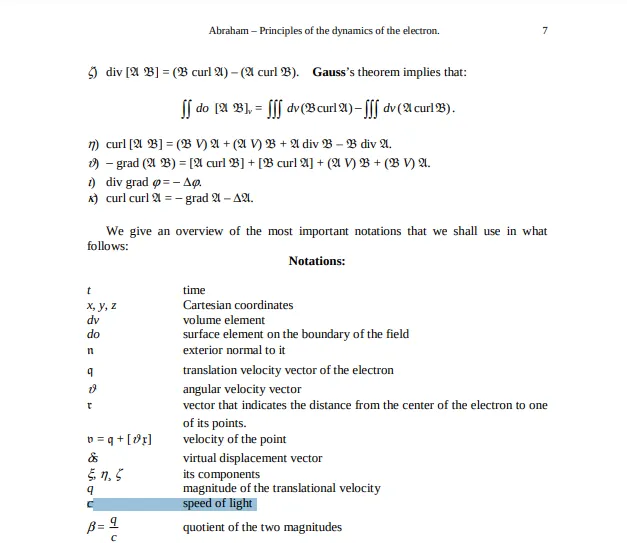
Mendelson says at the end that the earliest use of c specifically for the speed of light that he found was a paper by Abraham from 1903. It is hard to find:
CONCLUSION
Since the authors who used these symbols did not explain their reasons and because telepathy does not exist, it is difficult to establish a specific reason why Weber used the letter c. Nor is it clear why from the beginning of the 20th century that letter became established, instead of other symbols. It is evident that the acceptance that light is an electromagnetic wave must have influenced it. The use of that symbol to refer to the speed of light by important physicists, influenced by earlier ones, paved the way for the tradition.
According to the usage of some in Argentina and on some websites, if you liked this post, you can exclaim: Yeeeah!☉
Sources and related links
- Why is c the symbol for the speed of light?
https://math.ucr.edu/home/baez/physics/Relativity/SpeedOfLight/c.html - The story of c
Kenneth S. Mendelson
Am. J. Phys. 74, 995–997 (2006)
https://doi.org/10.1119/1.2238887
https://pubs.aip.org/aapt/ajp/article-abstract/74/11/995/864528/The-story-of-c - S. Harris Einstein Cartoons
http://www.sciencecartoonsplus.com/gallery/einstein/galeinsteinb.php
R. Kohlrausch and W.E. Weber, "Ueber die Elektrizitätsmenge, welche bei galvanischen Strömen durch den Querschnitt der Kette fliesst", Annalen der Physik, 99, pg. 10 (1856)
Isaac Asimov "C for Celeritas" published in "The Magazine of Fantasy and Science Fiction", Nov-59 (1959), reprinted in "Of Time, Space, and Other Things", Discus (1975), and also in "Asimov On Physics", Doubleday (1976)
Of Time, Space, and Other Things - Page 14/18 https://allnovel.net/of-time-space-and-other-things/page-14.html
Kohlrausch, R. and Weber, W. (1857) On the Amount of Electricity which Flows through the Cross-Section of the Circuit in Galvanic Currents.
Principles of the dynamics of electrons
Max Abraham https://www.neo-classical-physics.info/uploads/3/4/3/6/34363841/abraham_-_dynamics_of_electrons.pdf
Max Abraham Prinzipien der Dynamik des Electrons, Ann. D. Phys. 10 (4) 105-179 (1902) (received 23 October 1902, published in issue No. 1 of 30 December 1902) as cited in Mehra, Volume 1, Part 2, 2001, p. 730.
https://doi.org/10.1002/andp.19023150105
Seee https://es.wiktionary.org/wiki/Ap%C3%A9ndice:Jerga_de_Internet#:~:text=Seee!
About the images
Credit: S.Harris; K.Mendelson