Velocity, acceleration...and something more?
I allow myself to scare the reader: in mathematics (booo!), derivatives and integrals, used in calculus, are very useful and difficult. People get frightened just by mentioning them. You say "derivatives" and that leads to people running away scared.
But, if you managed to overcome the fear, then perhaps you already know what the derivative of a variable is: it is said to be the rate of change of a variable, in time and/or in space.
Let's say the position of an object is x and at a certain moment (time) it will then be x(t), which we can read as "the position of x at time t", where x and t are two numbers that refer to space and time, respectively; then after some change in space and time, we will have another position x+something (t+something). Or, using another notation, at a first moment it will be x1(t1) and then x2(t2). If there is a difference between one position and another, then the object moved at a certain speed. The rate of change in the position of an object is the velocity. The rate of change is called a "derivative", therefore the FIRST derivative of position is velocity. How it is calculated is another story. I will not talk here about the secant line and the tangent line.
The change in position could be at constant velocity. However, there could be a change in velocity. That is, the velocity (which we said is the rate of change in position) can also change and increase or decrease. We will then have a rate of change of a rate of change. In such a case, we will have the SECOND derivative of position, or first derivative of velocity: acceleration.
Is there a third derivative of position? Or, what is the same: is there a derivative of acceleration?
Short answer: Yes, there are third, fourth, fifth derivatives.
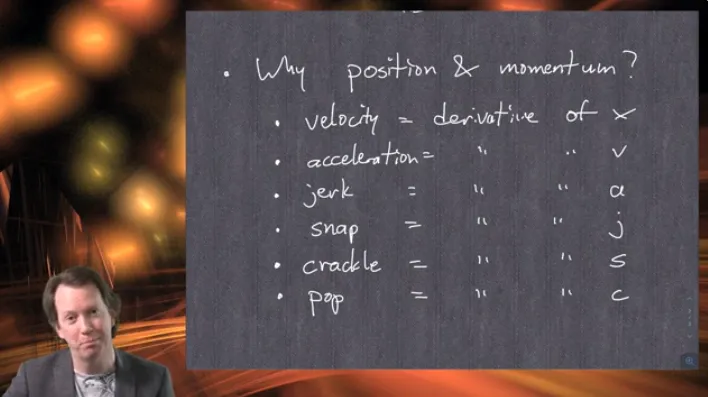
Physicist Sean Carroll has a blog and a YouTube channel. During the pandemic he published a series of videos on "The Biggest Ideas in the Universe". Within that series he talked about the topic and listed the different derivatives:
Third derivative: jerk
Fourth derivative: snap or jounce
Fifth derivative: crackle
Sixth derivative: pop
AND WHAT IS ALL THIS REALLY
Upon seeing that video, I remembered having read something about the matter, something I didn't pay much attention to, although it was striking: The Norton dome. Do you know what I'm referring to? It's long to explain, but I'll be concise:
A certain Norton published some time ago something difficult to understand: using only classical (Newtonian, deterministic) physics, he demonstrated that an object like a small ball, at the top of a dome, with position x, at rest, WITH NO VELOCITY OR ACCELERATION, without force or impulse or wind, at a given moment, moves and falls down the slope of the dome. The explanation, almost of black magic, lies in the fact that according to the calculations, the first and second derivatives are zero, which is expected. But the fourth derivative is not. So the key in the explanation is the snap. I leave the specific explanation through a link, below. In any case, it is more of a thought experiment than something with concrete application. So it doesn't help me much to understand the matter.
SIR, DON'T SELL ME SMOKE, GIVE ME A CONCRETE EXAMPLE RIGHT NOW OR I'LL CALL A LAWYER
I found a work on the matter that helped me understand. It is a paper by David Eaguer and others, which I will use here as a guide.
Let's think the following. Velocity does not occur suddenly, but grows from zero, so there must be a jerk involved. But that jerk does not occur suddenly, but grows from zero. So there must be another jerk (snap) involved, and so on.
Most human body motion situations are designed to minimize biomechanical effects on us, like taking a plane, a ship. But in some cases it is rather the opposite (to a certain extent), for example: roller coasters.
The authors use a couple of phrases to account for these terms in informal language, in English: ‘She jerked the phone out of his hands’; 'The carriages jerked and jolted along as the train moved forward'. In Spanish: "She snatched the phone from his hands"; "The carriages jerked and jolted as the train moved forward".
In a car, an experienced driver will accelerate gradually, while a novice will have a "jerky" driving. Changing gears with a manual clutch can cause the car to shake on the road, causing jerks and snaps. In physics, jerk and snap should always be considered when vibrations occur and particularly when this excitation induces several vibration modes. They should be considered whenever a transition occurs like starting and finishing, taking off and descending, accelerating and decelerating.
Roller coasters involve transitions between different types of motion. If the radius of curvature in a transition changes abruptly, it generates a sudden change in acceleration, a jerk. As an example, we consider a hypothetical circular loop that changes abruptly to a straight segment, which would imply changing from at least 5g to perhaps 1g at the end, in a short time. Jerk and snap can have negative effects on the human body, as well as on the structure of material objects.
Jerk is common in everyday experience, although we rarely realize it and it is hardly taught in mechanics. However, minimizing jerk is an important consideration for smooth driving of transports or the comfortable and stable design of roller coasters. Human tolerance and comfort has been measured and is well known. But tolerance to jerk and snap is not as well known.
It is more difficult to find examples of crackle and pop. On a known "forum", Reddit, a user gives the following explanations (translation via):
Snap is accelerating the acceleration, that is, pressing the car pedal so that the acceleration increases constantly. This makes the car go faster at an acceleration rate. The jerk, as we call it, is zero when the foot is firm at its new acceleration point and quickly becomes negative as the car begins to gain speed.
The crackle, or jerk, comes into play if you step on the pedal slowly at first and then more forcefully (assuming everything else stays constant and this happens relatively quickly), meaning that the acceleration increases at an ever-increasing rate. You are stepping on it at an ever-increasing rate.
The pop would be the crackle on a hill. You are accelerating because you are on a hill, plus you are stepping on the pedal to increase your acceleration (snap), plus you are stepping on the pedal with increasing force (increasing the rate at which your acceleration increases).
That same post adds other derivatives not mentioned in other sources, such as lock and drop.
ORIGIN OF THE NAMES
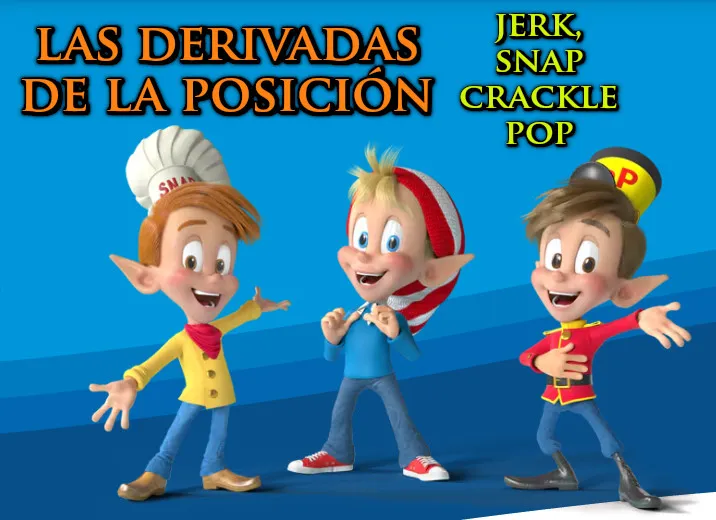
According to Wikipedia: Snap, Crackle and Pop are the cartoon mascots of Rice Krispies, a breakfast cereal brand marketed by Kellogg's and its successor companies.

IS THE RATE OF CHANGE OF THE RATE OF CHANGE AN INFINITE PHENOMENON?
If we accept that for every variable there can or indeed often is a rate of change, and if such a rate of change can also be considered a variable, don't we enter an infinite loop? Can there be some limit to this, or is it possible to think of infinite derivatives of position with respect to time?
I haven't tried to look for a bibliographic reference on this, but just by logic and factual experience I would say yes: if there is some limit like the Planck scale, there should also be a limit to this. On the other hand, our organs do not have infinite sensitivity, and scientific instruments and procedures also do not have unlimited precision.
Something, however, works against this reasoning: it's enough to go to a supermarket and see infinite shelves, like Hilbert's shelves, full of cereal: if it depends on that, one would have to study the relationship between position and milk. Perhaps it helps astronomers better understand the Milky Way.☉
Sources and related links
- Beyond velocity and acceleration: jerk, snap and higher derivatives
David Eager et al 2016 Eur. J. Phys. 37 065008
DOI 10.1088/0143-0807/37/6/065008
https://iopscience.iop.org/article/10.1088/0143-0807/37/6/065008 - Newtonian physics IS deterministic (sorry Norton)
https://blog.gruffdavies.com/2017/12/24/newtonian-physics-is-deterministic-sorry-norton/ - Snap, Crackle, and Pop
https://web.archive.org/web/20180626030437/https://info.aiaa.org/Regions/Western/Orange_County/Newsletters/Presentations%20Posted%20by%20Enrique%20P.%20Castro/AIAAOC_SnapCracklePop_docx.pdf
What practical roles do the 4th, 5th, 6th, 7th, and 8th derivative of displacement have? (snap, crackle, pop, lock, and drop)
Cosmic Jerk, Snap and Beyond
Maciej Dunajski, Gary Gibbons https://arxiv.org/abs/0807.0207
About the images
Credit: Rice Krispies https://www.ricekrispies.com/en_US/our-story.html
The Biggest Ideas in the Universe | 3. Force, Energy, and Action https://www.youtube.com/watch?v=sZb64bZ07aE&t=676s&ab_channel=SeanCarroll