The imagination (of astronomers) to power.
I learn from the AAS Nova page about a new paper titled "X-Ray Studies of the Pulsar PSR J1420–6048 and Its TeV Pulsar Wind Nebula in the Kookaburra Region". My brain reads and stops at the word "Kookaburra".
A simple web search informs me that it is a bird from Australia. By extension, also the Australian men's hockey team. And also: an airplane, a laptop, a song by Cocteau Twins. According to Wikipedia: "Kookaburras are best known for their call, which is surprisingly similar to human laughter." Look at that. Please: don't search for kookaburra videos on Youtube...
And what does this have to do with radio astronomy?
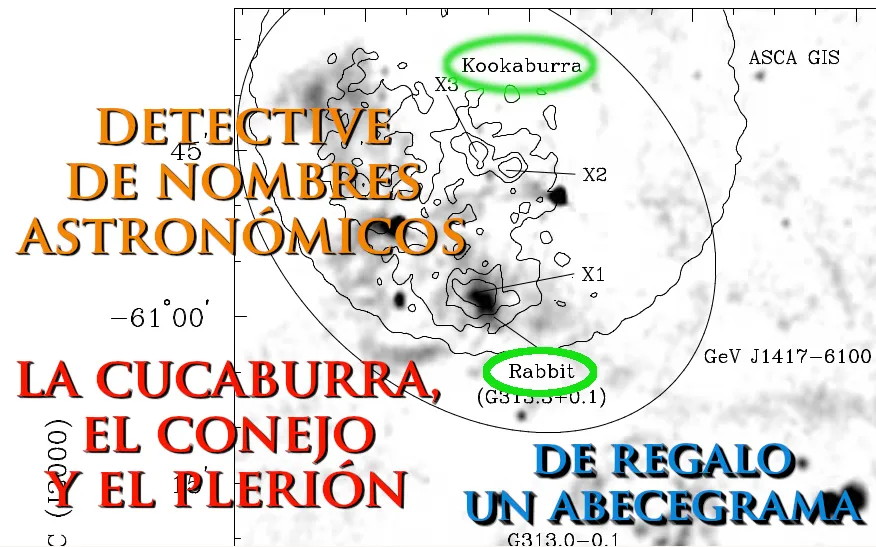
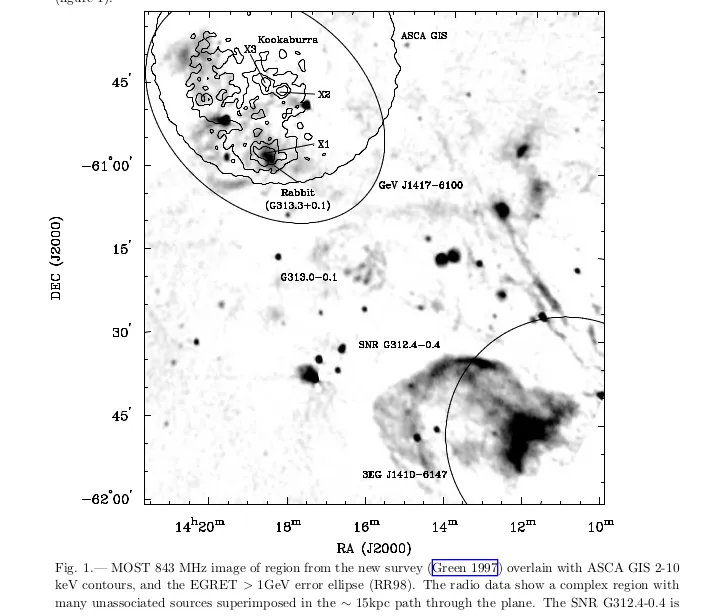
According to the aforementioned paper, it is a region, nicknamed that way by a previous work by Mallory Roberts and others (1999). I search for that paper and find what I was looking for and something else.
The astronomers were studying the region around an unknown gamma-ray source: J1417-6100. They did it with the ATCA radio telescope (Australia Telescope Compact Array), at 13 and 20 cm. What they find is a semi-spherical "structure" with "wings" to the north and south, which according to the authors, reminded them of a fat bird ("overweight bird") and since they were Australian they thought of naming the zone after the aforementioned bird.
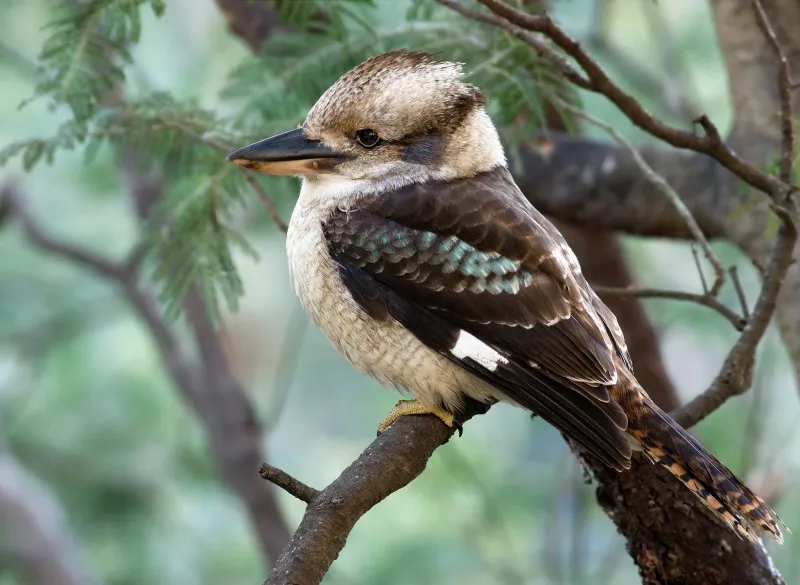
A photo of the bird? Here you go:
AND THE RABBIT?
In the same paper they believe they find, in the lower part of the region, another structure which they nicknamed "The rabbit" which would be a counterpart of the source being investigated. Photo of rabbit? Better not.
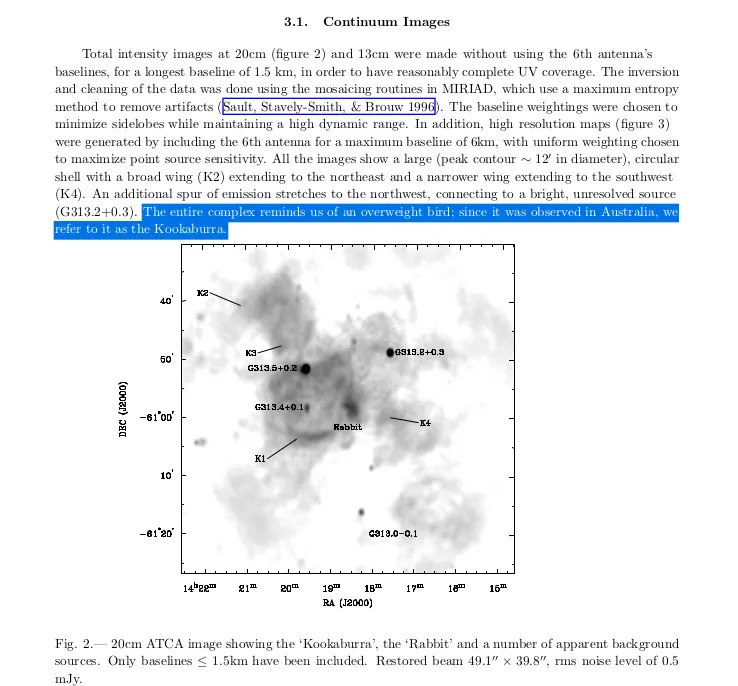
In the images of the paper these graphics appear: the zones marked as K2 and K4 would be the "wings" of the kookaburra. The dark source in the lower part would be "The rabbit". The imagination of these people has no limits. Amazing! The Rorschach test, at the level of a bean...
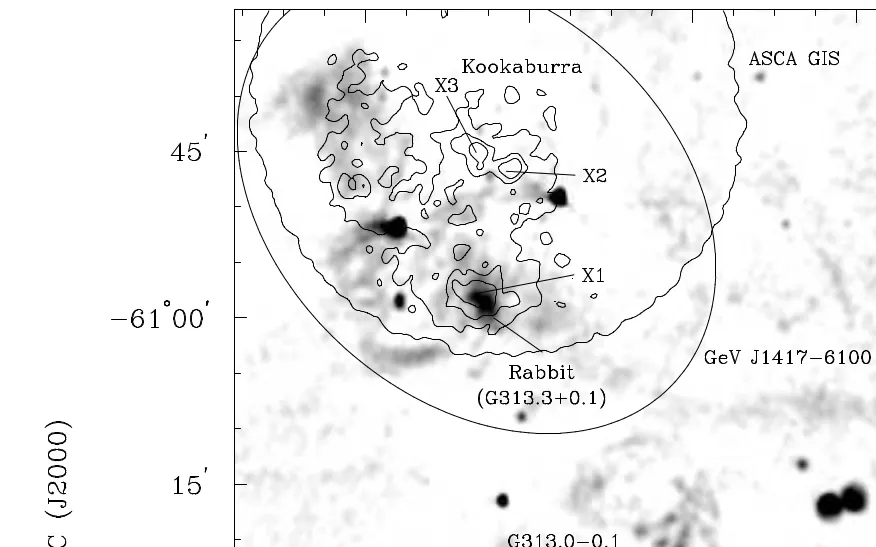
In the conclusions they indicate that the most likely thing is that the "rabbit" is a wind nebula surrounding a quiet gamma-ray pulsar. But lo and behold, they include the following phrase: "and its radio properties are consistent with it being a pulsar powered plerion, with the most likely location of the pulsar being near P1." [the bold is mine]
And what the heck is a plerion?
Wikipedia to the rescue: A plerion or pulsar wind nebula (Pulsar Wind Nebula in English, PWN), is a supernova remnant powered by the rotational energy of a pulsar. Good to know for playing scrabble or crosswords.
ASTRONOMICAL NAME DETECTIVE
Ahhh... how satisfying it is to be an astronomical name detective. I should print a card with that title. On other occasions I got into following the clues of those strange new names in astronomy. For example, when I talked about the molecular clouds of the Milky Way, in "Living in the nebula".
On another occasion, in the post "Good grief: Supernova forecasts" when I explained the origin of the name GADZOOKS! given by physicists from the Super-Kamiokande experiment. They are Cherenkov detectors for anti-neutrinos. And they were given that name for very nerdy reasons. Links, below.
AS A BONUS
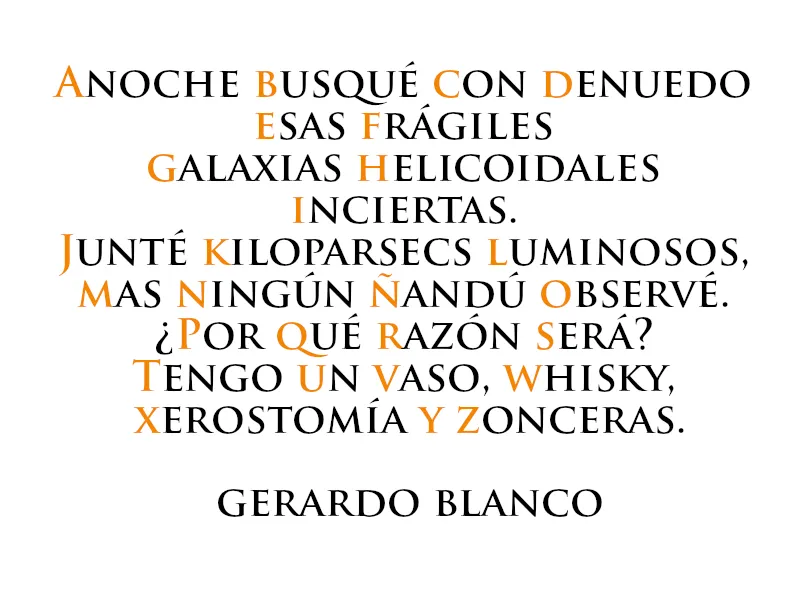
They say everything is connected. Suppose so. So here I leave as a gift for subscribers this astronomical abecedarian poem of my own creation. It's useless, but try to see if you are capable of inventing one and then claim it.
Abecedarian poem: Spiral galaxies
Last night I searched with zeal those fragile uncertain spiral galaxies. I gathered luminous kiloparsecs, yet no rhea I observed. For what reason will it be? I have a glass, whiskey, xerostomia and nonsense.
Conclusion: There is the objective sky and the subjective sky. The first surrounds us, the second is in the brain.☉
Sources and related links
- X-ray Studies of the Pulsar PSR J1420–6048 and Its TeV Pulsar Wind Nebula in the Kookaburra Region
Jaegeun Park et al 2023 ApJ 945 33
https://iopscience.iop.org/article/10.3847/1538-4357/acb1b0#new_tab - The `Rabbit': A Potential Radio Counterpart of GeV J1417-6100
Mallory S.E. Roberts, Roger W. Romani, Simon Johnston, Anne J. Green
The Astrophysical Journal, Volume 515, Issue 2, pp. 712-720.
https://arxiv.org/abs/astro-ph/9811113 - Living in the nebula
https://www.noticiasdelcosmos.com/2020/08/vivir-en-la-nebulosa.html - Good grief: Supernova forecasts
https://www.noticiasdelcosmos.com/2022/03/recorcholis-pronosticos-de-supernovas.html
About the images
By JJ Harrison (https://www.jjharrison.com.au/) - Own work, CC BY-SA 3.0, https://commons.wikimedia.org/w/index.php?curid=10708260
Graphics from Roberts et al (1999).