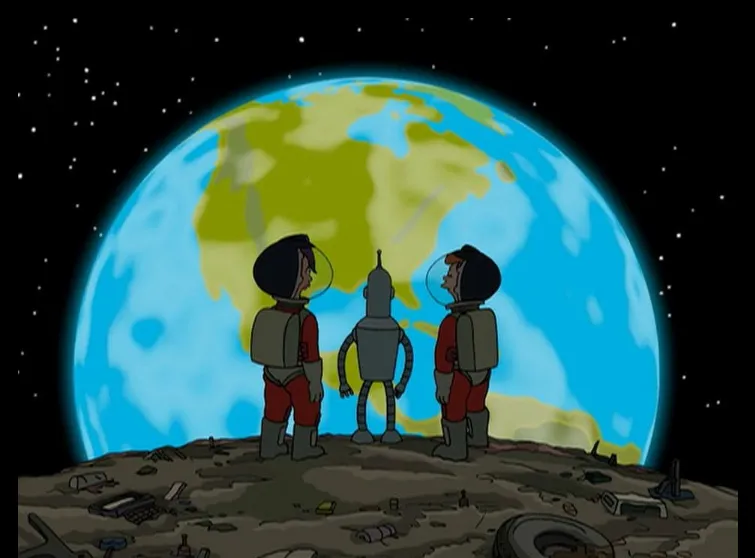
"A big piece of garbage", as Futurama would say.
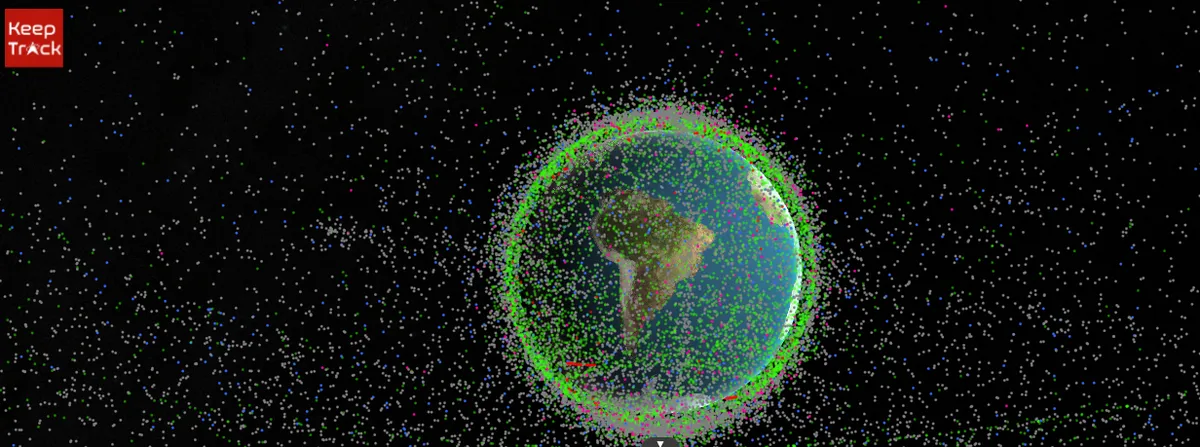
Last week I read on Microsiervos about an application called KeepTrack that allows you to visualize artificial satellites, both those that are working and those that already make up "space junk". I also read on Daniel Martin about the fragmentation of a satellite. We have talked here about the topic of space junk on other occasions (see below).
Then two interdiscursive, very nerdy references occurred to me, which I would like to share:
1-Futurama: "A big piece of garbage": in Spanish it would be "Un enorme montón de basura". I'm referring to episode 8 of the first season of the famous series. Thanks to Professor Fansworth's "Smell-O-Scope" they discover that a huge ball of garbage will impact Earth. It had been generated in the 20th Century and then they expelled it into space with a rocket. It's a joke, but also a metaphor for something that really happens.
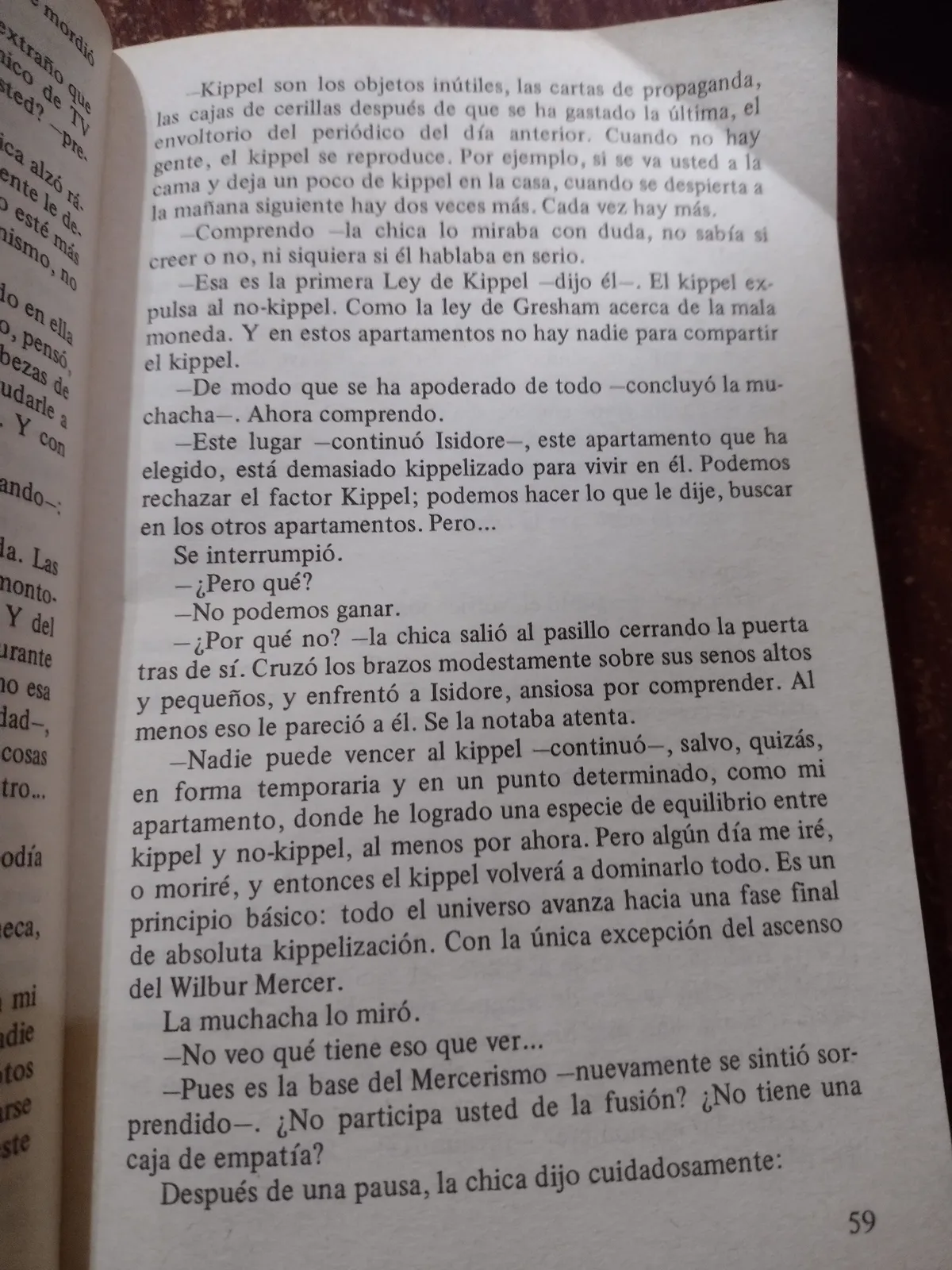
2-Bladerunner: actually, "Do Androids Dream of Electric Sheep?, by Philip Dick". At the beginning of the novel the word "Kippel" is mentioned without explaining its meaning. I think when I read the work, a thousand years ago, I thought it was a brand name (although it's not written with a capital letter) or some form of exotic food. But a few pages later, it is explained: here I put an image of the page in question and transcribe that small portion of text:
"Kippel is useless objects, junk mail, matchboxes after the last one is used up, the wrapper from the previous day's newspaper. When there are no people, kippel reproduces. For example, if you go to bed and leave a little kippel in the house, when you wake up the next morning there is twice as much. There is more and more all the time."
"I understand," the girl looked at him with doubt, not knowing whether to believe him or not, not even if he was serious.
"That is the first Law of Kippel," he said. "Kippel drives out non-kippel. Like Gresham's law about bad money. And in these apartments there is no one to share the kippel.
"So it has taken over everything," concluded the girl. "Now I understand.
"This place," Isidore continued, "this apartment you have chosen, is too kippelized to live in. We can reject the Kippel factor; we can do what I told you, search in the other apartments. But…
He interrupted himself.
"But what?
"We can't win.
"Why not?" the girl went out into the hallway closing the door behind her. She crossed her arms modestly over her high, small breasts, and faced Isidore, anxious to understand. At least that's how it seemed to him. She seemed attentive.""No one can defeat kippel," he continued, "except, perhaps, temporarily and at a specific point, like my apartment, where I have achieved a kind of equilibrium between kippel and non-kippel, at least for now. But someday I will leave, or die, and then kippel will dominate everything again. It's a basic principle: the entire universe is advancing toward a final phase of absolute kippelization."
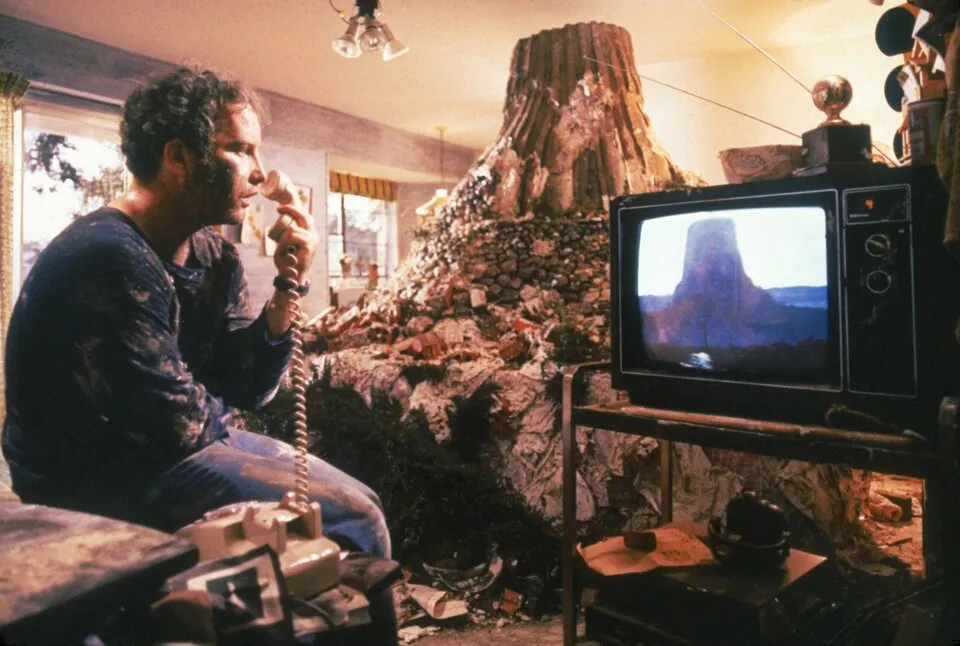
The character of Isidore in the novel has his later resonance in J. F. Sebastian in Ridley Scott's film.
Thus, it is possible to think that we are kippelizing the universe. If other intelligent beings did the same, and all the junk someday came together, it could compose a planet or asteroid of junk, perhaps like B-612 or asteroid 46610, which for the case is the same. It is also worth saying that the universe is so extraordinarily large that all the junk in human history would occupy very little space in the cosmos.
But if this kippel is close enough, it reflects detectable light. A fisherman could pull from the water, not a fish, but a shoe, in a polluted river. In an analogous way, the astronomers of the future will shout Eureka, thinking they have found an extraterrestrial ship, when in reality, what they will have detected is a 1978 Simon game repeating a sequence of sounds and colors: red-green-yellow-blue-blue/da-do-di-du-doo...while someone feels the compulsive need to create a mountain of junk, holy crap!☉
Sources and related links
- Futurama - A Huge Pile of Garbage (CASTELLANO)
https://www.youtube.com/watch?app=desktop&v=NrBcvNaFbmM - KeepTrack: a 3D application for satellite tracking, learning and also open source
https://www.microsiervos.com/archivo/espacio/keeptrack-aplicacion-3d-seguimiento-satelites-aprender-codigo-libre.html - KeepTrack
https://app.keeptrack.space/ - Space junk: the problem in images
https://www.noticiasdelcosmos.com/2008/04/desechos-espaciales-el-problema-en.html - New images about space junk
https://www.noticiasdelcosmos.com/2009/09/nuevas-imagenes-sobre-basura-espacial.html - The fragmentation of the American satellite Intelsat 33e and the problems of space junk in geostationary orbit
https://danielmarin.naukas.com/2024/10/24/la-fragmentacion-del-satelite-estadounidense-intelsat-33e-y-los-problemas-de-basura-espacial-en-la-orbita-geoestacionaria/ - A telecommunications satellite manufactured by Boeing explodes in geostationary orbit
https://www.microsiervos.com/archivo/espacio/explota-satelite-telecomunicaciones-fabricado-boeing.html
About the images
KeepTrack and screenshots.