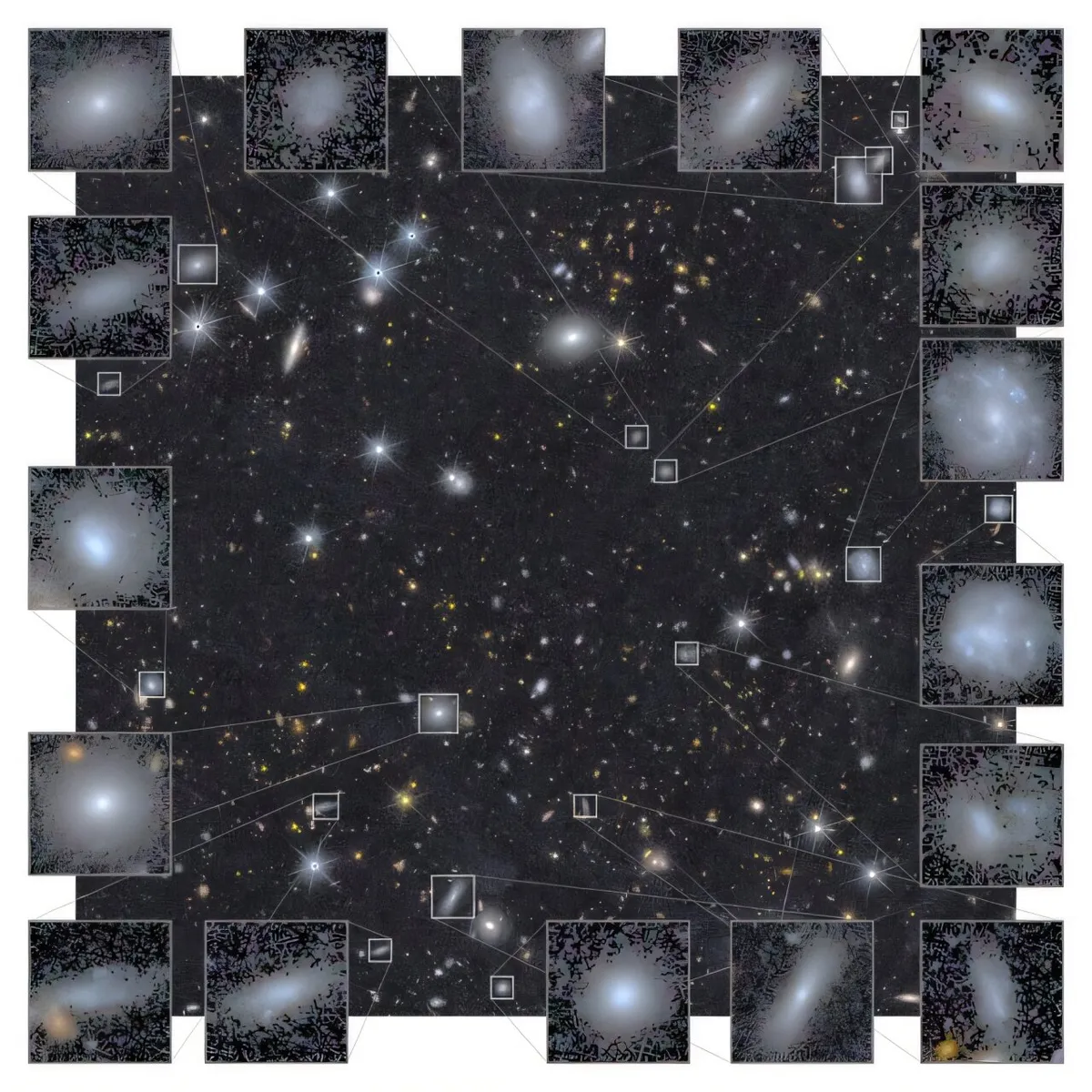
More than 2600 were found in 14 square degrees of the sky.
The European Space Agency's Euclid space telescope has been very valuable to astronomers in the last two years. It was launched on July 1, 2023. With its help, researchers are assembling a very precise map of the cosmos.
Now, Francine Marleau and her team at the University of Innsbruck discovered 2674 dwarf galaxies. Using a semi-automatic method, the astronomers identified candidates and analyzed and described the galaxies in detail.
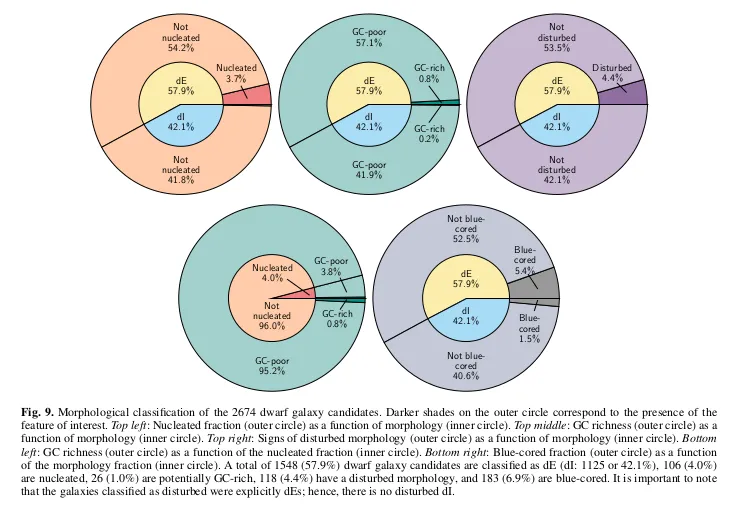
"Of the identified galaxies, 58% are elliptical, 42% are irregular and a handful are rich in globular clusters (1%), galactic nuclei (4%) and a notable fraction of dwarfs with compact blue centers (6.9%)," commented a team member.
The work was submitted to A&A to be published in a special issue. In its 27 pages, the report provides information on the morphology, distance, stellar mass and environment of the dwarf galaxies.
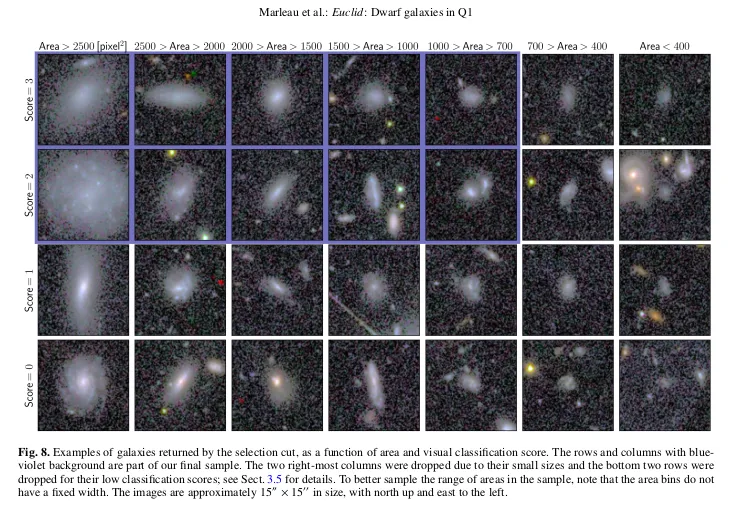
Dwarf galaxies are small and of low luminosity, with stellar masses less than 10⁹ Solar Masses. The Large Magellanic Cloud, with 2.7 x 10⁹ M☉ is at the limit of that regime. Dwarfs are the most abundant of galaxies and are thought in the hierarchical model to be the "building blocks" in galactic formation. They are distinguished from other low-mass objects, such as star clusters, by their larger radius and, more importantly, their dark matter content. Dwarf galaxies are classified according to their morphology: irregulars and compact blue ones, where the greatest difference is the star formation rate. The earliest galaxies, which have already stopped forming stars, are spheroidal, elliptical, ultra-diffuse, ultra-compact and ultra-faint.
The team of astrophysicists used the Jafar tool in their identification work. As a result, they found 2674 dwarfs in 25 mosaics from the source catalog -Euclid Quick Release (Q1)- covering 14.25 square degrees, which translates to 188 dwarfs per square degree.
Among the conclusions, the contribution of instruments as good as Euclid for the collection of astronomical data and the importance of conducting a census of dwarf galaxies to study their morphology and their role in galactic evolution stand out.
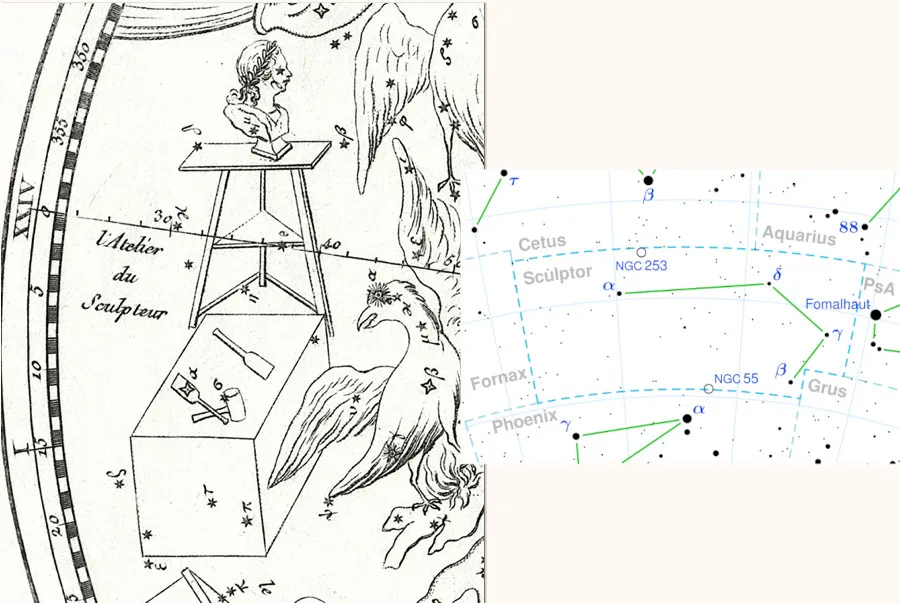
According to ESA, the Sculptor dwarf galaxy, the sculptor -a small constellation in the southern skies- was the first dwarf galaxy discovered, in 1937 by Harlow Shapley. It is located almost 300 thousand light-years away. The constellation Sculptor was named by Lacaille and he described it thus, according to Ian Ridpath: "It consisted of a carved head on a three-legged table, with the artist's mallet and a chisel on a block of marble beside it (although his illustration actually showed two chisels)." It is evident that Nicolas Louis de Lacaille had a giant imagination.☉
Sources and related links
- Euclid: Quick Data Release (Q1) -- A census of dwarf galaxies across a range of distances and environments
F. R. Marleau et al
https://arxiv.org/abs/2503.15335 - Astronomers discover 2,674 dwarf galaxies using Euclid telescope
https://phys.org/news/2025-03-astronomers-dwarf-galaxies-euclid-telescope.html - Euclid opens data treasure trove, offers glimpse of deep fields
https://www.esa.int/Science_Exploration/Space_Science/Euclid/Euclid_opens_data_treasure_trove_offers_glimpse_of_deep_fields - Sculptor dwarf galaxy
https://sci.esa.int/web/gaia/-/59807-sculptor-dwarf-galaxy
About the images
From Sculptor_constellation_map.png: Torsten Brongerderivative work: Kxx (talk) - Sculptor_constellation_map.png, CC BY-SA 3.0, https://commons.wikimedia.org/w/index.php?curid=10886462