How much science is there in the original comic and in the Netflix production?
The beginning of the series was good, we'll see how it ends. Meanwhile, what scientific aspects are there in the plot?
Science fiction novels and films can have different levels of scientific verisimilitude, from very low to very high. Is that important? On one hand, the facts are clear: several productions did not have much scientific cohesion, but they did have significance: Star Trek (films and series), as well as Star Wars, to name two successful cases, propose plots that conflict with scientific knowledge. Let's think that individuals of different species coexist on the same ship or planet, with the same atmosphere, and speak the same language. Not to mention faster-than-light travel. Several films have proposed time travel or loops.
But here we are interested in astronomy and science in general, so we ask about the scientific basis. On the other hand, it has been reported that the director of the Netflix adaptation of El Eternauta -Bruno Stagnaro- consulted two Argentine astrophysicists. Let's see then what science there is in the original and the film version.
SPOILER ALERT
Here we will advance some aspects of the audiovisual plot. I will also comment on details of the original comic that might not be part of the second season. Given this, I warn of spoilers, although the original story has been known for decades...
1-SCIENTIFIC ASPECTS OF NETFLIX'S EL ETERNAUTA, SEASON 1
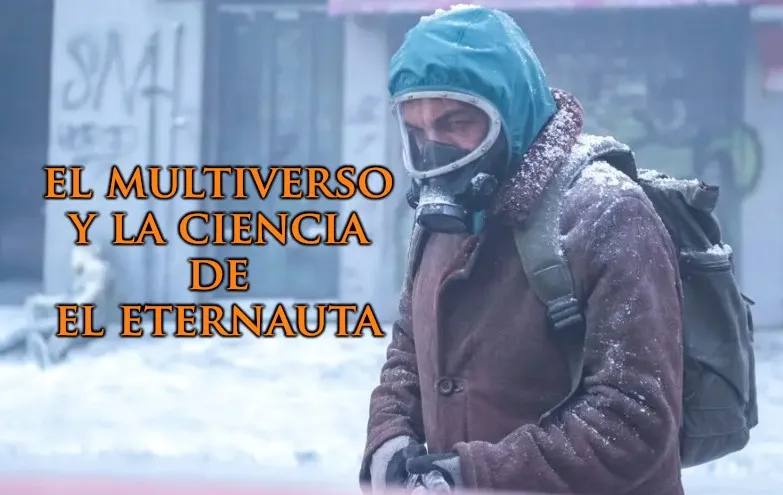
In the 6 episodes that make up the first season available so far, a notable aspect is the snow that kills instantly, as a prelude to an alien invasion. One of the characters, Favalli, tries to explain that there is a change in Earth's magnetism, detected with his instruments. And that this would be the cause of charged particles from the Sun entering the planet.
This scientific basis is not part of the original story. It is evident that it is an updated, advised element. This is not my assumption. The scientists who advised the director say so, in a note published in Nexciencia (link, below). They are Pablo Mininni (UBA-CONICET) and Gastón Giribet (New York University/UBA).
Despite this "explanation," that the solar wind, or perhaps cosmic rays, become snow that kills on touch is implausible.
However, it is a key element, which captivates the audience because those of us who live in this part of the world do not know snow in Buenos Aires, except for the occasional sleet. The recreated scenarios have been very well achieved and it is an interesting starting point in the original story.
Other elements: the 'cascarudos' and those who send the 'cascarudos'. The latter are still not clear in the series, it is assumed they will be addressed in the continuation. But we already glimpse that they command remotely and have "mental powers."
2-ASPECTS OF THE ORIGINAL STORY
We cannot clearly answer the previous questions until the continuation can be seen. But we can glimpse the issues from the original.
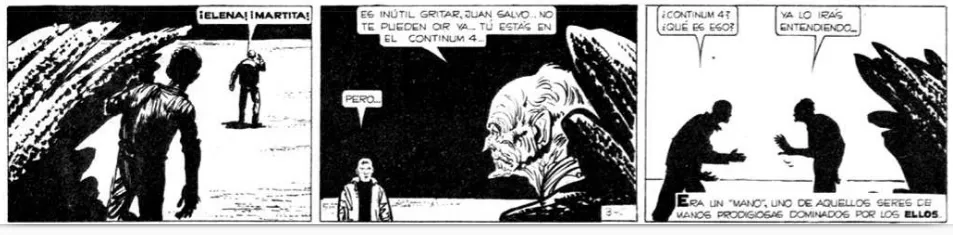
In the comic, the 'cascarudos' are controlled by "El Mano," who in turn mentally controls several humans, the "robot-men." There are others, the "Ellos." And a ship, the cosmo sphere. When activated, it accesses another dimension, the Continuum 4. But there are infinite dimensions. From there will come the name of the character and the series.
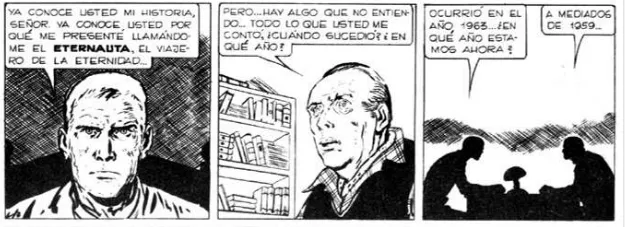
The end will also be the beginning. Juan narrates his story to the scriptwriter, but the story he tells happened later. Juan is a visitor from the future. This is a summary. Let us know that the original had two parts and other versions.
THE MULTIVERSE IN SCIENCE
The concept of the multiverse in science appears both in cosmology and in quantum mechanics. In the first case, it is a product of inflationary theories. There are so many versions, that a few years ago the "Encyclopaedia Inflationaris" was published with almost 800 pages (see links).
The basic idea is that before the "hot Big Bang" there was a period of exponential expansion from a scalar field, the inflaton. At the end of inflation, a process called reheating occurs in which the inflaton particles decay into the radiation that begins the Big Bang.
However, this process would not have occurred everywhere simultaneously, so although it decays here, it continues there until it decays there, but continues elsewhere and so on, generating infinite "bubbles" of space-time, a multiverse.
There are other theories, such as the bounce theory, which assumes that the universe expands and then collapses, in a process that starts over and over again.
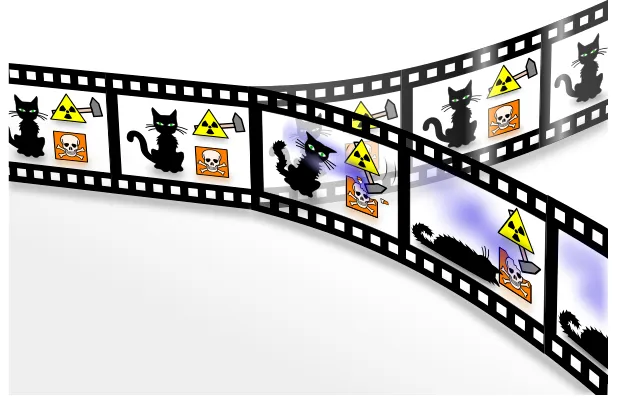
On the other hand, in quantum mechanics Hugh Everett proposed a theory, later known as the "many-worlds theory" in which there is no collapse of the wave function, but the entire universe is a wave function in superposition, where each value occurs in a different world.
In unification theories, such as String Theory, the possible existence of extra spatial dimensions is considered, albeit tiny. The concept of dimensions has been used prolifically in fiction, as have "portals" or black holes.
None of these multiverse theories has empirical evidence. Faster-than-light travel is not possible, although the possibility has been presented using "exotic matter," not detected so far. Travel to the past does not seem possible and, in some cases, would not even be desirable. Even if any of these ideas were true, it would be very difficult to know.
CONCLUSION
The deadly snow can hardly be explained by a geomagnetic change. Perhaps other beings in the universe have telepathy and mental powers among members of that species. It is less plausible that they could control the human mind, though...
The idea of the multiverse sometimes seems inevitable, since it is part of the Cosmological Model and Quantum Mechanics, but there is no consensus on the matter, simply because there is no concrete evidence. And there probably never will be, which is why some consider those ideas unscientific.
Everett's many-worlds idea is from the same year as the comic; inflationary theory is from 1981, so that must not have been the inspiration.
In that sense, the scientific content of the original and the series (so far) is very little. In fact, in the Nexciencia note, Mininni says: "I think the contribution we made is minuscule."
The discussion about hard and soft science fiction (as well as hard and soft sciences) is old, but it will continue to exist. On the other hand, here I analyzed the discourse from the point of view of physics-cosmology theories, but it could be analyzed from other sciences, like sociology. We must not forget that it is fiction, not a documentary. At some point we will have to suspend disbelief, provisionally.
Adaptations always imply changes. Some will be more comfortable, others less so. But some original aspects that are interesting are maintained, both from the plot and the aesthetics. The beginning of the series was good, we'll see how it ends.☉
Sources and related links
- El Eternauta [I, II, III], OESTERHELD, H. G. & LÓPEZ, S.
https://archive.org/details/El.Eternauta.123/OESTERHELD%2C%20H.%20G.%20%26%20L%C3%93PEZ%2C%20S.%20-%20El%20Eternauta%20%28II%29%20%5Bpor%20Ganz1912%5D/ - Los ciencianautas
https://nexciencia.exactas.uba.ar/el-eternatura-campo-magnetico-tierra-cinturon-van-allen-inversion-polos-pablo-mininni-gaston-giribet - Encyclopaedia Inflationaris
Jerome Martin, Christophe Ringeval, Vincent Vennin
https://arxiv.org/abs/1303.3787
About the images
Credits: Wikimedia/Netflix/Oesterheld-López