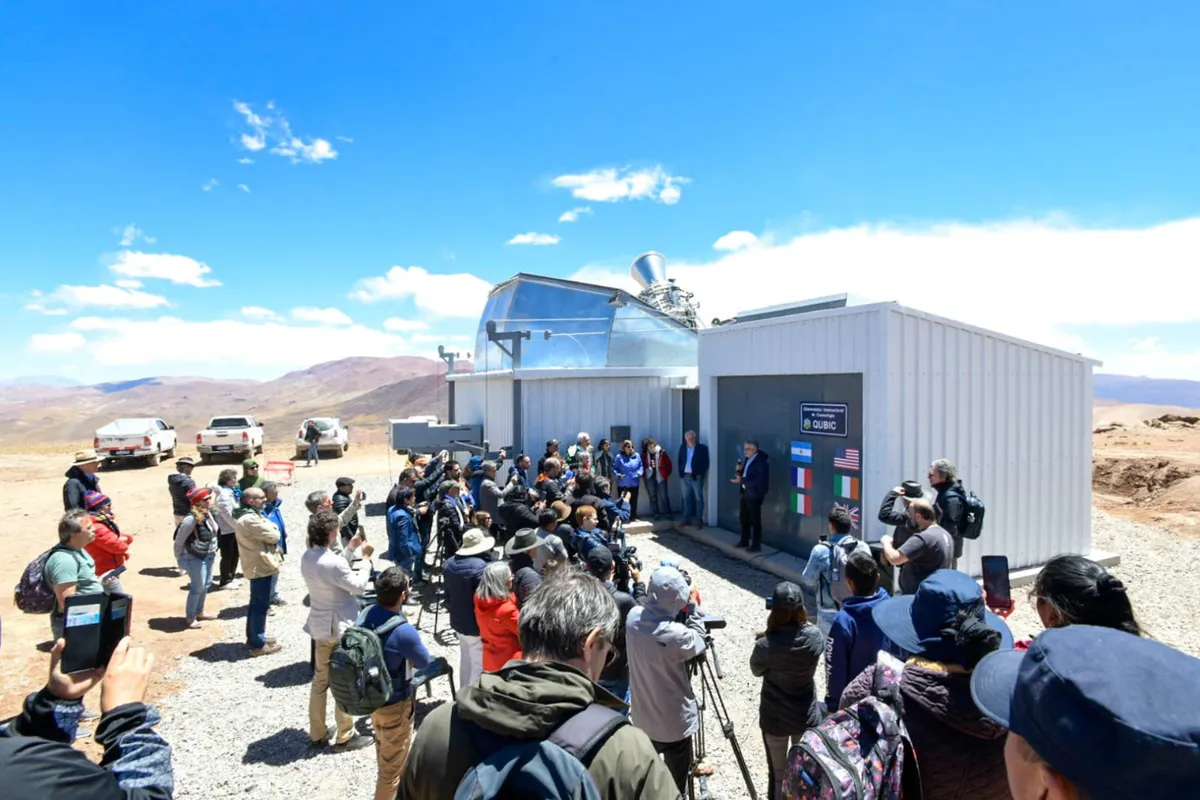
With the presence of national and provincial authorities, the QUBIC Observatory was inaugurated with great success.
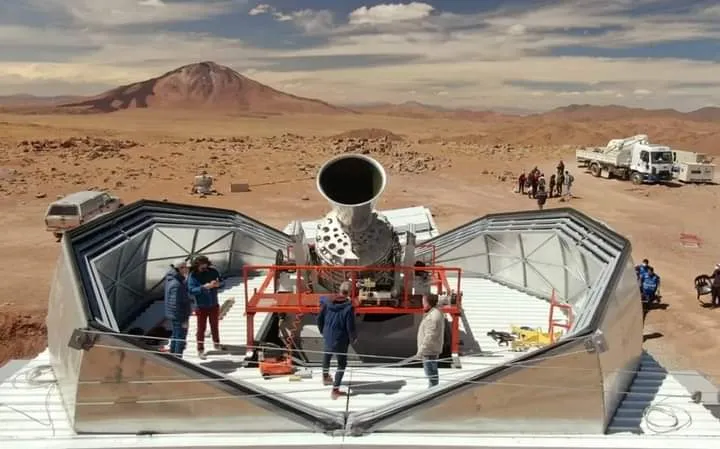
QUBIC (Q-U Bolometric Interferometer for Cosmology) is an International Collaboration involving universities, institutes and laboratories in France, Italy, Argentina, the United Kingdom and the United States. We had already talked about the project here, which was officially inaugurated this Wednesday, November 23, in Salta.
The Collaboration in the QUBIC Project has developed a completely novel instrument. It is enclosed in a cylindrical housing or cryostat 1.8m high and 1.6m in diameter, which protects it and maintains it at -269°C. It is open to the sky through a 45cm diameter window of rigid high-density polyethylene, transparent to the microwave radiation that the experiment seeks to measure; it meticulously and detailedly scans the sky at two frequencies: 150 and 220GHz, and records said radiation with a novel technique, hybrid between two techniques used in CMB studies (called respectively interferometry and bolometry) through a set of 1024 photodetectors, whose signals allow analyzing the characteristics of the radiation under study. To detect the signal, the cryostat will be globally cooled to 4 K (corresponding to -269.15 °C, only 4°C above absolute zero), but the bolometric sensors must work at temperatures 10 times lower (~300 mK). This implies the design of a complex cooling system, specially designed for QUBIC.
Astronomers will use the instrument to search for the imprints of primordial gravitational waves "B Mode", which have a certain polarization, in the Cosmic Microwave Background.
The Alto Chorrillos site had already been evaluated and chosen to install a radio telescope called the Large Latin American Millimetre Array (LLAMA), a product of Argentine-Brazilian scientific cooperation. To do this, Conicet obtained a 400ha area on a 20-year loan from the provincial government. For QUBIC, just over 1ha is needed.
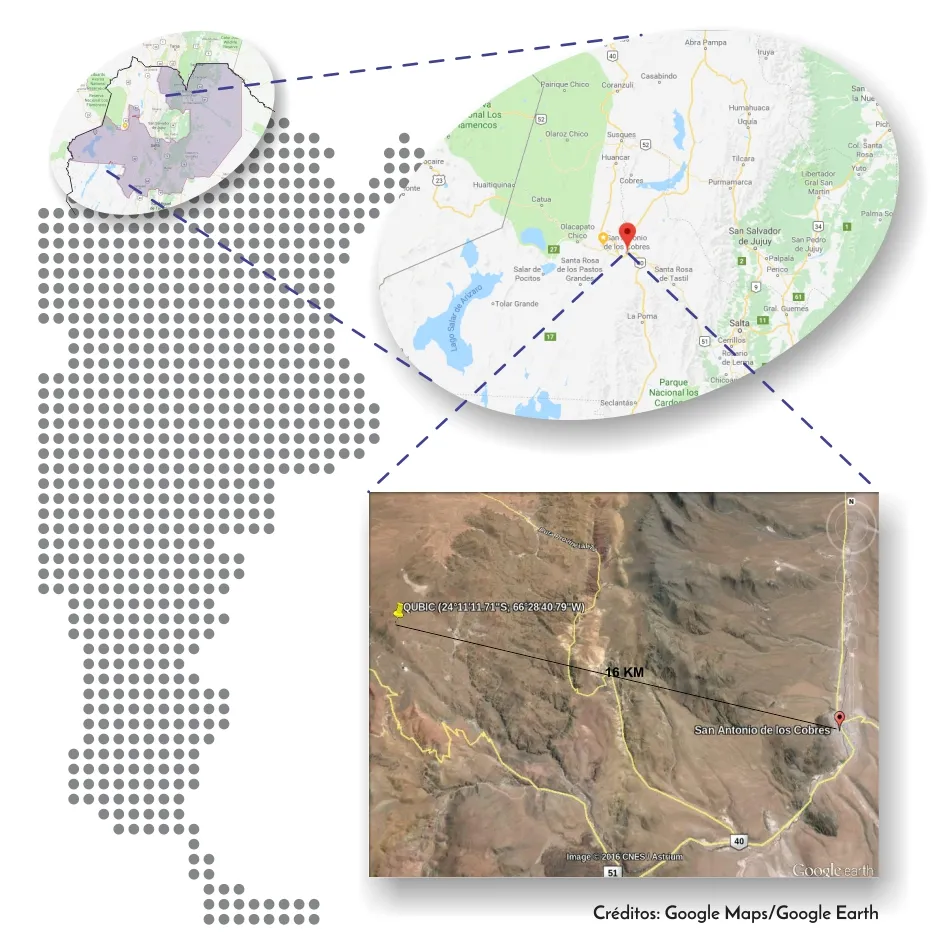
The location of this type of facility will position the Salta puna as a global technological and astronomical hub, and will bring with it the need to improve, among other things, the energy supply, communications and access roads to the site, as well as to build in this and possibly in San Antonio de los Cobres, respective headquarters that include laboratories and can be shared by QUBIC and LLAMA. In addition to certain economic benefits for the residents of San Antonio de los Cobres in the form of demand for goods and services, and job offers.
At the local level, QUBIC is overseen by a Steering Committee composed of Alberto Etchegoyen (ITeDA), Beatriz García (ITeDA), Diego Harari (CAB), Gustavo Romero (IAR).
There are few countries that have instruments to investigate the Cosmic Microwave Background. It is a fossil radiation, a relic from the early times of the Universe, so its detailed study allows advancing the development of modern cosmology.
THE NAME GAME
QUBIC is the acronym for "Q-U Bolometric Interferometer for Cosmology". Why is it called that? Because of the Stokes parameters.
The Stokes parameters are a set of values that describe the polarization state of electromagnetic radiation. Two of those parameters are called Q and U. In a scientific paper on the subject, the following equation is used, with those parameters added:

Bolometric comes from bolometers, which are sensors for measuring radiation at all wavelengths. Interferometer comes from Interferometer, and it is because the telescope combines bolometers with another instrument that measures wavelength. The use of both instruments allows for greater certainty about what is being detected.
THE PATIENCE GAME
The results will take a few years to arrive. First, data must be collected and all necessary corrections made to be able to analyze it. The first conclusions could arrive in a couple of years. The Cosmic Microwave Background Radiation was discovered in 1964. Almost six decades later, it is still yielding new findings.☉
Sources and related links
- QUBIC: Observing the Polarized Microwave Skyover the Puna
QUBIC Collaboration
http://www.scirevfew.net/index.php/sciencereviews/article/view/16/20 - QUBIC
https://www.qubic.org.ar/
About the images
QUBIC Collaboration/MINCYT