The Star Formation Rate, revisited.
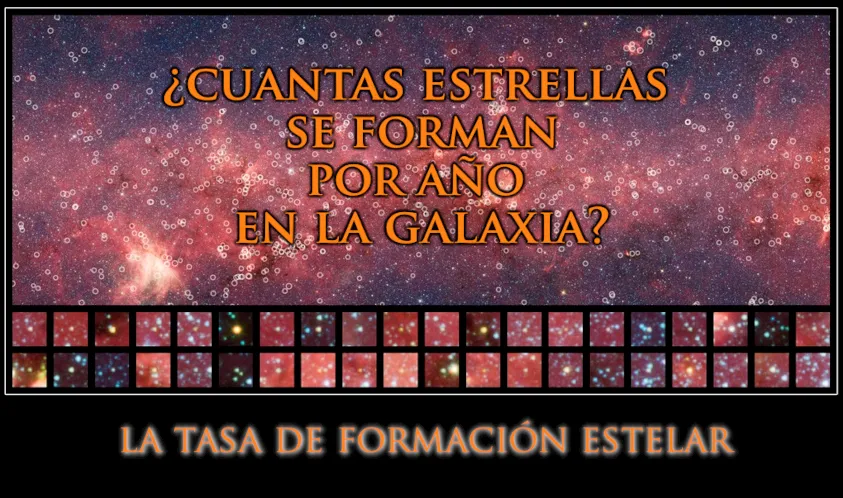
Professional astronomers who study galaxies are concerned with calculating the Star Formation Rate (SFR), that is, the number of new stars, although they actually use the solar mass (M☉) as a unit of measurement.
Important: Solar Masses is not the same as stars. Most of the stars in the galaxy are red dwarfs, much less massive than our Sun. Therefore, 1 M☉ equals many typical stars.
In a press release from the people who operated the Spitzer space telescope, in 2010, they indicated that until then it was thought that the SFR of the Milky Way was 5 M☉, that is, equivalent to 5 stars like our sun. But with infrared data and computer simulations, they concluded that the SFR was actually only 1 M☉.
Stars form from the gravitational collapse of gas in a molecular cloud in the interstellar medium. Forming stars are difficult to detect, as they are surrounded by dust disks, but they can be observed in the infrared range of the spectrum.
The creation rate seems low, considering the galaxy is about 13 billion years old. If one star is produced per year, then there should be about 13 billion stars, but it is estimated that between 100 and 400 billion stars make up the Milky Way. This implies that the SFR was higher in the past.
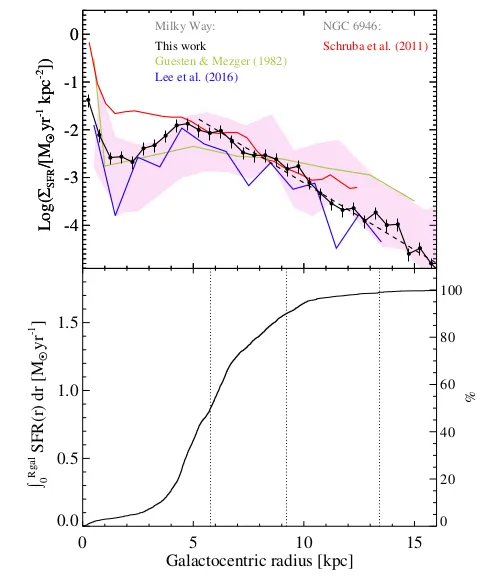
In this graph by D. Elia et al (2022) the SFR of the Milky Way is shown in black, that of NGC 6946, another galaxy with higher star formation, in red. Below, the correlation with the galactic radius.
To calculate the SFR, astronomers take many things into account: observations in high-energy regimes (UV-X-rays) to low-energy ones like radio waves; observations of H II regions, etc. In a 2012 work, Kennicutt & Evans arrived at a value of 1.9 M☉ for the SFR of our galaxy.
More recently, in 2022, an international group led by Davide Elia also arrives at that value of 2 M☉ per year.
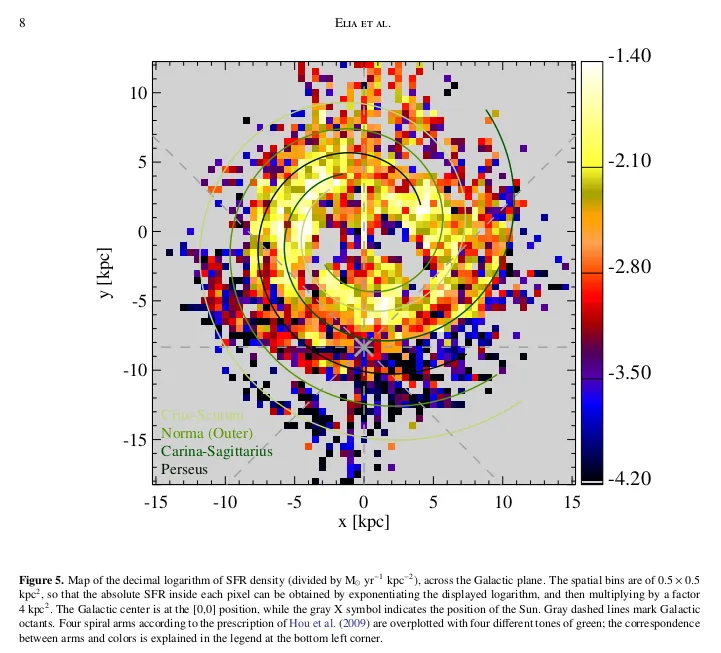
Here we see a logarithmic map of the SFR density (divided by M☉ per year per kpc) across the galactic plane. The galactic center is at position 0,0; the gray X indicates the position of the Sun.
Aluminum-26
In 2023, a group of researchers led by Thomas Siegert reported that gamma rays from aluminum-26, a radioactive isotope that arises mainly from massive stars, reveals that the Milky Way converts 4 to 8 masses of interstellar gas and dust into new stars, per year.
The astrophysicists studied the emission of the isotope in the galaxy. A massive star creates it during its birth and collapse. Before the end, stars expel the material into the interstellar medium. If the stars explode as supernovae, more material is forged. The isotope, as it decays, emits gamma rays.
CONCLUSION
The value of 2 M☉/year for the SFR of the Milky Way is the one that appears most in the literature. But clearly there is much to improve on this topic both regarding our galaxy and others. Starburst galaxies don't sell coffee. They are starburst galaxies that have SFR >100/year and are of interest to better understand the star formation rate. Globular clusters are also of interest in this topic, as they are the "capsules" in which stars are manufactured. It could well be said that this is gourmet astronomy.☉
Sources and related links
- The Star Formation Rate of the Milky Way as seen by Herschel
https://arxiv.org/abs/2211.05573 - Star Formation in the Milky Way and Nearby Galaxies
Robert C. Kennicutt Jr, Neal J. Evans II
https://arxiv.org/abs/1204.3552 - Spitzer Detects the 'Heartbeat' of Star Formation in the Milky Way Galaxy
https://www.spitzer.caltech.edu/news/feature10-03-spitzer-detects-the-heartbeat-of-star-formation-in-the-milky-way-galaxy - Star Formation and Gas in Galaxies, the observed relationship
https://astrobitos.org/2019/07/23/formacion-estelar-y-el-gas-en-las-galaxias-la-relacion-observada/ - Galactic Population Synthesis of Radioactive Nucleosynthesis Ejecta
https://arxiv.org/abs/2301.10192 - The Milky Way may be spawning many more stars than astronomers had thought
https://www.sciencenews.org/article/milky-way-star-formation-astronomy
About the images
Initial image: Credit: NASA / JPL-Caltech / T. Robitaille (Harvard-Smithsonian Center for Astrophysics), GLIMPSE Team
Graphs: D. Elia et al (2022)