Astronomers discovered a galaxy with a star formation burst 4500 times greater than the Milky Way.
Is that why the object is part of the TV show The Big Bang Theory?
Astronomers recently discovered that a galaxy is having an unusual burst of star formation. Located 12.7 billion light-years from Earth, the object is observed at a critical stage in galactic evolution, just one billion years after the Big Bang.
The galaxy, called SPT 0346-52, was discovered using the South Pole Telescope (SPT) and was later observed with other instruments such as the Atacama Large Millimeter/submillimeter Array (ALMA). The data revealed very bright infrared light emission, suggesting a high production of stars.
However, an alternative explanation was possible: could that emission be the result of a rapidly growing supermassive black hole? Gas falling into the black hole becomes hotter and brighter, which would cause the surrounding dust and gas to glow in the infrared. To explore that possibility, the researchers used NASA's Chandra Observatory and the CSIRO radio telescope in Australia.
Neither X-rays nor radio waves were detected, so the black hole was ruled out as responsible for the emission in question.
"We now know that this galaxy does not have a hungry black hole, but instead is shining with the light of newly formed stars", explained Jingzhe Ma from the University of Florida, author of the paper published in The Astrophysical Journal.
The star formation in this object is 4500 times the mass of the Sun per year, that is, a very high rate in contrast to the Milky Way, whose star formation is 1 solar mass per year.
"Astronomers call galaxies with a lot of star formation 'starburst' galaxies. But the term doesn't seem to do justice to this galaxy, so we are calling it a 'hyper-starburst'" commented Anthony Gonzalez from the same institution.
Starburst could be translated as "star formation burst".
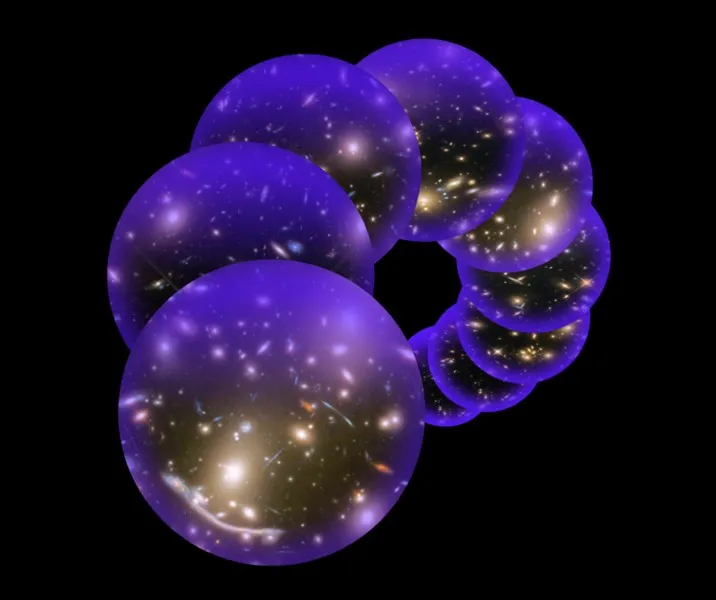
The following graphic shows a frame from a computer simulation (main image) and astronomical data (inset) of SPT 0346-52.
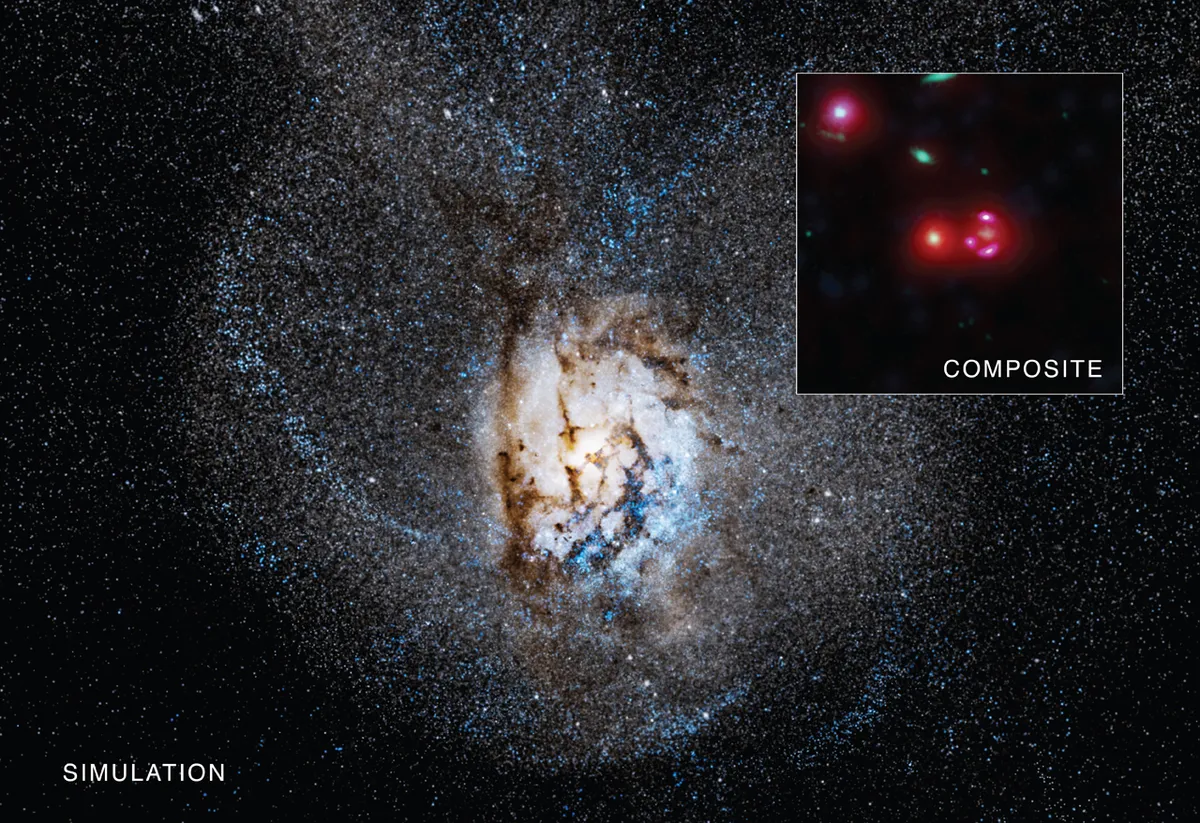
The simulation created on a supercomputer shows the distortion produced by the collision of galaxies and their merger. Such a merger could explain the star formation rate in the studied object. The gas near the center of the merging galaxies (the brightest region in the center of the simulation) is compressed, producing the abundant formation of new stars.
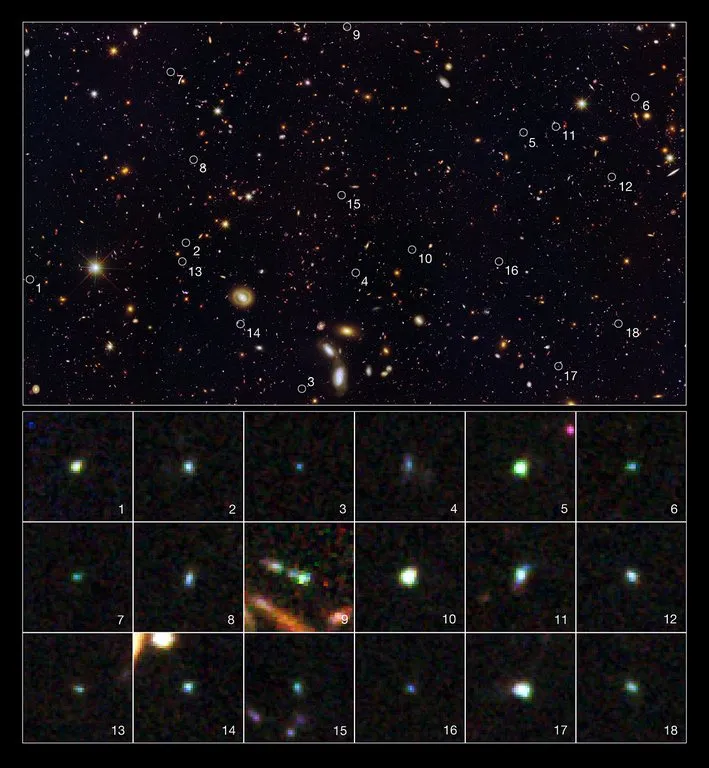
The inset shows a composite image of X-rays from Chandra in blue; short-wave infrared data from Hubble in green; longer infrared from Spitzer in red; and even longer infrared with ALMA in magenta. In the last case, the light from the galaxy is distorted and magnified by the gravity of an intervening galaxy, producing three elongated images in the ALMA data near the center of the image.
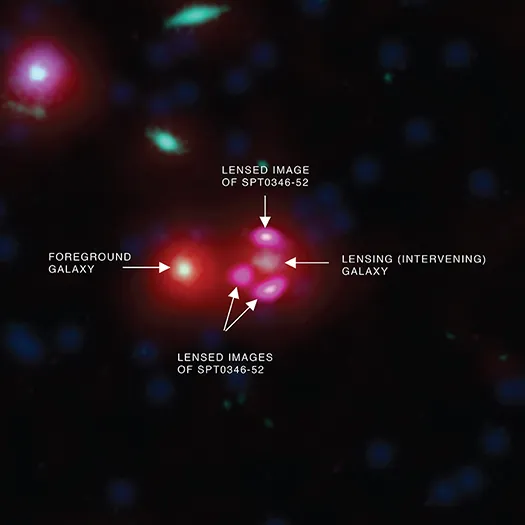
There is no blue in the center of the image, showing that Chandra did not detect X-rays (therefore, no black hole).
As the lead author narrates in the Chandra blog, she was surprised not to find the expected X-rays in the data, but then used the spectral energy distribution technique that astronomers developed to compare the observed brightness at different wavelengths with models. It turned out that including a growing black hole in the model contradicts the observed data, and removing it better explains what is observed. There were also no traces of black holes in the ATCA (Australia Telescope Compact Array) data.
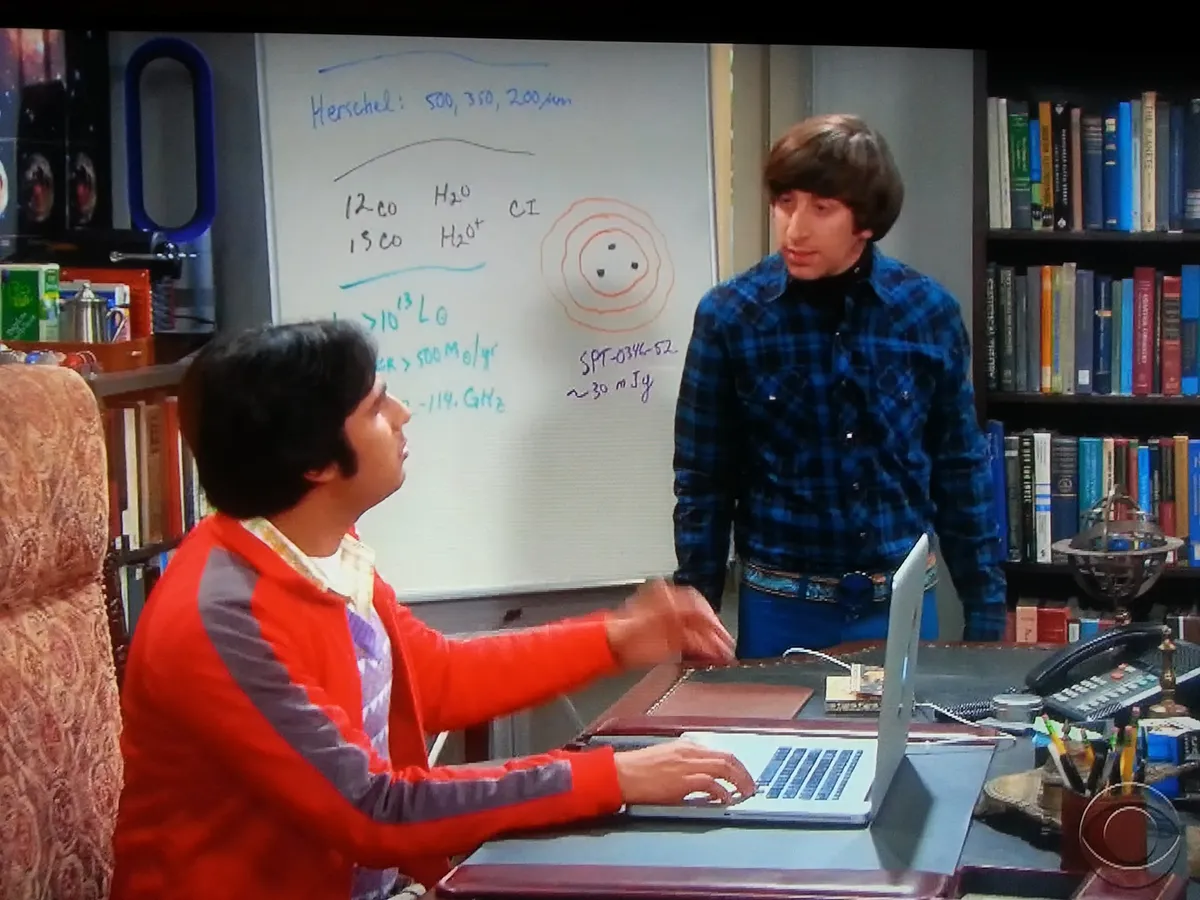
Jingzhe Ma ends her post on the Chandra blog with a fun fact. By some coincidence, SPT0346-52 appears in an episode of the TV show "The Big Bang Theory".
Indeed, as indicated on a page by Joaquin Vieira from the University of Illinois, co-author of the work, in season 6, episode 21 (from April 25, 2013) titled The Closure Alternative, Raj is seen talking to Howard. To the side there is a blackboard with notes and graphs. One of the notes is SPT-0346-52, as can be seen in the initial image of this post, taken from Vieira's page (see below).
The possibility that the infrared emission is due to a supermassive black hole arises because it is not very common to observe such primitive galaxies with such a high star formation rate. On the other hand, the lack of X-rays does not rule out the black hole hypothesis. But after the various observations at different wavelengths, if the black hole is ruled out, then the submillimeter galaxy appears as a great case study.
The hypothesis of a galaxy merger must be studied further, so to get better answers, new observations will have to be made. Much of scientific work boils down to persistence.
Penny...Penny...Penny...
Sources and related links
- SPT0346-52: Negligible AGN Activity in a Compact, Hyper-starburst Galaxy at z = 5.7
Jingzhe Ma et al (2016)
arXiv:1609.08553 [astro-ph.GA]
http://lanl.arxiv.org/abs/1609.08553 - Chandra Blog: Super Starburst Galaxy Found One Billion Years After the Big Bang
http://chandra.si.edu/blog/node/625 - Chandra Press Release: Under Construction: Distant Galaxy Churning Out Stars at Remarkable Rate
http://chandra.si.edu/press/16_releases/press_120816.html
About the images
X-ray: NASA/CXC/Univ of Florida/J.Ma et al; Optical: NASA/STScI; Infrared: NASA/JPL-Caltech; Radio: ESO/NAOJ/NRAO/ALMA; Simulation: Simons Fdn./Moore Fdn./Flatiron Inst./Caltech/C. Hayward & P. Hopkins http://chandra.si.edu/photo/2016/spt0346/
Joaquin Vieira SPT Sub-Millimeter Galaxies http://www.astro.caltech.edu/~vieira/spt_smgs.html