How to add the object to know its location.
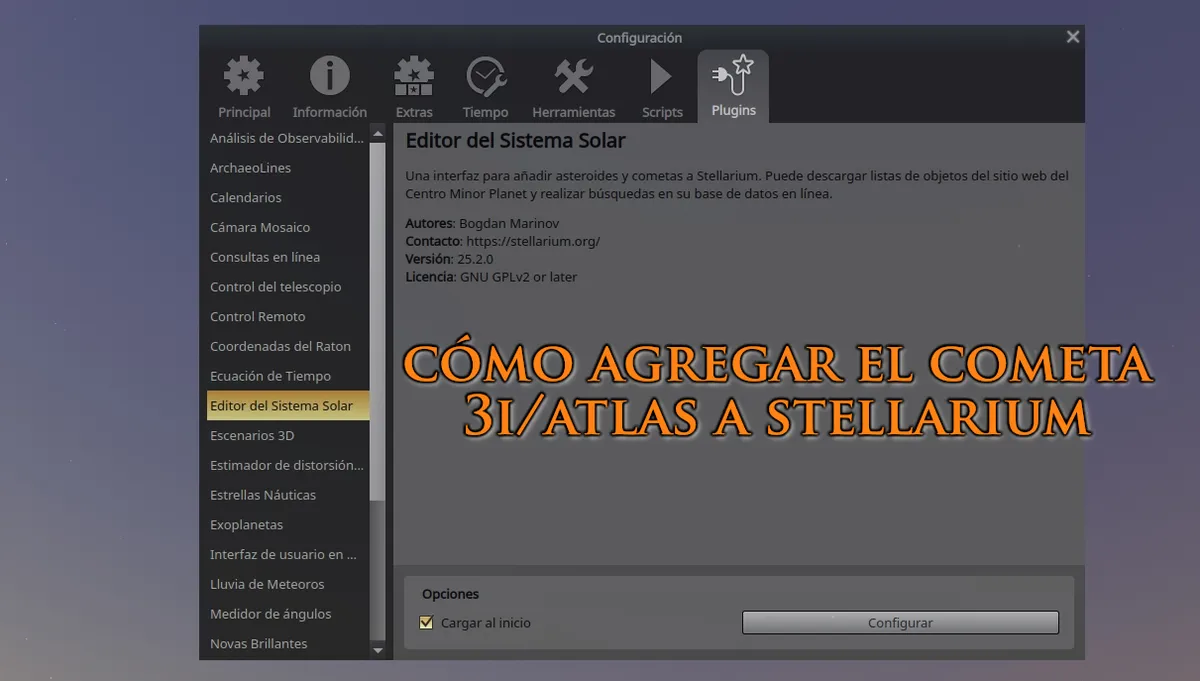
Stellarium is powerful planetarium software. Adding new objects is simple. Here we will show how to add the novel interstellar visitor, comet 3I/ATLAS.
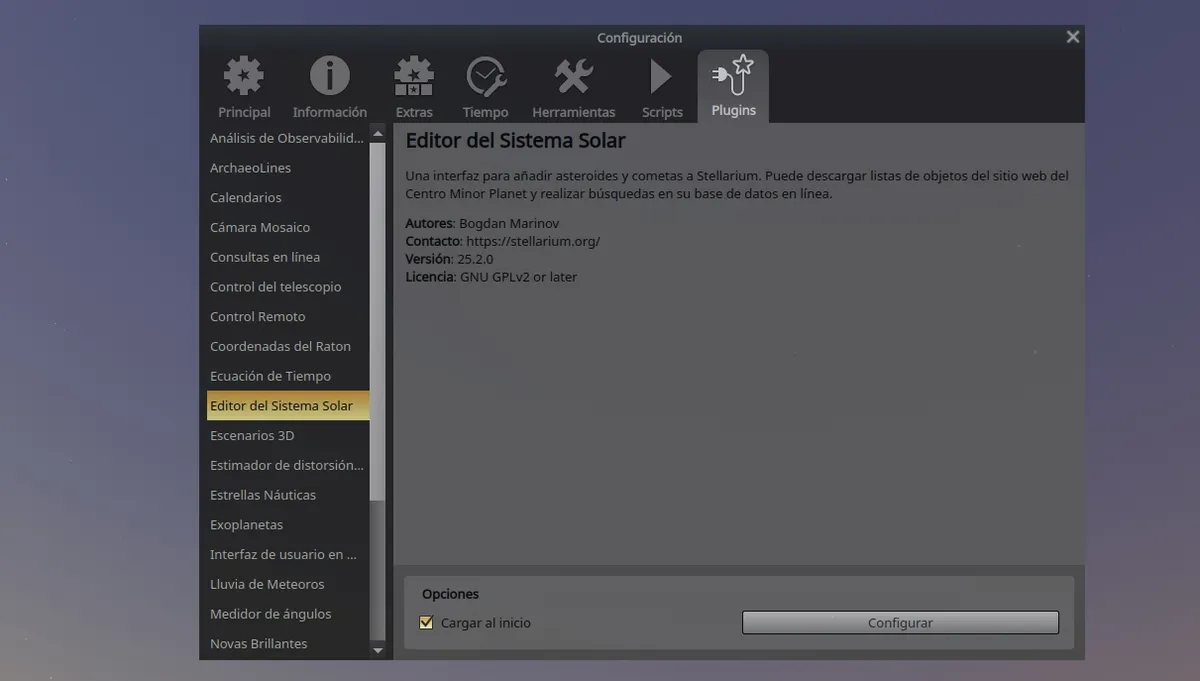
To do it (in the new versions, I am using version 25) we must go to Plugins and choose Solar System Editor. Click on Configure.
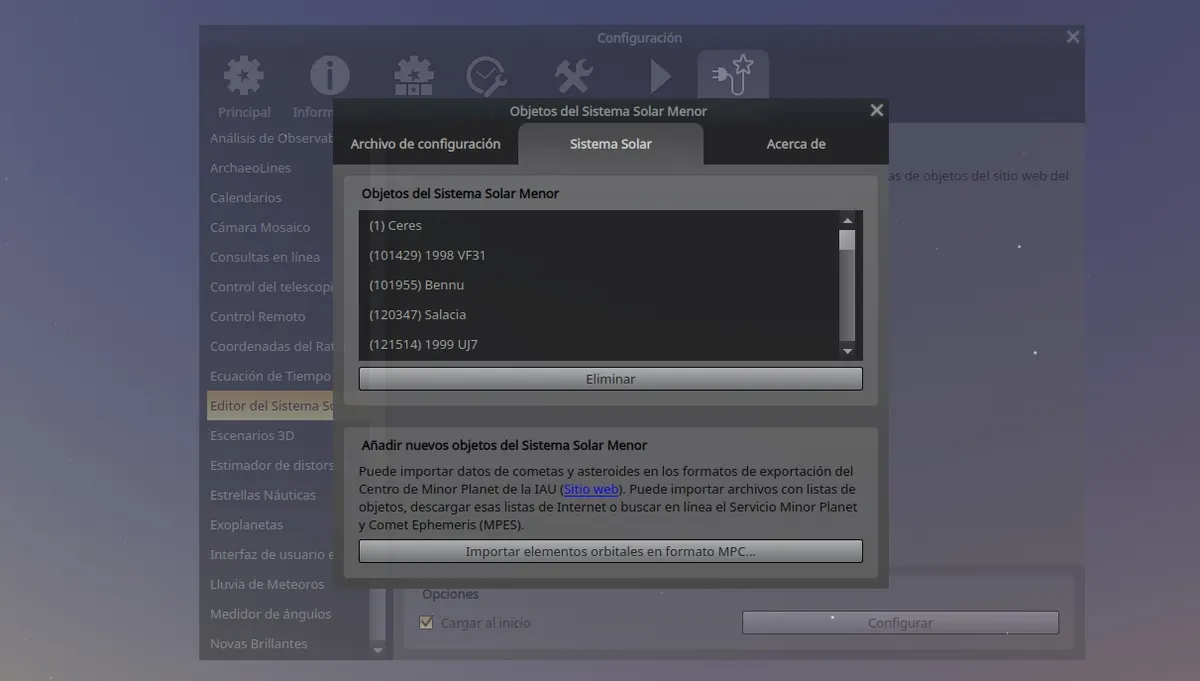
We go to the Solar System tab and choose the option Import elements...
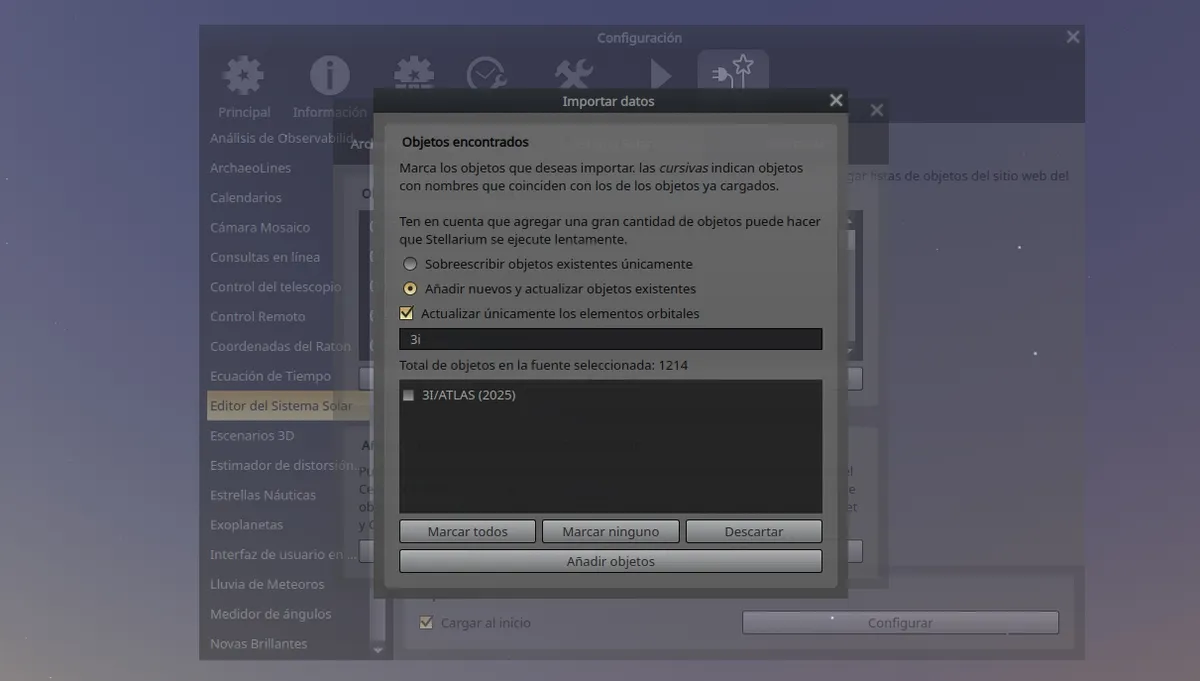
There we choose the option Add new... and below we search for the desired one, we mark it and click Add objects. Done!
Without restarting, we can go to the search tool and we will be able to select the object.
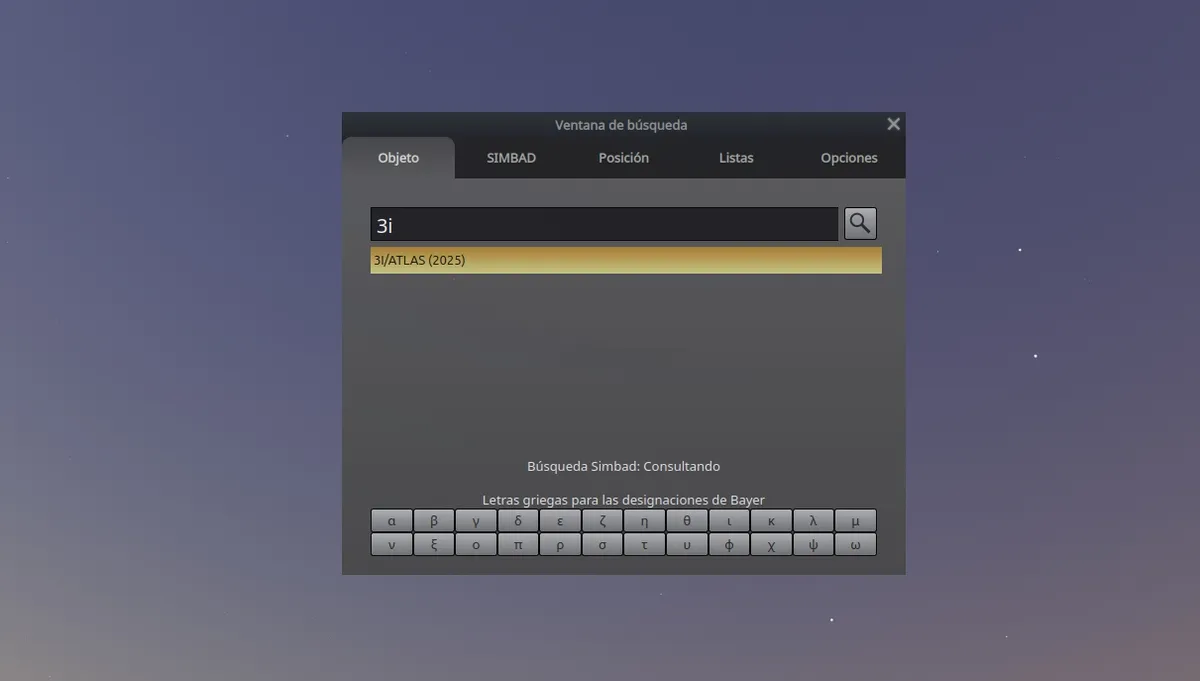
If it indicates that at that moment it is below the horizon we can change the time until it appears above it.
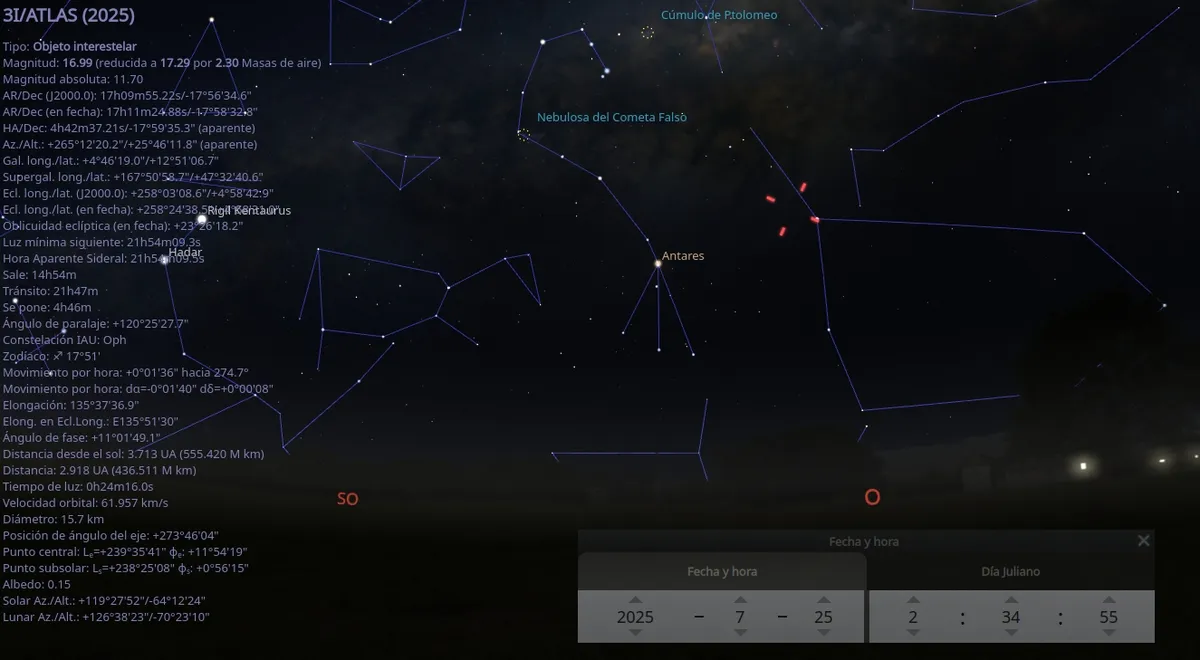
Observing comets is always challenging. Their brightness is very variable, difficult to predict and they are usually faint. If you own a telescope, besides needing the luck of good weather, it is essential to know where to point it.
Discovery
The ATLAS survey telescope (Asteroid Terrestrial-impact Last Alert System), funded by NASA and located in Río Hurtado, Chile, first reported observations of comet 3I/ATLAS to the Minor Planet Center on July 1, 2025. From the first report, pre-discovery observations were collected from the archives of three different ATLAS telescopes around the world and from Caltech's Zwicky Transient Facility at Palomar Observatory in San Diego County, California. These pre-discovery observations date back to June 14.
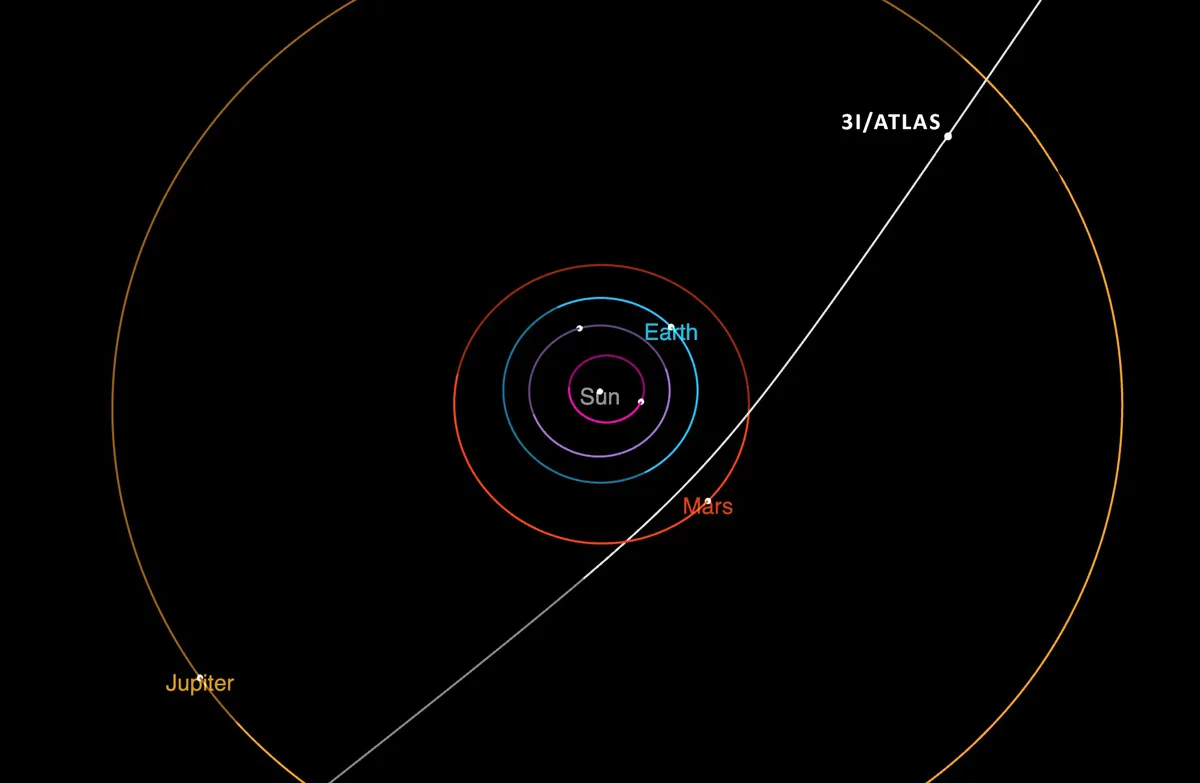
Comet 3I/ATLAS is the third known object from outside our solar system discovered. Astronomers have classified it as interstellar due to the hyperbolic shape of its orbit. (It does not follow a closed orbit around the Sun). By tracing the orbit of 3I/ATLAS into the past, the comet clearly originated outside our solar system.
Comet 3I/ATLAS does not pose a threat to Earth and will remain distant. Its closest approach to our planet will be approximately 1.8 astronomical units (about 270 million kilometers). Comet 3I/ATLAS will reach its closest point to the Sun around October 30, 2025, at a distance of approximately 1.4 au (210 million kilometers), just inside the orbit of Mars.
THE PREQUEL OF THE FIND
According to a paper on arXiv, a test survey, during the scientific validation period of the Vera Rubin Observatory, would have recorded the object before its discovery. It is reported that photos of the comet were taken between June 21 and July 7.
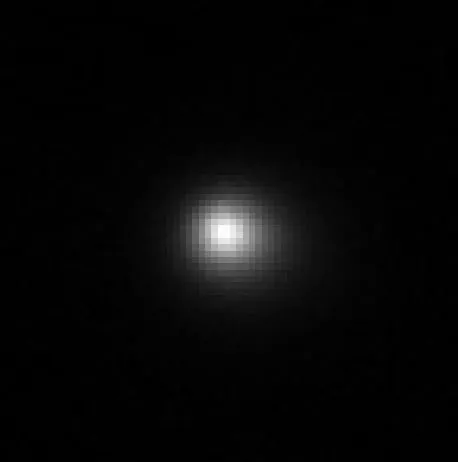
The images are high resolution, considering the telescope's 8.4m mirror. There is great expectation from the worldwide astronomical community, both amateurs and professionals, to collect as much data as possible from this interstellar visitor. Let's remember it is the third, after 1I/ʻOumuamua and 2I/Borisov.
Those three objects are interstellar, which also means intra-galactic, from the same galaxy. Will it ever be possible to observe an inter-galactic object, from outside the galaxy? It would be great, unless the Beastie Boys were right...☉
Sources and related links
- Comet 3I/ATLAS
https://science.nasa.gov/solar-system/comets/3i-atlas/ - NSF-DOE Vera C. Rubin Observatory Observations of Interstellar Comet 3I/ATLAS (C/2025 N1)
https://arxiv.org/abs/2507.13409 - Apparently Vera Rubin Captured Images Of 3I/ATLAS Before It Was Even Discovered
https://www.universetoday.com/articles/apparently-vera-rubin-captured-images-of-3iatlas-before-it-was-even-discovered
About the images
Credit - C.O. Chandler et al./ NASA