Today, Monday the 14th, NASA's Messenger spacecraft will fly by the planet closest to the Sun, 33 years after the planet's last visit.
The MErcury Surface, Space ENvironment, GEochemistry, and Ranging spacecraft or MESSENGER is the first mission established to orbit Mercury. Before its orbit begins in 2011, the spacecraft will make three flybys. The instruments on board are expected to take more than 1200 images and other observations during the approach, encounter, and departure. They will be the first measurements since Mariner 10 flew by the planet in March 1975.
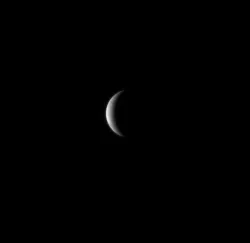
Already on January 9, MESSENGER sent its first images from a distance of 2.7 million kilometers, through its Narrow Angle Camera. The planet has a diameter of 4880 kilometers and the image has a resolution of about 40 kilometers/pixel. The spacecraft will pass 200 kilometers from the surface at 19:04 UTC on January 14.
Given that Mariner 10 observed only one of the hemispheres, one of the mission's objectives is to be able to study the other. Furthermore, measurements are expected to be made on the structure of the gravitational field and to obtain key information about the internal structure, particularly the size of the core.
A site of interest will be the Caloris crater, about 1300 km in diameter and one of the largest in the solar system. It is a crater almost a quarter of the planet's diameter with mountains up to 3 kms high. By studying the area with different color filters, it will be possible to understand what its composition might be and learn something about the planet's surface.
The flyby is an opportunity to begin mapping the exosphere with ultraviolet observations and to document the population of energetic particles and plasma in the magnetosphere. In addition, the flyby trajectory allows measurements of the characteristics of the particles and plasma in Mercury's magnetic tail that will not be possible from orbit.
MESSENGER is just over halfway through its 7.9 billion kilometer journey to Mercury's orbit, which includes 15 trips around the Sun. It has already passed Venus twice (10/24/2006 and 6/5/2007) and will pass Mercury three times: now, January 2008, in October of this same year, and in September 2009. It will use the planet's gravitational pull to guide the spacecraft progressively closer to the orbit so that insertion will be accomplished on the fourth encounter planned for March 2011.
The complexity of the mission with its numerous flybys and multiple maneuvers will require close and constant attention. Dr. Sean C. Solomon, of the Carnegie Institution of Washington, leads the mission and the Johns Hopkins University Applied Physics Laboratory (APL) manages the mission for NASA's Science Mission Directorate. The MESSENGER science team was increased by an impressive set of experts participating in a NASA program that includes 46 scientists from 26 institutions.
The MESSENGER project is the seventh in NASA's Discovery program, scientifically focused on space missions, and was launched on August 3, 2004.
Sources and related links
- *NASA: NASA Spacecraft to Make Historic Flyby of Mercury
- *MercuryToday: MESSENGER Set for Historic Mercury Flyby
- *EurekAlert: MESSENGER set for historic Mercury flyby
- *MESSENGER Site at Applied Physics Lab
- *Where is MESSENGER now?
About the images
Image taken on January 9 by MESSENGER.
Credit: NASA/Johns Hopkins University Applied Physics Laboratory/Carnegie Institution of Washington