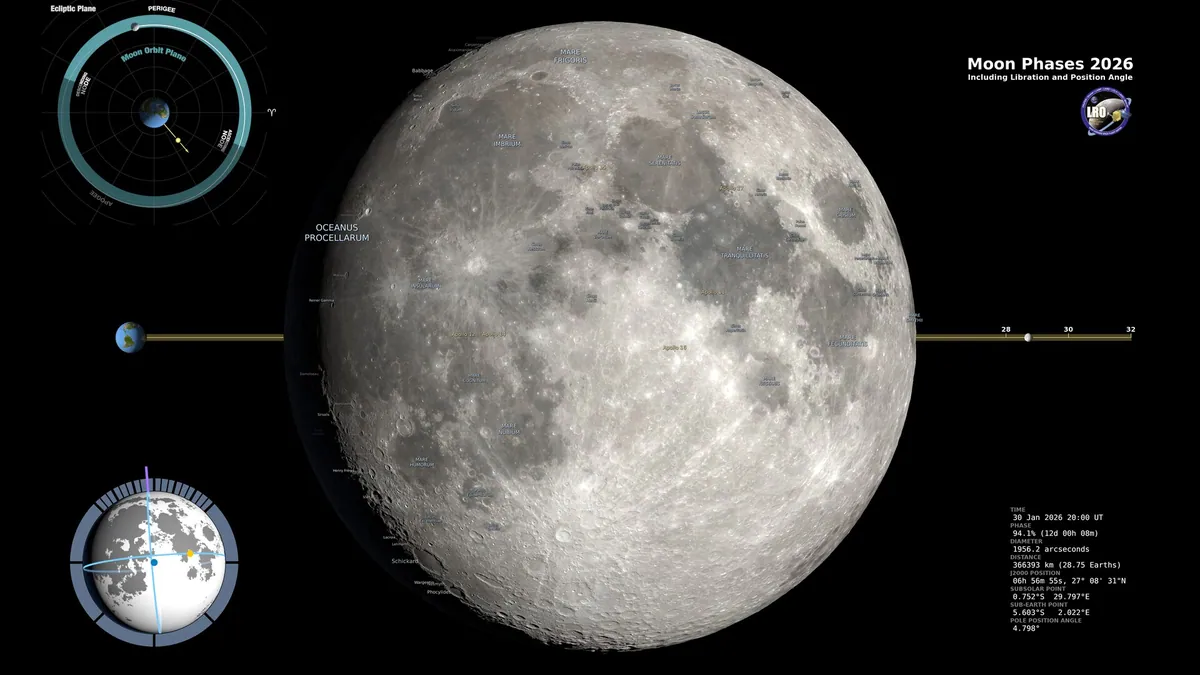
The December 2026 full moon, traditionally known as the Cold Moon, will reach peak splendor on Wednesday, December 23 at 8:28 p.m. EST (0128 GMT on December 24). This event will also be a supermoon, as it coincides with perigee, the closest point of the lunar orbit to Earth. According to calculations by astronomer Fred Espenak, the moon will be only 356,740 kilometers from our planet, making it the closest supermoon of the entire year 2026. Compared to a full moon at its farthest point, a supermoon can appear 14 percent larger and up to 30 percent brighter.
The best time to observe the phenomenon will be just after sunset on December 23, when the Cold Moon rises over the eastern horizon. At that moment, the satellite may present a striking golden or orange hue because its light travels through more of Earth's atmosphere, scattering the bluer wavelengths. Its proximity to the horizon can exaggerate its apparent size due to an optical effect known as the moon illusion. To know the exact moonrise time for each location, it is recommended to consult tools like those from Time and Date or astronomy apps like Stellarium or SkySafari 7 Pro.
The name Cold Moon refers to the freezing temperatures characteristic of winter in the northern hemisphere. According to the Old Farmer's Almanac, it is also known as the Long Night Moon by the Mohican tribe of North America, due to its proximity to the winter solstice, the shortest day of the year. In old English tradition it was called the Moon Before Yule, according to Time and Date, and the Celts of Europe called it the Oak Moon after traditions centered on oak trees. This full moon also coincides with festivities like the Hindu Datta Jayanti, which celebrates the birth of Lord Dattatreya, and precedes the Christian Christmas on December 25.
The December Cold Moon will rise over the eastern horizon at dusk on December 23. Observers can begin by locating Sirius, the brightest star, in the southeast. From there, the pattern continues to the blue supergiant star Rigel in the constellation Orion, then to the orange glow of Aldebaran in Taurus, then to Capella in Auriga, then to Pollux in Gemini and nearby Procyon, before closing the circle again with Sirius. These stars are bright enough to be seen despite the lunar glare.
The presence of planets will add interest to the night sky. Jupiter and Mars, with its reddish light, will be visible low in the eastern sky in the hour before midnight. Saturn will be located near the western horizon. Just before dawn, Venus will stand out as a bright Morning Star in the southeast, with the red giant Arcturus shining higher up, near the constellation Bootes. The full moon offers an excellent opportunity for astrophotography, presenting its disk fully illuminated and free of shadows.
The phenomenon of a full moon occurs when Earth is exactly between the Sun and the Moon. A complete lunar cycle, called a synodic month, lasts approximately 29.5 days. Besides the supermoon, there are other types with specialized names, like the Blue Moon, which is the second full moon in the same month. Another example is the Harvest Moon, which occurs closer to the autumnal equinox and is characterized by providing extended hours of moonlight.
The term supermoon is reserved for a full moon that aligns with lunar perigee, making it exceptionally large and luminous. To qualify as one, it must be within approximately 90 percent of its closest distance to Earth. Although the exact moment of fullness is brief, to the naked eye the moon appears full for about three days. The names of full moons, like the December Cold Moon, come primarily from a blend of cultural, agricultural, and natural observations, and aim to allow humans to predict seasonal changes and track the passage of time. Many of these titles, like the Wolf Moon of January or the Hunter's Moon of October, have their roots in Native American, Colonial American, or other North American traditions.