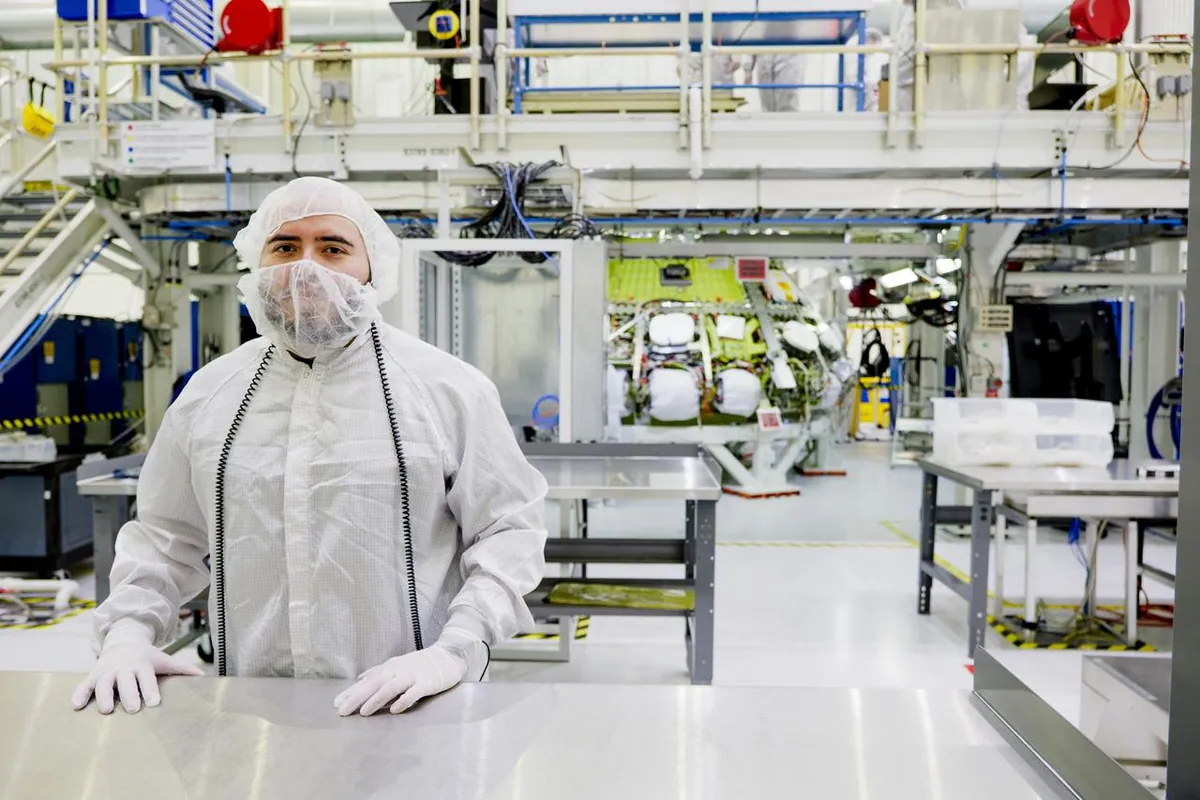
The four Artemis III astronauts posed next to the Orion spacecraft that will take them to space, during a break in their rigorous training at NASA's Kennedy Space Center in Florida. The image shows the crew, composed of NASA commander Randy Bresnik, ESA pilot Luca Parmitano, and NASA mission specialists Frank Rubio and Andre Douglas, holding up three fingers in a sign of camaraderie. The moment took place in the Neil A. Armstrong Operations and Checkout Building, where the spacecraft is currently located. The Artemis III mission, a crewed test flight in Earth orbit, will not land on the moon, but it is a critical step toward that goal, as it will practice rendezvous and docking with lunar landing vehicles.
The crew has a complex mission ahead of them. The four astronauts will launch to low Earth orbit, where they plan to practice rendezvous and docking maneuvers with the Blue Origin Blue Moon and SpaceX Starship lunar landing vehicles. To prepare, the team must undergo months of critical training to be physically ready and prepared to handle any situation that may arise during their mission. According to NASA, if Artemis III goes as planned and the agency has a landing vehicle that passes rendezvous and docking tests with the Orion spacecraft, Artemis IV could see astronauts land on the moon for the first time since the final Apollo mission in 1972.
The European Space Agency (ESA) will play a key role in the mission, not only with its astronaut Luca Parmitano as pilot, but also by providing the third European Service Module (ESM) for the flight. This module is the power source for the Orion spacecraft, providing propulsion, electrical power, thermal control, air, and water for the four astronauts on board. ESA Director General Josef Aschbacher stated that Parmitano's assignment as pilot reflects the depth of European expertise in human spaceflight and draws on his extensive operational experience in high-pressure situations. Aschbacher added that the news from Houston is a powerful recognition of ESA's role in humanity's return to the Moon.
Luca Parmitano is an ESA astronaut from Italy who has spent 366 days in space across two long-duration missions to the International Space Station, Volare and Beyond. During those missions, he supported hundreds of experiments, performed six spacewalks totaling more than 30 hours, and became commander of the Station. Since returning to Earth, he has served as ESA's liaison at NASA's Johnson Space Center in Houston, acting as CAPCOM and training ESA astronauts for spacewalks and robotic operations. Last year, he participated in NASA's Underway Recovery Test 12 off the coast of California to simulate the splashdown and recovery of Artemis astronauts.
Before joining the European astronaut corps, Parmitano was selected in 2007 by the Italian Air Force to become a test pilot. He trained as an Experimental Test Pilot at EPNER, the French test pilot school in Istres. He was promoted to the rank of colonel in the Italian Air Force before his Beyond mission in 2019. He has logged more than 2000 flight hours, is qualified on more than 20 types of military airplanes and helicopters, and has flown over 40 types of aircraft.
Parmitano stated that he is honored to be part of this crew and that, as a test pilot, this is truly a dream mission, as they will be able to help test systems and develop procedures so future crews can go farther and ultimately take humanity back to the Moon. The first two European Service Modules have already flown successfully, powering the uncrewed Artemis I mission in 2022 and the crewed Artemis II mission earlier this year. After launch aboard NASA's Space Launch System rocket, the European module's engines will be used to perform key propulsion maneuvers, as well as to support proximity operations and docking demonstrations with lunar landing system prototypes. The backup crew member for Artemis III is NASA astronaut Bob Hines.