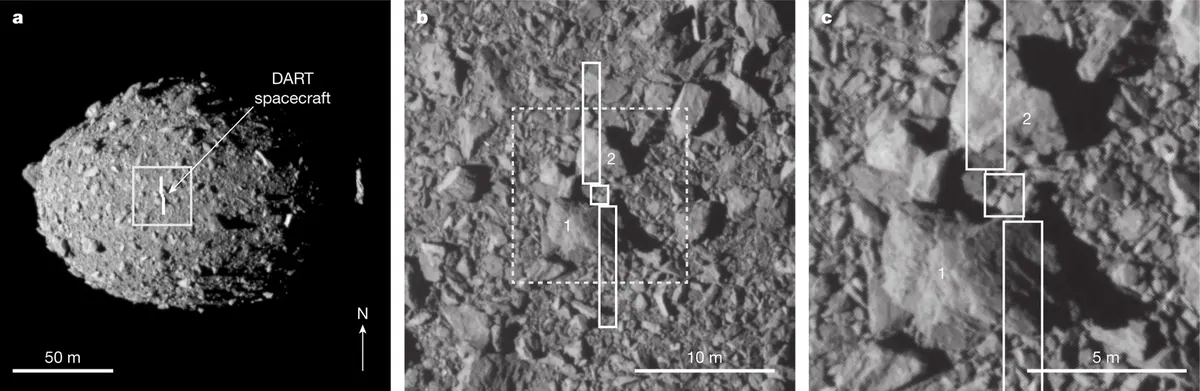
The European Space Agency's Hera probe has revealed that the impact of NASA's DART mission in 2022 left a stadium-sized crater on the face of asteroid Dimorphos. The first images, taken from about 25 kilometers away, show that the previously rounded surface on that side has been flattened by the collision. The small asteroid is now tumbling chaotically in its orbit around its larger companion, Didymos, and both are surrounded by hundreds of previously unknown rocks. Hera arrived at the binary asteroid system on November 4, after a two-year journey, to conduct the most detailed investigation to date of the aftermath of humanity's first planetary defense test.
According to Patrick Michel, principal investigator of Hera, scientists debated whether Dimorphos had sustained an impact crater, changed its shape or stayed the same. He explained that, much to their surprise, the answer turns out to be all three at once, as the face struck by DART has been flattened into an impact crater the size of a sports stadium, which extends across the asteroid's entire width. The rest of Dimorphos does not show major changes, with boulder fields that look just like they did in DART's 2022 images. Michael Kueppers, ESA's Hera mission scientist, noted that as Hera returned more images, it became clear that the DART impact has left Dimorphos tumbling wildly in its orbit. Another unexpected finding is the presence of hundreds of rocks, just a few meters in size, orbiting around the asteroid pair. The team will have to take account of these objects in the coming weeks as the spacecraft moves in closer to acquire higher-resolution images.
Hera mission manager Ian Carnelli presented the first images at the Museum fur Naturkunde Berlin. He said that 66 million years ago, an asteroid impact changed the course of life on Earth, and that today, for the first time in history, humanity is validating how to prevent such an event from happening again. He added that NASA's DART mission demonstrated that we can change an asteroid's orbit, and that Hera is now revealing what happened to the asteroid itself, taking a decisive step towards making asteroid deflection a reliable tool. Dimorphos, about 150 meters in diameter, orbits the 730-meter asteroid Didymos. On September 26, 2022, the 576-kilogram DART spacecraft deliberately impacted Dimorphos at a speed of 6.1 kilometers per second, shortening its orbital period by 33 minutes, from 11.92 to 11.37 hours. This success confirmed the viability of the kinetic impactor technique for planetary defense.
Julia de Leon, a researcher at the Instituto de Astrofisica de Canarias and scientific lead for the Hyperscout-H instrument, highlighted that this is a very powerful instrument. It allows them to obtain an image with good spatial resolution to identify surface features and, at the same time, information about the minerals and the degree of alteration they have experienced. Regarding the rocks surrounding the system, she emphasized that it is amazing, as although they were prepared to see material orbiting after such an impact, this exceeds their best expectations. Hera's investigation is far from over. In December, the spacecraft will move in to about 13 kilometers from the asteroid pair, returning progressively higher-resolution images.
In January 2027, it plans to deploy two shoebox-sized CubeSats. These are Juventas, led by Luxembourg, which will use radar to probe the asteroid's interior and attempt a landing, and Milani, led by Italy, which will study asteroid materials and surrounding dust. Together, they will form a pioneering three-spacecraft system exploring two asteroids. ESA Director General Josef Aschbacher commented that this is international collaboration at its best, where NASA demonstrated that an asteroid can be deflected and ESA is providing the detailed scientific investigation to understand how that deflection worked, with contributions from international partners like JAXA. According to him, together they are transforming a successful experiment into the scientific knowledge needed to develop a reliable planetary defense capability. Hera is ESA's first planetary defense mission, but the agency is already developing the Ramses mission, in cooperation with JAXA, to investigate asteroid Apophis during its close Earth flyby in April 2029.