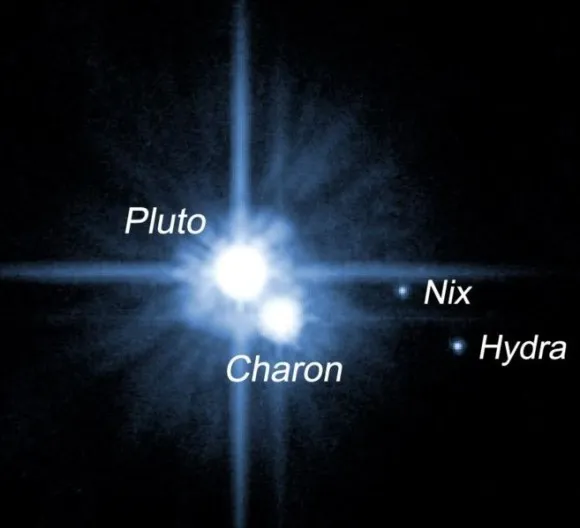
The International Astronomical Union (IAU) decided that the term "Plutoid" will designate dwarf planets like Pluto in a meeting of the Executive Committee in Oslo.
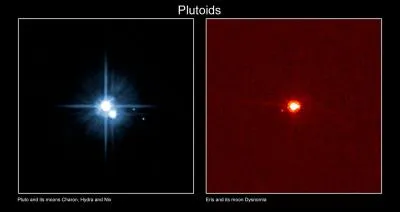
Almost two years after the IAU introduced the category of dwarf planets, the organization decided, as promised, on the name for trans-Neptunian dwarf planets similar to Pluto. The name Plutoid was proposed by members of the IAU Committee on Small Body Nomenclature (CSBN) and approved by the Executive Committee in a recent meeting in Oslo, Norway.
Plutoids are celestial bodies in orbit around the Sun at a distance greater than Neptune's, which have sufficient mass for their own gravity to overcome rigid body forces so that they assume a hydrostatic equilibrium shape (approximately spherical) and that have not cleared the neighborhood around their orbit. The two objects that will receive this label - for now - are Pluto and Eris.
The dwarf planet Ceres does not fall into this category as it is located in the asteroid belt between Mars and Jupiter (and not farther than Neptune as the definition requires). Current scientific knowledge lends credence to the belief that Ceres is the only object of its kind, so a separate category for this object will not be proposed for now.
At the Oslo meeting, the time involved in naming new plutoids was discussed. It was decided that, for naming purposes, any Solar System body that has:
a) a semi-major axis greater than Neptune's and b) an absolute magnitude brighter than H=+1 will be considered a Plutoid and named by the Working Group for Planetary System Nomenclature and the Committee on Small Body Nomenclature. Names proposed by the discovery teams will be given deference. If subsequent research shows that the object is not massive enough and does not qualify as a plutoid, it will keep the name but change category.
Sources and related links
IAU:Plutoid chosen as name for Solar System objects like Pluto
About the images
Credit:IAU, NASA/ESA Hubble Space Telescope, H. Weaver (JHU/APL), A. Stern (SwRI), the HST Pluto Companion Search Team and M. Brown.