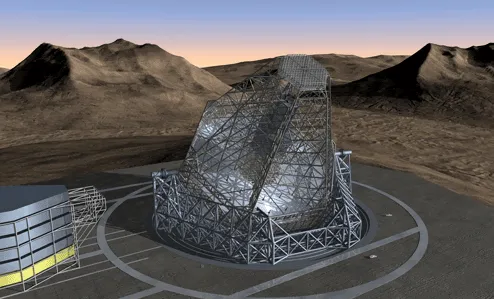
European astronomers finalized last week the definition of what will be the world's largest optical telescope, with a mirror 42 meters in diameter composed of between 800 and 1,000 hexagonal pieces that will form a light-gathering area of 1,200 square meters. The ELT (Extremely Large Telescope) could enter service in 2018.
Via El País
A. R. - Madrid
"We have obtained here in Marseille the consensus of the scientific community on the specifications of the future ELT," said Catherine Cesarsky, director general of the European Southern Observatory (ESO), which leads the project, reports France Presse. The preliminary studies for the large facility will still last three or four more years, but scientists have already defined the essential characteristics of the 42-meter ELT. Its cost would be about 1,000 million euros.
The new telescope will incorporate adaptive optics technology to compensate for atmospheric fluctuations that affect light from stars and reduce the telescope's resolution. Orbiting observatories do not have this problem, but they are much smaller: the Hubble's mirror measures 4.2 meters in diameter, and the next space telescope, which will be for infrared, will measure 6.5 meters.
In recent years, the possibility of building a 100-meter diameter telescope has been considered, but it is deemed too risky.
The United States also proposes a ground-based observatory of this range, with two competitive projects: one of 30 meters in diameter in collaboration with Canada and another of 21.5 meters with Australia. Regarding the location of the ELT, Cesarsky said that the Canary Islands were not excluded (the agreement for Spain's entry into ESO indicates that this location will be taken into account when choosing a suitable site for the future European telescope). The possibility of Chile (where ESO has its current observatories) will also be explored, "but also Argentina, where we have found an exceptional site," said the director general.
Cesarsky commented that for ESO, it would not be at all foolish to consider installing the future ELT near the large ALMA radio telescope, which is now being built in northern Chile.