Using NASA's Hubble Space Telescope and the Keck Observatory in Hawaii, astronomers have learned that the gaseous formation of one of the brightest and supergiant stars in the sky is more complex than originally thought.
Via Hubblesite
The eruptions are from VY Canis Majoris, a red giant also classified as a supergiant due to its high luminosity. The eruptions have formed arcs of material moving at different speeds and directions. The star has had many eruptions in its last 1,000 years as it is near the end of its stellar life.
A team of astronomers led by Roberta Humphreys of the University of Minnesota used the Hubble telescope and the Keck Observatory to measure the movements of the ejected material and map the distribution of highly polarized dust that reflects light in a specific orientation. Polarized light shows how the dust is distributed. With the information from both telescopes combined, a three-dimensional map of the matter emitted from VY Canis Majoris will be created.
"We thought that the matter lost in red supergiants was a simple, spherical, uniform eruption, but in this star it is very complex," said Humphreys. "VY Canis Majoris is ejecting large amounts of gas at a formidable rate and is consequently one of the most important stars for understanding the loss of large amounts of mass near the end of the evolution of a massive star. During the eruptions, the star loses about 10 times more mass than the usual loss."
"With these observations, we have a complete picture of the movements and directions of the eruptions and their spatial distribution, which confirm their origin from eruptions at different times from separate regions of the star."
Humphreys and her collaborators presented their discovery on January 8 at the meeting of the American Astronomical Society in Seattle, Wash.
Astronomers have studied VY Canis Majoris for more than a century. The star is located 5,000 light-years away. It is 500,000 times brighter and between 30 and 40 times more massive than our Sun. If the Sun were replaced by this star, its surface could extend to the orbit of Saturn.
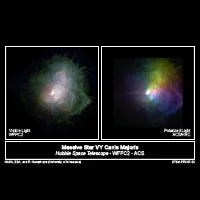
Images taken with the Wide Field Camera and the Planetary Camera 2 revealed for the first time the complexity of the star's ejections. The first images provide evidence that the brightest arcs were created during several eruptions. The random orientation of the arcs also suggests that they were produced by eruptions localized in active regions of the stellar surface.
With spectroscopy obtained using the Keck Telescope, Humphreys and her team learned more about the shape, movement, and origin of the star's eruptions. The team found that the numerous arcs were moving at different speeds and in various directions, confirming that they were produced by separate events and from different locations on the star.
The astronomers also used the measurements to determine when these eruptions occurred. The outer material was ejected about 1,000 years ago, while a knot was ejected as recently as 50 years ago.
The arcs and knots represent massive eruptions of gas probably ejected from large zones or convective cells on the stellar surface, analogous to the activity of our Sun with its spots and prominences associated with magnetic fields, but on a much larger scale. Magnetic fields were measured in the ejections of VY Canis Majoris and correspond to strong fields on its surface comparable to the magnetic fields on the Sun. These measurements show that the supergiant's fields will supply enough energy for these massive eruptions.
The astronomers have combined the measurements of the speed and direction of the eruptions with the dust distribution maps and determined the location of the arcs and knots, obtaining a three-dimensional shape of the form of VY Canis Majoris and its ejections.
"With these observations, we have captured a small phase of life in a massive star. The most luminous supergiants could eventually experience episodes of large mass loss like those of this star, before the end of their lives," said the team's lead astronomer.
The phase of typical red supergiants lasts about 500,000 years. A massive star becomes a red supergiant near the end of its life, when it exhausts the hydrogen in its core. As the core contracts under gravity, the outer layers expand, the star becomes 100 times larger and begins to lose mass at a much greater rate. VY Canis Majoris has probably lost half its mass and will eventually explode as a supernova.
Technical facts about this news release:
About the Object Object Name: VY Canis Majoris
Object Description: Variable Star with Circumstellar Nebula
Position (J2000): R.A. 07h 22m 58s.33
Dec. -25° 46' 3".2
Constellation: Canis Major
Distance: Approximately 5,000 light-years (1.5 kiloparsecs)
Dimensions: These images are roughly 35 arcseconds (0.85 light-years or 0.25 parsecs) across.
About the Data Data Description: The Hubble image was created from HST data from proposals 7304: R. Humphreys, K. Davidson, T. Jones, and R. Gehrz (University of Minnesota) and J. Krautter and T. Szeifert (Landessternwarte, Heidelberg); and 10262: R. Humphreys and T. Jones (University of Minnesota), G. Herbig (University of Hawaii), and G. Wallerstein (University of Washington).
Instrument: WFPC2 ACS/HFC
Filters: F410M (Strömgren v), F656N (H-alpha), F547M (Strömgren y), and F1042M F658N (R) (POL0V, POL60V, and POL120V)
F550M (V) (POL0V, POL60V, and POL120V)
Exposure Date: March 22, 1999 and June 13, 2005 August 17, 2004
About the Image Image Credit: NASA, ESA, and the Hubble Heritage Team (STScI/AURA)-ESA/Hubble Collaboration
Release Date: January 8, 2007
Color: This image is a composite of many separate exposures made by the WFPC2 and ACS instruments on the Hubble Space Telescope using several different filters. Three filters were used to sample various wavelength ranges in each instrument. The color results from assigning different hues (colors) to each monochromatic image. In this case, the assigned colors are:
WFPC2 ACS/HRC
F410M (Strömgren v) blue F550M (R; POL0V) cyan
F547M (Strömgren y) green F550M (R; POL60V) yellow
F656N (H-alpha)+F1042M red F550M (R; POL120V) magenta