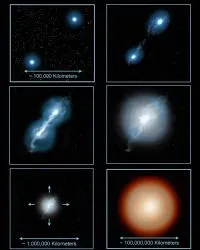
Imagine two stars whose winds are so powerful that they expel an amount similar to the mass of Earth once per month. Now, imagine two of those winds colliding. Such a titanic collision produces incredibly hot gases that radiate bright X-rays.
Via ESA
Astronomers have identified emissions of this type in about two dozen systems in our Milky Way. But they had never seen one outside the galaxy, until now.
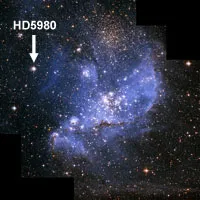
Thanks to the ESA's XMM-Newton X-ray observatory, with help from NASA's Chandra observatory, an international team led by Dr. Yaël Nazé of the Université de Liège in Belgium has found a system of that type in a nearby galaxy, the Small Magellanic Cloud, 170,000 light-years from Earth.
The binary system, known as HD 5980, contains two massive stars, which "weigh" between 30 and 50 times the mass of our Sun. Each star radiates more than a million times the light of the Sun, thus generating more light in one minute than our host star generates in an entire year.
The stars of HD 5980 are separated by only 90 million kilometers, about half the average distance from Earth to the Sun.
This energetic X-ray emission was first reported in 2002 using data from Chandra, but its origin was uncertain.
HD 5980 is one of the brightest systems in the Small Magellanic Cloud. Located on the periphery of the cluster NGC 346, both stars are near the end of their days and will eventually end as supernovae.
The more massive HD 5980A is going through the Luminous Blue Variable (LBV) phase, an erratic age that only the most massive stars go through. Its companion, HD 5980B is a Wolf-Rayet star that has already expelled much of its original envelope.
More on Wikipedia
Stellar Evolution
List of largest known stars