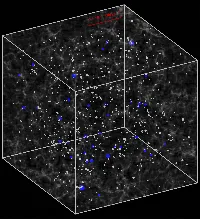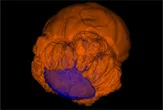
For years astronomers have tried in vain to explode an Earth-sized star using computer simulation. Finally, mission accomplished. And the result of the 3D simulation has revealed, step by step, the process of such explosions.
Via Space.com
White dwarfs are stars with a size similar to that of our planet but with a mass like that of the Sun. At the end of their stellar lives they explode in so-called type Ia supernovae which are thought to be responsible for the production of most of the iron in the universe.
Previous attempts to produce simulations of this type required scientists to manually tell the computer that the star should explode. By improving the models, a team of scientists from the University of Chicago generated natural detonations of white dwarfs in two-dimensional simulations.
It was said that in three dimensions it wouldn't work, but they finally achieved it.
The simulation confirmed what the team already suspected: The star explodes in a supersonic process, similar to the combustion of a diesel engine.
Unlike a gasoline engine, where a spark ignites the fuel, in a diesel engine it is achieved with compression triggers.
"You wouldn't want a supersonic explosion in a car, but the trigger is similar," commented team leader Dean Townsley of the Joint Institute for Nuclear Astrophysics in Chicago.
Although the simulation took a total of 58,000 hours and more than 700 processors, the actual process from start to finish -when the star explodes- takes only three seconds.
This "movie" reveals a complex series of events that conclude with the bang. Seconds before the stellar end, a bubble about 10 miles in diameter forms near the center of the white dwarf. Immediately the giant bubble ejects the 1,200 miles of the stellar surface. A second later, this flame collides with itself and triggers the detonation.
"It seems that the dynamics of the collision is what creates a localized zone of compression where the detonation will manifest itself," commented Townsley.
Type Ia supernovae have been used to calibrate the size and expansion of the universe, because they are flares of similar intensity. In this way, the conclusion was reached in the late 1990s that the expansion is accelerating. It is postulated that dark energy, which would be a repulsive energy, is winning the battle against gravity and would be the reason for this acceleration.
The new simulations could help scientists improve their calibrations to detail the smallest variations between one supernova and another. Understanding the nature of these variations would make it possible, among other things, to better understand dark energy.
On the Space.com page, the original source from which I translated the news signed by Jeanna Bryner, there are more detailed graphics and videos.