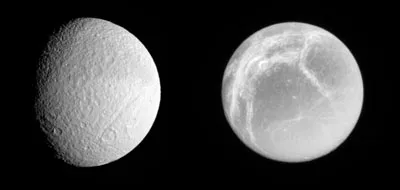
This means that Pluto, demoted to dwarf planet last year, does not hold the title of the largest in that category either. New data show that Eris is 27% more massive than Pluto.
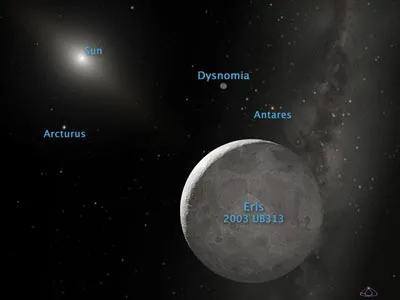
Illustration. Credits: NASA, ESA, and Adolph Schaller (for STScI)
According to Mike Brown, the discoverer of Eris, and his graduate student Emily Schaller, the data confirm that Eris weighs 16.6 billion trillion kilograms, data obtained by calculating the time it takes Eris's moon, Dysnomia, to complete an orbit.
"This was Plutón's last chance to be the largest object in the Kuiper Belt," said Brown, a professor of planetary astronomy at the California Institute of Technology.
Eris was discovered in 2005 with the Oschin telescope at Palomar Observatory.
When it became apparent that Eris was similar in size, if not larger, than Pluto, Brown and others went to the International Astronomical Union to account for its planetary status, which ultimately resulted in Pluto's demotion to dwarf planet.
Schaller said that the new results, obtained with the Hubble Space Telescope and data from the Keck Observatory, indicate that the density of Eris's material is about two grams per cubic centimeter. This means that Eris is made of ice and rock, meaning its composition is very similar to Pluto. Previous results had allowed scientists to determine its diameter as 2400 kilometers, also larger than Pluto.
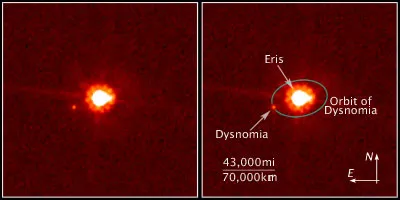
Images of Eris and its satellite. Credit: NASA, ESA, and M. Brown (California Institute of Technology)
"Pluto and Eris are essentially twins—except that Eris is the larger of the two—and a bit colder," say Brown and Schaller.
The reason for Eris's cold is its distance from the Sun, about 97 astronomical units, which makes it reach temperatures below 400 degrees Fahrenheit.
The orbits of Eris and Pluto are also different. In its very elliptical 560-year journey around the Sun, Eris approaches the star to about 38 AU, although it is currently at its greatest distance.
Pluto, in its 250-year revolution, comes as close as 50 AU from the Sun. This means that Eris is, at times, closer to our star.
Based on spectral data, researchers think that Eris is covered with a layer of methane that seeped from the interior and froze on the surface. As in the case of Pluto, the methane underwent chemical transformations, probably due to weak solar radiation, causing the layer to redden. But on Eris, the layer is more yellowish perhaps because it is farther from the Sun.
The authors reported the discovery in the paper "The Mass of Dwarf Planet Eris" in the June 15 edition of Science.
IAU 2006: Results