Saturn's moons Tethys and Dione are expelling waves of particles into space, according to new data from the Cassini mission. The discovery suggests the possibility of some kind of geological activity, perhaps even volcanic, on these icy worlds.
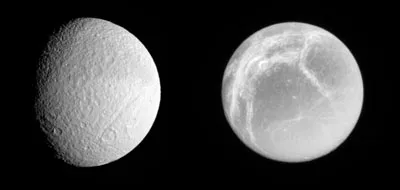
Image composite made from separate shots of Saturn's moons, Tethys (left) and Dione (right) taken by Cassini. Credits: NASA/JPL
The particles were traced back to the two moons by their dramatic movement of electrically charged gas in the planet's magnetic surroundings. Known as plasma, the gas is composed of negatively charged electrons and positive ions, which are atoms with some missing electron. Because they are charged, the electrons and ions can become trapped in a magnetic field.
Saturn rotates on its axis in just 10 hours and 46 minutes. This sweeps the magnetic field and the trapped plasma into space, away from the center of rotation.
After Cassini reached Saturn, in June 2004, it revealed that the planet's rapid rotation sends the plasma into a disk and from there into space.
Now, Jim Burch of the Southwest Research Institute, USA, and his colleagues have made a careful study of these events using the Cassini Plasma Spectrometer (CAPS). They showed that the direction of the ejected electrons points toward Tethys and Dione. "It establishes Tethys and Dione as important sources of plasma in Saturn's magnetosphere," said Burch.
Until these results, among the planet's inner moons, only Enceladus was known as an active world, with enormous geysers expelling gases hundreds of kilometers above the moon's surface. "This new result seems to be a strong indication that there is activity on Tethys and Dione as well," says Andrew Coates, a collaborator on the study.
"The best results are achieved by combining a variety of data to understand the observations," comments Michele Dougherty, from Imperial College.
In the case of these two moons, more flybys are scheduled in the future. Meanwhile, the team will have to review the data from the flybys made in 2005 to look for similar data.
The discoveries appear in the June 14 edition of Nature. The article 'Tethys and Dione as sources of outward-flowing plasma in Saturn’s magnetosphere' is by J. Burch, J. Goldstein, W. Lewis, D. Young, A. Coates, M Dougherty and N. André.
Related links
ESA press release
NASA/Cassini press release