Astronomers suspect that early Earth was a difficult place. Temperatures were extreme, and the planet was constantly bombarded by cosmic debris. Many scientists believe that the building blocks of life must have been very resilient to survive this tumultuous environment.
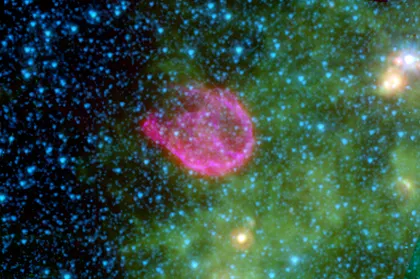
Composite image from Spitzer and Chandra in X-ray and infrared. Credit: X-ray: NASA/SAO/CXC; Infrared: NASA/JPL-Caltech/A. Tappe & J. Rho
Now it has been discovered that the organic molecules thought to be among the building blocks of life, called PAHs, can survive another type of very complicated environment, supernova explosions.
Dr. Achim Tappe from the Harvard-Smithsonian Center for Astrophysics used the infrared spectrograph aboard NASA's Spitzer Space Telescope to detect the abundance of PAHs in the supernova remnant N132D, located 163 thousand light-years away in the Large Magellanic Cloud.
"The fact that we can see PAHs surviving this explosion illustrates their resilience," said Tappe.
These intriguing molecules are comprised of carbon and hydrogen atoms and have been found in comets, around star-forming regions and planetary formation disks. Since all life on Earth is based on carbon, astronomers suspect that some of the planet's original carbon could have come from these molecules - possibly from comets that collided with the young Earth.
Astronomers say there is some evidence that a massive star exploded near our solar system as it began its formation about 5 billion years ago. The PAHs that could have survived that explosion might have helped seed life on our planet.
Tappe's paper was published in December in Astrophysical Journal.
Press release on Chandra
Press release on Spitzer