After exceeding its expected operational lifetime, the exploration vehicle Opportunity begins another risky adventure, this time venturing into Victoria crater on Mars.
The route followed by Opportunity during its descent.
Credit: NASA/JPL/Cornell/University of Arizona/Ohio State University
Opportunity, NASA's "all-terrain" vehicle exploring Mars, is scheduled to descend a rocky slope into the interior of the massive Victoria crater on the Red Planet. The adventure carries a real risk for the long-lived robotic explorer, but NASA and the vehicle's science team hope it will provide valuable scientific results.
Opportunity has already explored the layered rocks that protrude from the cliffs around Victoria crater. The team has carefully planned the descent to allow for a possible exit, but Opportunity could become trapped inside the crater or could lose some of its capabilities. The explorer has already exceeded the original expectations for its operational lifetime by twelve times, which were initially only 90 days.
The scientific motivation is the opportunity to examine and investigate the composition and textures of materials exposed deep within the crater for clues about ancient wet environments. As the vehicle descends the slope, it will be able to examine increasingly older rocks in the exposed crater walls.
"While we take seriously the fact that we don't know if Opportunity will be able to climb out of the crater, the potential value of the investigations that seem possible inside the cavity convinced me to authorize the team to proceed and enter Victoria crater," said Alan Stern, NASA associate administrator, in the Science Mission Directorate at NASA headquarters in Washington. "It's a calculated risk worth taking, especially because this mission has already far exceeded its original goals."
This "geologist robot" will enter Victoria crater through an opening called Duck Bay. The eroding crater has a steep rim, formed by promontories shaped like cliffs called capes. These capes alternate with inlets that have gentle slopes, also called bays.
A meteorite impact, millions of years ago, excavated Victoria crater, which lies at a distance of approximately 7 kilometers (4 miles) south of the landing site of the vehicle in January 2004. The impact basin has a diameter of about 800 meters (half a mile) and is approximately five times wider than Endurance crater, where Opportunity performed exploration tasks for over six months in 2004.
The explorer began its journey towards Victoria crater from Endurance crater about 30 months ago. It reached the rim at Duck Bay nine months ago. Opportunity then traveled clockwise almost a quarter of the rim's circumference, examining layers of rock visible in the promontories and investigating possible entry routes into the crater through the gaps between the cliffs. Now, the explorer has returned to the most favorable entry point.
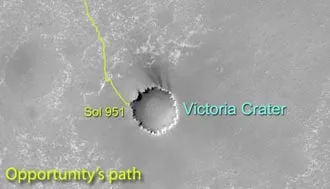
"Duck Bay appears to be the best candidate for entry," said John Callas, project manager for the rover at NASA's Jet Propulsion Laboratory. "It has slopes of 15 to 20 degrees as well as exposed bedrock that allows for safe driving of the vehicle."
If the vehicle's six wheels continue to function, engineers expect Opportunity to be able to climb back out of the crater. On the other hand, Spirit, Opportunity's twin rover, has been unable to use one of its wheels for over a year, which reduced its climbing ability.
"These rovers have already exceeded their expected lifetimes and another wheel could fail on either vehicle at any time," said Callas. "If Opportunity lost the ability to use one of its wheels inside Victoria crater, it would be very difficult, perhaps impossible, to climb back out."
"We don't want this to be a one-way trip," said Steve Squyres, principal investigator for the rovers' scientific instruments at Cornell University in Ithaca, N.Y. "We still have excellent scientific targets on the plains that we would like to visit after going into Victoria. But if Opportunity gets stuck there, it will at least be worth it for all the knowledge we will have gained."
-------------
Update July 05
Dust storms hinder rover travel on Mars
A dust storm enveloping Mars intensified in recent days and has halted the operations of NASA's rovers on the planet, confirmed today by the Jet Propulsion Laboratory (JPL).
The storm began last week and has prevented the six-wheeled vehicles from receiving the sunlight they need to operate on their panels.
As a result, the entry of "Opportunity" into Victoria crater, scheduled for this week, has had to be delayed several days, said sources at JPL.
"Spirit", the twin brother of "Opportunity", has also been affected by the storm, even though it is on the opposite side of the planet.
According to Steve Squyres, a layer of dust the thickness of a human hair is enough to reduce sunlight on the panel by 96 percent.
Squyres indicated that the solar panels also receive light scattered by dust particles, so "in reality, the loss of energy is not that great."
However, John Callas, director of the rover explorations on Mars, noted that "the storm has affected both and has reduced 'Opportunity's' energy levels."
"We remain vigilant but our entry into Victoria will be delayed and will not occur before next Friday," he added.
However, the scientist stated that some data received from Mars indicate that the peak intensity of the storm has likely passed.
"The situation could improve quickly and we will have to wait" to make a decision, he said.
That data about the storm comes from the "Mars Reconnaissance Orbiter" orbiting the planet.
The risky mission of "Opportunity" in Victoria crater aims to study the history of the planet's geological structure by analyzing its slopes.
NASA authorities consider this to be the most dangerous mission of its journey on the planet, begun more than three years ago.
Specifically, they fear the vehicle may not be able to exit the crater once it has entered, which would end a job on the surface of Mars that has exceeded all expectations.
"Opportunity" has already explored the rocks near the crater and the team that directs it from JPL has carefully planned its entry, as well as its exit.
However, it could become trapped in the crater or lose part of its operational capacity, NASA said last week when reporting that the vehicle has exceeded its initial work capacity, originally calculated at 90 days, by more than twelve times.
According to NASA authorities, no matter what the dangers are, the results of that mission will offer the opportunity for a better knowledge of the planet.
"Although we take seriously the danger that 'Opportunity' may not return, the potential value of its investigations inside the crater convinced me to authorize the descent into Victoria crater," said Alen Stern, NASA deputy administrator.
"It is a calculated risk worth taking, especially considering that this mission has already far exceeded all expectations," he added.
Sources and related links
- Ciencia@NASA: Dangerous Descent
- NASA Mars Exploration: Dust Delays Mars Crater Entry
- ABC: The suicide mission of the «Opportunity» on Mars
- Unionradio.net: Dust storms hinder journey...