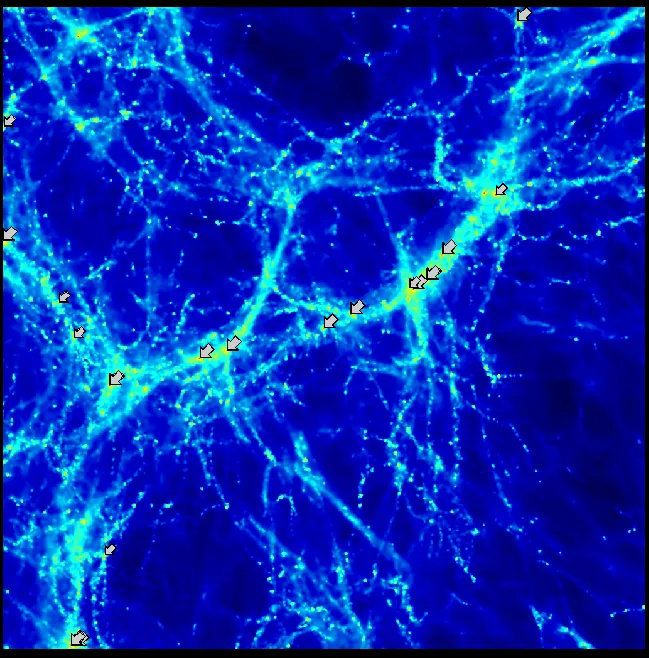
The U.S. space agency has created a new office to study in more detail some of the most exotic phenomena in the universe: dark energy, black holes, and the cosmic microwave background radiation.
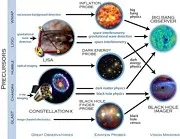
Composition of the Beyond Einstein program - NASA
The new office, called the Einstein Probes Office, will facilitate future scientific missions to investigate these profound cosmic mysteries. The office will be part of the Beyond Einstein program at the Goddard Space Flight Center.
The program consists of five proposed missions: two large observatories and three small probes. Technological developments for the observatories are already underway. The Laser Interferometer Space Antenna or LISA would orbit the Sun measuring gravitational waves in our galaxy and beyond. Constellation-X would see matter falling into supermassive black holes.
The proposed probes would investigate the nature of dark energy, the physics of the Big Bang, and the distribution and types of black holes.
The probes would be:
The Joint Dark Energy Mission (JDEM): Less than a decade ago we did not know of the existence of this energy that, apparently, causes the acceleration of the universe's expansion. This energy comprises 70% of the mass-energy of the Cosmos, but we do not know what it is. The mission is a collaboration between agencies, NASA and the Department of Energy, to develop a mission that will study this dark energy and determine how it evolves over time. Several ideas for Dark Energy study Probes have been proposed and three of these concepts have recently been selected for further study.
The Inflation Probe:
Immediately after the Big Bang, the Universe appears to have had a period of inflation that expanded so rapidly that parts of the universe moved apart faster than the speed of light. This rapid expansion allowed slight density differences in the dense early cosmos that enabled the subsequent formation of stars, galaxies, and large voids seen today. But what produced that inflation? Could it be the same force that is accelerating the expansion of the universe today? That is what this probe will be dedicated to.
Black Hole Finder Probe:
Scientists have identified two main classes of black holes: small, star-sized ones that form from the collapse of massive stars; and supermassive ones in the nucleus of most galaxies. The latter can contain the mass of millions to billions of suns and grow by "swallowing" stars and gas that come near. This releases large amounts of energy, but the light coming from these black holes is not enough to explain that growth. The probe in question will conduct a census of these ultra-compact objects, trying to reveal when, where, and how they form and will allow the study of the cosmic evolution of black holes.
The observation missions
Big Bang Observer
To explore the beginning of time, a "Big Bang Observer" will be built with LISA to directly measure the gravitational waves from the very early universe, still present. In contrast to the Inflation Probe, which will measure the frozen imprints of longer waves in the microwave background, this Observer will observe the gravitational waves in their original form from the still early Big Bang. A direct view of the creation of space-time.
Black Hole Imager
To explore the frontiers of space, Constellation-X will measure the spectral signatures of gas falling into black holes and LISA will record the stars around them. But there are no substitutes for direct imaging. An instrument to observe black holes, based on a technique known as X-ray interferometry, could take images, directly revealing the fate of matter near a black hole.
The space agency and the U.S. Department of Energy have commissioned a committee of the National Research Council to assess which of the missions should be developed and launched first. The recommendations should be made in September of this year.
The Beyond Einstein program is designed to provide key information to help answer fundamental questions about the origin and evolution of the universe.