Observing a faint object that is near a star is a more than difficult task since the object is hidden by the glow of its companion.
A greater challenge is characterizing this object by taking its spectrum. However, thanks to ingenious scientists and a new spectrograph from ESO, it is now feasible, marking the path toward new exciting discoveries.
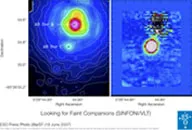
ESO PR Photo 28c/07: Hertzsprung-Russell Diagram. (SINFONI/VLT)
These high-contrast observations are fundamental for directly seeing exoplanets as well as low-mass stars and brown dwarfs.
Astronomer Niranjan Thatte and his colleagues developed a new method for this purpose. The basis of the concept is relatively simple: while the position of most elements associated with the host star and artifacts produced by the telescope and instrument scale with wavelength, the location of a faint companion does not. Therefore, if the image has an internal reflection of the masked star as a planet, this ghost planet will be in one location in the image when viewed in red light and in another when viewed in blue; a real planet will remain in the same position regardless of the color it is viewed in. However, with the combined detection of spectrum and position, one can see what is scaling, subtract it, and be left with the rest, the faint object. Such observations can be made with specific instruments, called "integral field spectrographs" like SINFONI on ESO's VLT. This technique, called Spectral Deconvolution (SD in English), although first proposed in 2002 for space applications, has not been applied to obtain spectra of real objects until now.
"We have applied our new technique to a very small stellar companion—about twice the size of Jupiter—known as AB Doradus C and the result was surprising," commented Thatte.
Using SINFONI and this new technique, the astronomers were able for the first time to obtain a spectrum of the object free from the light of its luminous companion and containing all the information necessary for a complete classification.
The new observations led to a new temperature for the object and change the results that some of the same scientists derived in 2005.
"That's how science progresses," commented Laird Close, team leader. "New instruments lead to better techniques and measurements that usually achieve better results and one must happily change course."
The observations were complemented with previous data obtained at ESO's VLT with the NACO instrument.
AB Doradus is a system of two pairs of stars (4 in total, a quadruple system), 48 light-years away toward the constellation Doradus (the swordfish).
AB Doradus A is the principal member of the system and has a faint companion, AB Dor C, at 3 astronomical units (AU). This latter object was seen for the first time in 2005. The other members are the pair AB Doradus BaBb at 133 AU from AB Dor A.
While AB Doradus A has a mass of about 85% of the Sun's mass, AB Dor C is about 10 times less massive than AB Doradus A and belongs to the category of cold red dwarfs.
Red dwarfs are very interesting because their mass is on the edge of being brown dwarfs. Greater knowledge of these stars is necessary to improve our understanding of stellar evolution. If AB Dor C were slightly less massive than its 93 Jupiter masses, it would have failed to become a star, being instead a brown dwarf. As it is, the center of AB Dor C is slowly heating up and in about a billion years its core will be hot enough to fuse hydrogen into helium, something a brown dwarf will not be able to do.
"This red dwarf is 100 million times closer to its bright companion than the entire system is to us and about 100 times less bright. It is a perfect example where our high-contrast technique is required," explains Matthias Tecza, a team member.
From previous observations, this unique star seemed to be colder than expected for an object of that mass and age. The new and more precise observations show that this is not the case, with the observations in good agreement with theory, in particular with the models developed by the group of Gilles Chabrier of Lyon, France.
With a temperature of about 3000 degrees (about half as hot as our Sun) and a luminosity about a thousand times fainter than our star, AB Dor C is on the expected path for a star of about 75 million years with 9% the solar mass. AB Dor C is the only (young and cold) star with a precise mass, so the determination of an exact temperature is critical to validate these models.
In the future one could use these data to extrapolate the mass of small young stars, once their temperature and luminosity are precisely determined.
Sources and related links
- ESO: New Technique for Observing Faint Companions
- Axxón: Weighing small stars