One of the largest and most luminous stars in our galaxy is, surprisingly, a prolific place for the creation of complex molecules important for life on Earth, a new study reveals.
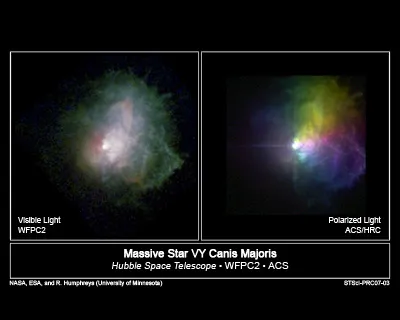
Hubble images of VY Canis Majoris. Credit: NASA, ESA, and R. Humphreys (University of Minnesota)
"Where we thought molecules could never form, we are finding them. Where we thought they would not survive, they survive," says Lucy Ziurys, an astronomer at the University of Arizona, in Tucson.
Using the 10m radio antenna at the top of Mount Graham in Arizona, Ziurys and her team conducted a search in the extensive gas envelope around VY Canis Majoris, a red supergiant estimated at 25 solar masses and nearly half a million times brighter than our star.
There they found emissions from several components, including hydrogen cyanide (HCN), silicon monoxide (SiO), sodium chloride (NaCl) and a molecule, PN, in which a phosphorus atom and a nitrogen atom are bonded.
The PN molecule is interesting for astrobiologists because phosphorus is relatively rare in the universe, and necessary for the construction of DNA and RNA, as well as ATP, the key molecule in cellular metabolism.
For years, astronomers have known that dense molecular clouds, dominant in the plane of our galaxy, are the repositories of a great variety of chemicals that later find their place in nascent solar systems. What was less clear is how these molecules form in the first place.
In recent years, astronomers have turned their attention to older stars, which typically expel large amounts of gas as they expand and become red giants. Until recently, it was expected that any molecule condensed from the cold, expelled gas would later be destroyed by the intense ultraviolet radiation emitted by the star.
The work of Ziurys and others demonstrates that this is not the case. The ejected material contains clusters of dust particles that apparently form a shield for the molecules and can guide them safe and sound into interstellar space.
Chemical variety
The latest findings add a twist to the story. Because VY Canis Majoris is an oxygen-rich star it was not expected to harbor so many interesting molecules. Oxygen atoms easily outnumber carbon atoms around such stars and one would expect the oxygen to take the available carbon to form CO.
The discovery of molecules like HCN and a sulfurous carbon component around VY Canis Majoris suggests that the chemical composition can vary greatly in a stellar environment. It also implies that the chemistry that leads to life could be more extensive in the universe and more robust than previous studies had suggested.
A new era
The new technology comes from an improved version of a device called a Superconductor-Insulator-Superconductor (SIS), which can discern the energy emitted when molecules spontaneously change from one state to another.
The detector used by Ziurys and her team was developed for ALMA, a high-altitude radio interferometer, consisting of 50 antennas -each 12 m wide- currently under construction in Chile.
"This is the beginning of a new era in interstellar chemistry," said the scientist.
Sources and related links
- Dying star generates the stuff of life, NewScientist.com, Ivan Semeniuk
- Chemical complexity in the winds of the oxygen-rich supergiant star VY Canis Majoris, L. M. Ziurys, S. N. Milam, A. J. Apponi & N. J. Woolf, Nature 447, 1094-1097 (28 June 2007)