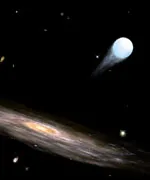
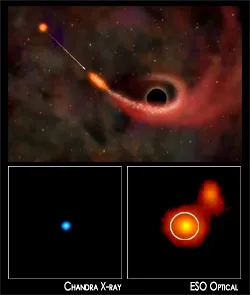
According to a new study, supermassive black holes grow more rapidly in young galaxy clusters. These black holes can have a great influence on the galaxies and clusters in which they live.
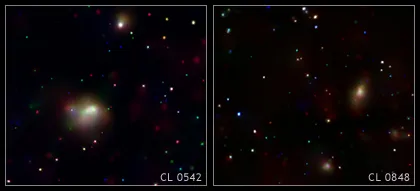
These two galaxy clusters, CL 0542-4100 and CL 0848.6+4453 are part of the sample used to count the fraction of galaxies with rapidly growing black holes.
Credit: NASA/CXC/Ohio State Univ./J.Eastman et al
Using the Chandra X-ray Observatory, scientists studied a sample of clusters and counted the fraction of galaxies with rapidly growing black holes, known as Active Galactic Nuclei or AGN. The data show, for the first time, that young and more distant galaxy clusters contain many more AGN than old and closer ones.
Galaxy clusters are some of the largest structures in the Universe, and consist of many individual galaxies, some of which contain AGN. Earlier in the history of the universe, these galaxies contained much more gas for star formation and the growth of black holes than galaxies in clusters have today. This fuel allows the black holes in young clusters to grow much more rapidly than their counterparts in nearby clusters.
"The black holes in these early clusters are like piranhas in a well-fed aquarium," says Jason Eastman of Ohio State University and lead author of the study. "It's not that they fight for food, but there was so much that all the piranhas were able to thrive and grow quickly."
The team used Chandra to determine the fraction of AGN in four different galaxy clusters at great distances, when the Universe was only 58% of its current age. They then compared this value with the fraction found in closer clusters, those in which the age of the Universe was 82% of the current one.
The result was that the more distant clusters contain about 20 times more AGN than the closer sample. AGN in outer clusters are also more common when the Universe was younger, but only by factors of 2 or 3 over the same period.
"It has been predicted that there would be fast-track black holes in clusters, but we never had good evidence, until now," says co-author Paul Martini. "This may help solve a couple of mysteries about galaxy clusters."
One mystery is why there are so many blue, star-forming galaxies in young, distant clusters and few in closer and older ones. It is thought that AGN expel or destroy the cold gas in their host galaxy through powerful eruptions from the black hole. This can suppress star formation and the massive and blue stars will gradually die, leaving behind only the older and redder stars. This process takes about a billion years or more, so the death of star-forming galaxies is only evident for the oldest clusters.
The process that sets the temperature of the hot gas in clusters when they form is also an open question. These new results suggest that even more AGN would have been present when most clusters were forming about 10 billion years ago. The early heating of a cluster by a large number of AGN may have a significant effect on the structure of a cluster by heating the gas.
"In some nearby clusters we have seen evidence of large eruptions generated by supermassive black holes. But this is little compared to what would be happening in young clusters," adds Eastman.
These results appeared in the July 20 issue of The Astrophysical Journal Letters.
Sources and related links
- Press release on Chandra
- Note on EurekAlert and Physorg
- Paper:First Measurement of a Rapid Increase in the AGN Fraction in High-Redshift Clusters of Galaxies, Jason Eastman, Paul Martini, Gregory Sivakoff, Daniel D. Kelson, John S. Mulchaey, and Kim-Vy Tran, APJL Vol. 664, No. 1, July 20, 2007