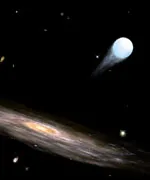
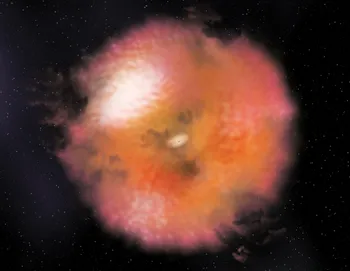
The fate of stars that are very close to black holes could be more violent than previously thought. They not only suffer the black hole's tremendous gravity, but the process can initiate a nuclear explosion that tears the star apart from the inside, according to a new study.
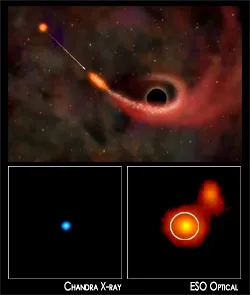
Scientists know that stars close to a supermassive black hole are torn apart by its gravity. You can see an animation of a star interacting with a black hole (mov format) on the Chandra site.
Now, a pair of physicists say this unequal tug is not the only risk for stars. The process could also trigger a nuclear explosion powerful enough to destroy the star from the inside.
Matthieu Brassart and Jean-Pierre Luminet of the Observatoire de Paris in Meudon, France, carried out computer simulations of the final moments in the life of a star close to a supermassive black hole.
When the star gets close enough, the unequal forces (stronger on the closer parts) crush the star into a pancake shape. Some previous studies suggested this flattening would increase the density and temperature inside the star enough to trigger intense nuclear reactions that would tear it apart.
But other studies suggested the situation would be complicated by shock waves generated during the flattening and that the nuclear explosion should not occur.
The new simulations investigated the effects of shock waves in detail, and found that even when their effects are included, the conditions favor a nuclear explosion.
Although the explosion destroys the star, it saves some of the star's matter from being devoured by the black hole, since the explosion is powerful enough to hurl part of the matter out of the black hole's reach, as Brassart explains.
The devouring of stars by black holes may have already been seen, though at a later stage. It is thought that several months after the event that tears the star apart, its matter—which has been spiraling through the hole—emits ultraviolet and X-rays.
NASA's GALEX spacecraft may have already seen such an event (see Black hole seen devouring star in best detail yet). Another event may have been seen by ESA's orbital observatories (see Giant Black Hole Rips Star Apart)
If stars near a black hole really explode, they could, in principle, allow these events to be detected at an earlier stage, says Jules Halpern of Columbia University. "It might make it possible to see the disruption of the star immediately if it gets hot enough."
Brassart adds that "Perhaps it could be observed in X-rays and gamma rays, but that is something that needs to be studied more."
Chris Fryer, a supernova researcher at Los Alamos Laboratory, says the deaths of these stars are difficult to simulate and that he is not sure the researchers have proven their case.
But if these explosions occur, future observations, such as the LSST (Large Synoptic Survey Telescope), which will detect a large number of supernovae, could find explosions of this type.
Sources and related links
- NewScientist.com: Black holes trigger stars to self-destruct, by David Shiga
- Paper: Shock waves in tidally compressed stars by massive black holes, M. Brassart, J.-P. Luminet (Laboratoire Univers & Theories, Observatoire de Paris-Meudon), 4 pages, 45 figures, submitted to Astron. Astrophys