An international team of astronomers using NASA's Swift satellite and the Suzaku X-ray observatory discovered a new class of active galactic nucleus.
Active galactic nuclei or AGN by their English acronym, are extraordinarily energetic galactic nuclei that, like quasars, blazars and Seyfert galaxies, are among the most luminous objects in the universe.
Using the Swift and Suzaku telescopes, the team discovered that a relatively common class of AGN has escaped detection...until now. These objects are surrounded by gas and dust in such a way that virtually no light escapes from them.
"This is an important discovery because it will help us better understand why some supermassive black holes shine and others do not," says astronomer and team member Jack Tueller of the Goddard Space Center.
The evidence for this new type of AGN began in the past two years. Using the Swift Burst Alert (BAT), a team led by Tueller found several hundred relatively nearby AGN that had not been previously detected because their visible and ultraviolet light was extinguished by gas and dust. The BAT was able to detect high-energy X-rays because these rays can be detected through gas and dust.
To follow up on that discovery, Yoshihiro Ueda of Kyoto University, Tueller and a Japanese and American team focused on two of those AGN with Suzaku. They hoped to determine if these dark AGN were basically the same type of objects as other AGN. The AGN reside in galaxies ESO 005-G004 and ESO 297-G018, which are about 80 million and 350 million light-years away, respectively.
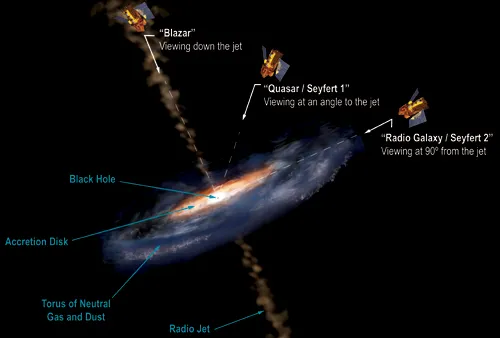
According to popular models, AGN are surrounded by a doughnut-shaped ring of material, which partially obscures our view of the black hole. But team member Richard Mushotzky thinks these recently discovered AGN are completely surrounded by a shell of material.
"Our results imply that there must be a larger number of yet undiscovered AGN in our local universe," says Ueda.
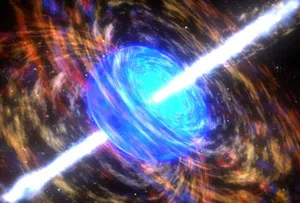
Illustration of the different features of an AGN or how our viewing angle determines the type of AGN we observe. Credit: Aurore Simonnet, Sonoma State University.
In fact, these objects could comprise about 20% of the point sources of the X-ray background. The Chandra X-ray observatory found that this background is currently produced by a huge number of AGN, but the observatory was not able to identify the nature of all the sources.
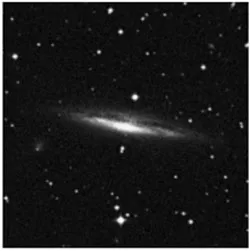
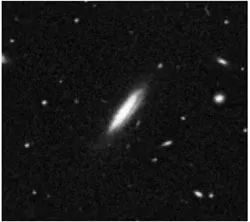
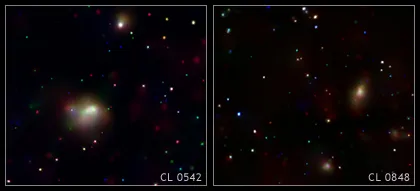
Galaxies ESO 005-G004 (right) and ESO 297-G018 (left) by the SDSS. Both galaxies are spirals. Credit: DSS/UK Schmidt Telescope/AAT Board.
By not having discovered this new class before, previous studies of AGN are partial and give an incomplete picture of how supermassive black holes and their host galaxies have evolved throughout cosmic history.
The discovery will appear in the August 1st edition of Astrophysical Journal Letters under the title "Suzaku Observations of Active Galactic Nuclei Detected in the Swift BAT Survey: Discovery of a "New Type" of Buried Supermassive Black Holes" by Yoshihiro Ueda, Satoshi Eguchi, Yuichi Terashima, Richard Mushotzky, Jack Tueller, Craig Markwardt, Neil Gehrels, Yasuhiro Hashimoto, and Stephen Potter
Sources and related links
- NASA press release
- EurekAlert: Japanese and NASA satellites unveil new type of active galaxy
- ScienceDaily: New Type Of Active Galaxy Discovered
- UniverseToday: Many Active Galaxies are Shrouded from View