Astronomers find a dust disk around a pair of stars that make up a quadruple system.
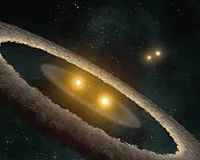
Artistic illustration of the HD 98800 system. Credit: NASA/JPL-Caltech/T. Pyle (SSC-Caltech)
Scientists used the infrared vision of the Spitzer Space Telescope to study a dust disk around a pair of stars in the quadruple system HD 98800. Such disks, it is thought, give rise to planets. Instead of a smooth and continuous disk, the telescope detected gaps that could be caused by a gravitational relationship between the four stars in the system. Alternatively, the gaps could indicate that planets have already begun to form.
"Planets are like cosmic vacuum cleaners. They clean up all the dirt in their path around the central stars," says Elise Furlan, of NASA's Institute of Astrobiology at the University of California, Los Angeles. Furlan is the lead author of the paper that has been accepted for publication in The Astrophysical Journal.
HD 98800 is approximately 10 million years old and is located 150 light-years away in the constellation TW Hydrae.
Before Spitzer turned its attention to HD 98800, astronomers had an idea of the system's structure from observations with ground-based telescopes. They knew that the system contains four stars, and that they are paired as binaries. The stars in the binary pairs orbit each other and the two pairs also orbit each other like choreographed dancers. One of the stellar pairs, called HD 98800B, has a dust disk around it, while the other pair has none.
Although the four stars are gravitationally bound, the distance separating the two binary pairs is about 50 astronomical units (AU), slightly more than the average distance between our Sun and Pluto. Until now, technological limitations have hindered astronomers' efforts to look at the dust disk around HD 98800B more closely.
With Spitzer, scientists finally have a detailed view. Using the infrared spectrometer, Furlan's team perceived the presence of two belts in the disk. One belt is at approximately 5.9 AU from the central binary, HD 98800B, or about the distance between the Sun and Jupiter. This belt is probably made of asteroids and comets. The other belt is between 1.5 and 2 AU, comparable to the area where Mars and the asteroid belt are located, and probably consists of finer grains.
"Typically, when astronomers see gaps like these in a debris disk, they suspect that planets have cleared the path. However, given the presence of the pair of stars at 50 AU without a disk, the internal migration of dust particles is probably a matter of complex forces, so at this point, the existence of a planet is only speculation," says Furlan.
Astronomers believe that planets form like snowballs over millions of years, as small dust grains clump together to form larger bodies. Some of these cosmic rocks then collide to form rocky planets, like Earth, or the cores of giant gas planets like Jupiter. Large rocks that do not form planets often become asteroids and comets. When these rocky structures collide violently, pieces of dust are released into space. Scientists can see these dust grains with Spitzer's supersensitive infrared eyes.
According to Furlan, the dust generated from the collision of rocky objects in the outer belt should eventually migrate toward the inner disk. However, in the case of HD 98800B, the dust particles do not regularly fill the inner disk as expected, due either to planets or to the diskless binary pair at 50 AU that gravitationally influences the movement of the dust particles.
"Since many young stars form multiple systems, we must think that the evolution of disks around them and the possible formation of planetary systems can be more complicated and disturbed than in a simple case like our solar system," adds Furlan.
Planets of multiple stars would also have interesting sunsets. For more information about planets with double and triple sunsets, see:
"NASA Telescope Finds Planets Thrive Around Stellar Twins" and "NASA Scientist Finds World With Triple Sunsets."
Sources and related links
- Spitzer press release, by Linda Vu
- Note on Physorg
- Paper: HD 98800: A 10-Myr-Old Transition Disk, E. Furlan, B. Sargent, N. Calvet, W. J. Forrest, P. D'Alessio, L. Hartmann, D. M. Watson, J. D. Green, J. Najita, and C. H. Chen, Received: 01 Dec 2006, Accepted: 30 Apr 2007 in APJ