Astronomers find that stars hosting planets are polluted with planetary debris.
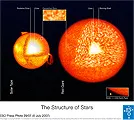
ESO PR Photo 29/07: The structure of stars
By observing the chemical composition of stars that host planets, astronomers have found that while smaller stars show iron enrichment on their surface, giant stars do not. Astronomers think that planetary debris falling toward the outer layers of the star produces a detectable effect on the smaller star, but this pollution is diluted in the giant star and mixed into its interior.
Stellar tiramisu
"It's a bit like a tiramisu or a cappuccino," says Luca Pasquini of ESO, author of the paper reporting the results. "There is cocoa powder only on top."
Only a few years after the discovery of the first exoplanet, it became evident that planets are found preferentially around stars enriched in iron. These stars are, on average, twice as rich in metals as those that do not have planets.
The immediate question is whether the enrichment increases planet formation or is caused by the presence of planets. The classic chicken-and-egg problem. In the first case, the star would be rich in metals to its core. In the second case, debris from the planetary system would have polluted only the outer layers of the star.
By observing stars and taking spectra, astronomers, in effect, only see the outer layers and cannot be sure that the star has the same composition throughout.
A team of astronomers has decided to tackle the question by looking at a different type of star: red giants. These are stars, which as will happen to the Sun in several billion years, have exhausted the hydrogen in their core and have inflated, becoming much larger and cooler.
By observing the distribution of metals in 14 giants hosting planets, astronomers found that their distribution was different from that of normal stars with planets.
"We find that evolved stars are not rich in metals, even when hosting planets," says Pasquini. "Thus, the anomalies found in stars with planets seem to disappear as they expand and age."
After considering several options, the astronomers conclude that the best explanation would lie in the difference in structure between red giants and stars similar to our Sun: the size of the convection zone, the region where all the gas is completely mixed. In the Sun, this zone comprises only 2% of its mass. But in red giants, the convection zone is enormous, encompassing 35 times more mass. The pollution material would thus be 35 times more diluted in a red giant than in a Sun-like star.
"Although the interpretation of the data is not straightforward, the simplest explanation is that Sun-like stars appear rich in metals due to the pollution of their atmospheres," explains co-author Artie Hatzes.
When the star was still surrounded by a protoplanetary disk, material enriched in heavier elements would fall onto the star and pollute its surface. The excess metal from this pollution is visible in the thin atmospheres of stars like the Sun, but is completely diluted in the massive atmospheres of giants.
Sources and related links
- ESO press release: Star Surface Polluted by Planetary Debris
- EurekAlert: Stellar tiramisu
- "Evolved stars hint to an external origin of enhanced metallicity in planet-hosting stars," by L. Pasquini et al. To appear in Astronomy and Astrophysics. Online on arXiv