Astronomers using data from the Robert Byrd Green Bank Telescope (GBT) found the largest negatively charged molecule in space.
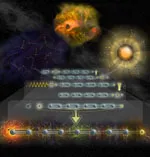
Illustration of how these negative molecules are thought to form. Credit: Bill Saxton, NRAO/AUI/NSF
The discovery of the third negatively charged molecule, called an anion, in less than a year and the size of the latest anion, will force a drastic revision of theoretical models of interstellar chemistry, astronomers say.
"This discovery adds to the diversity and complexity already seen in interstellar chemistry," says Anthony J. Remijan of the National Radio Astronomy Observatory (NRAO).
A team of scientists from the Harvard-Smithsonian Center for Astrophysics (CfA) found a negatively charged octatetraynyl in a cold, dark cloud of molecular gas. A second team led by Remijan found octatetraynyl in the gas envelope around an old, evolved star. In both cases, the molecule, a chain of eight carbon atoms and one hydrogen atom, has an extra electron, giving it a negative charge.
Around 130 neutral molecules and about a dozen positively charged molecules have been discovered in space, but the first negatively charged molecule was not discovered until last year. The largest ion previously discovered in space has six carbon atoms and one hydrogen atom.
Ultraviolet light from stars can remove an electron from a molecule, creating a positively charged ion. Astronomers thought that molecules would not be able to hold an extra electron, and thus generate a negative charge in interstellar space for a significant time. "That obviously is not the case," says Mike McCarthy of CfA. "Anions are surprisingly abundant in these regions."
"Until recently, many theoretical models of how chemical reactions evolve in interstellar space have largely denied the presence of anions. This can no longer be the case, and this means that there are many more ways to form large organic molecules in cosmic environments that have been explored," says Jan M. Hollis of NASA's Goddard Space Flight Center.
Remijan and his colleagues found the octatetraynyl anion in the envelope of the evolved giant star IRC +10 216, about 550 light-years from Earth, in the constellation Leo. They found radio waves emitted at specific frequencies characteristic of the charged molecule by searching archival data from the GBT.
Another team from CfA found the same characteristic emission when they observed a cold cloud of molecular gas called TMC-1 in the constellation Taurus. These observations were also made with the GBT. In both cases, previous laboratory experiments by the team showed what radio frequencies are emitted by the molecule, and thus know what to look for.
"It is essential that candidate interstellar molecules are first studied in laboratory experiments to know the radio frequencies they can emit in advance for an astronomical observation," says Frank Lovas of the National Institute of Standards and Technology (NIST).
Both teams announced their results in the July 20 edition of Astrophysical Journal Letters.
Sources and related links
- CfA press release
- Press release at NRAO
- Paper: Detection of the Carbon Chain Negative Ion C8H- in TMC-1, S. Brünken, H. Gupta, C. A. Gottlieb, M. C. McCarthy, and P. Thaddeus, Vol 664 No. 1, 07-20-2007 APJL.
- Paper: Detection of C8H- and Comparison with C8H toward IRC +10 216, Anthony J. Remijan, J. M. Hollis, F. J. Lovas, M. A. Cordiner, T. J. Millar, A. J. Markwick-Kemper, and P. R. Jewell, Vol 664 No. 1, 07-20-2007 APJL.
Image explanation
Scientists think the molecule probably forms in steps, illustrated in the image in the note:
1-A C2H molecule joins a C6H2 molecule, producing a C8H2 molecule and a hydrogen atom.
2-Radiation (wavy lines) breaks a hydrogen atom from C8H2, leaving C8H and a hydrogen atom.
3-Finally, an electron joins the C8H molecule, releasing radiation and leaving the C8H ion negatively charged.