Landing on the Moon is not an easy task, which is why NASA is testing new technologies for the engines of its future descent modules.
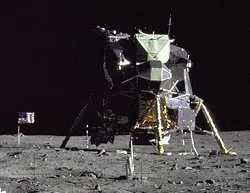
The Eagle Lunar Module from the Apollo 11 mission. NASA.
For a common car, accelerating from 0 to 60 km/h and then decelerating when approaching a traffic light is not a problem. But if you were driving a space rocket, this wouldn't be so easy. Most rocket engines are designed to ignite fully (liftoff!) or to shut off completely (extinguishing in space), without an intermediate mode. And that can be a problem —specifically, how do you land with this machine?
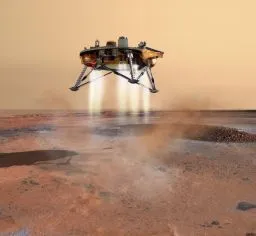
Engine thrust regulation is crucial for a spacecraft that wants to land on another planet. Descending from orbit is a delicate balancing act, which involves reducing the machine's power as the descent module loses mass through exhaust, which slows it down until the vehicle's legs barely kiss the surface. To perform a lunar landing, speed must be reduced from almost 6800 to 0 km/h in about an hour.
The descent engine of the Lunar Module (LM) from the Apollo mission, which is the all-time champion in speed regulation actions, performed six perfect lunar landings between 1969 and 1972 and could modify the vehicle's thrust from 4593 kg down to 567 kg. It was also a simple engine, capable of burning corrosive fuel and oxidizer that ignited on contact, and was fed by pressurized tanks, which eliminated the need for a pumping system.
NASA plans to return to the Moon in the next decade and "we want to place heavier payloads on the lunar surface than those carried by the Apollo mission. That means we need a higher-performance engine," says engineer Tony Kim from NASA's Marshall Space Flight Center. "The Apollo Lunar Module descent engine was very good, very reliable, but it doesn't have the performance we need for future exploration."
With the aim of researching technologies for a new generation of lunar descent modules, engineers from two NASA centers —Marshall Space Flight Center in Alabama and Glenn Research Center in Ohio— are supporting the company Pratt & Whitney Rocketdyne in the development of the Common Extensible Cryogenic Engine (CECE).
At the core of the CECE is the RL10 engine, which propelled seven Surveyor reconnaissance robots to the Moon between 1966 and 1968, and later transported dozens of other missions during operations totaling over 2,200,000 seconds (almost 26 days) and 718 space ignitions. The RL10 is a much more complex and powerful beast than the Apollo LM engine. It burns hydrogen and oxygen stored as super-cold liquids in insulated tanks. These are not only high-energy propellants but also environmentally friendly propellants, compared to the corrosive fuel of the original LM.
Now the engine is intended to demonstrate something new: that it can regulate thrust from 100 percent of its 6260 kg thrust down to 10 percent, the same as required for a spacecraft carrying humans. But performing thrust regulation is not as simple as pressing and releasing the accelerator pedal. Like most rocket engines, the RL10 was designed to operate at maximum power. Almost as if it were a living being, if changes occur in one part of the system, they are felt in the rest. For example, at low power, liquid hydrogen becomes sluggish and evaporates in the cooling tubes, possibly clogging the machine.
In the Phase 1 Demo 1 tests, "we were able to modify the engine and demonstrate that thrust regulation is possible, although it must be done carefully," says Kim. The CECE accumulated a total of 932 seconds of burn time in eight tests, although some of them stopped early "because we are experimenting."
The main challenge was "chugging." Something caused the engine to vibrate 100 times per second. Pratt & Whitney Rocketdyne conducted a test called "Demo 1.5" to investigate and isolate the problem: apparently, oxygen vapors formed on the injector plate and this inhibited normal flow at the lowest levels of thrust regulation.
"We are considering making modifications to the injector and valves to improve performance," says Kim. The CECE has already demonstrated that the combustion process is stable (without chugging), its regulation ratio is 5 to 1, and in operability (with some chugging), its regulation ratio is 11 to 1.
Even though the CECE is not yet ready to be launched into space, Kim emphasizes, it is an important testbed for developing technology. "This work has enough potential to influence the design of the next lunar descent module."
The CECE is one of many candidate technologies being investigated by NASA's Exploration Technology Development Program.
Sources and related links
Note on Ciencia@NASA