With the vacancy left by the Dawn mission, the path was opened for Phoenix, the next mission to Mars.
Every 25 months, there are a few weeks to send a spacecraft to the red planet.
The "window" for liftoff will be between August 3 and 24. The journey will be made with a Type II interplanetary trajectory and would arrive between May 25 and June 5, 2008.
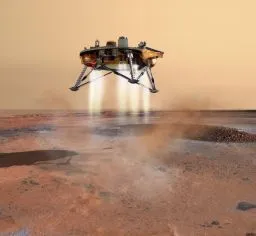
The probe will land on Mars softly, using retrorockets. The last time such an arrival was performed was with the two Vikings in 1976 since the Mars Polar Lander ended badly. For that reason, extensive tests of the entry, descent, and landing systems were conducted. Those tests exposed a worrying failure in a data card that interacts with the MARDI instrument which is critical for maintaining orientation during its descent.
However, the HiRISE instrument aboard the MRO will be capable of producing detailed images of the probe's landing site.
Once on the surface, Phoenix will embark on a mission that is fundamentally different from those of Pathfinder and the Rovers. In principle, its lifetime will be limited by the season, because it is a solar-powered probe that will descend near the planet's north pole. Phoenix will enjoy continuous sunlight for about three months, but as autumn begins in the planet's northern hemisphere, the Sun will sink lower and lower on the horizon.
It will land in that place to try to find out what is beneath the surface. It is more of a vertical mission since the surface is quite uniform, but the important thing in this case is what lies below.
In this map taken by the Mars Global Surveyor marks the probable landing site of Phoenix. Credit: NASA/JPL.
Based on mineralogical information from Mars Odyssey and high-resolution images from MRO, the team is confident that the subsurface at the landing site will contain significant amounts of ice but without certainty of how much the robotic arm will have to dig. The arm is 2.35 meters long. Furthermore, of course, the probe is equipped to perform in-situ analysis, for example:
Sources and related links
- Planetary.org:Phoenix prepares for August Launch
- Site of NASA Phoenix
- Sondas Espaciales - Phoenix ready to fly