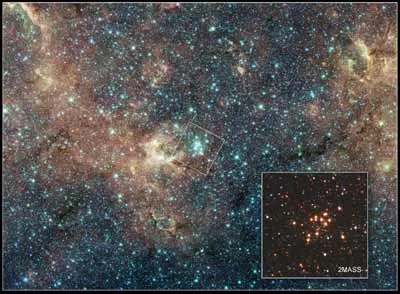
A new and spectacular image from NASA's Spitzer Space Telescope reveals a small group of young stars in the southern region of Serpens, located approximately 848 light-years from Earth.
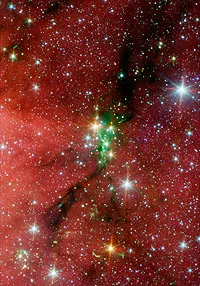
NASA/JPL-Caltech/L. Allen (Harvard-Smithsonian CfA) & Gould's Belt Legacy Team
Scientists suspect this discovery will lead them to more clues about how these cosmic families - containing hundreds of gravitationally bound stars - form and interact.
"It's amazing how these stars appear in the images. At visible light wavelengths the stars cannot be seen at all, they are completely obscured by the dust of the cloud," says Dr. Robert Gutermuth. "It's the first time anyone has been able to see these stars."
Astronomers named this new family "Serpens South."
For years, astronomers have debated how the members of large stellar families - which can contain hundreds of stars - are related. Some suspect the stars may be "fraternal sisters," born at the same time from the same cloud of gas and dust. On the other hand, there are those who think these members are "adopted," meaning the stars were born in small sets of a few and eventually many of these small groups come together to form a massive cluster or family.
According to Dr. Lori Allen, of the Harvard-Smithsonian Center for Astrophysics, one of the biggest challenges in determining how the stars in a cluster are related is finding the small and youngest clusters in the first place.
Once the small groups are detected, scientists must decipher whether they are forming a new "family unit" or if they are members of an established stellar "clan." In the case of Serpens South, Dr. Tyler Bourke used the SMA (the Smithsonian's Submillimeter Array) to try to solve this stellar mystery.
He measured the movements of the gas around the newly formed cluster and determined that the stars belong to the star-forming cloud of Serpens, in which the famous and massive stellar cluster also resides.
"With the SMA, we are able to show that Serpens South is moving at the same speed as the Serpens cluster," says Bourke and adds that "It seems the smaller families are coming together."
Family colors
The stars of the newly discovered Serpens South are shown in green, yellow, and orange, sitting on a black line that runs through the middle of the image. The "line" is a long path of dust and gas that is condensing to form stars.
Shades of green represent hot hydrogen gas.
Wisps of red in the background are organic molecules called Polycyclic Aromatic Hydrocarbons (PAHs) that are being excited by stellar radiation from the neighboring star-forming region called W40.
Gutermuth is leading the analysis of the Serpens South cluster and is a member of the Gould's Belt Legacy project, which discovered the cluster and is using Spitzer to search for other small ones obscured by cosmic clouds.
Sources and related links
- Press release on Spitzer
- CfA press release
- Note in NewScientist